Peruvian records: why this message "This record is unavailable for legal reasons"?

Looking for Peruvian records, I keep on getting this message "This record is unavailable for legal reasons." I understand 19th century records are open to the public, are public, so this banning of records makes no sense. When will the records be opem to the public again? Thanls so much.
Answers
-
@KrugerMaria8 Good morning
FamilySearch must comply with laws and regulations of the record holder/creator as well as any contractual agreements. The Peruvian government has recently passed a new law regarding data privacy.
This thread may be helpful:And
2 -
At the time the Peru records were restricted all records were removed to meet a deadline. In the last few weeks all records that are legally within the guidelines of the new privacy laws are being republished.
3 -
Thank you for the update. Is the work on republishing still ongoing? I have come across some records where the images are partially restricted within the same microfilm, but chronologically it does not make sense (eg. records from 1850-1860 are visible, but records from 1860-1880 are not, and then records from 1880 - 1900 are, again, not restricted).
0 -
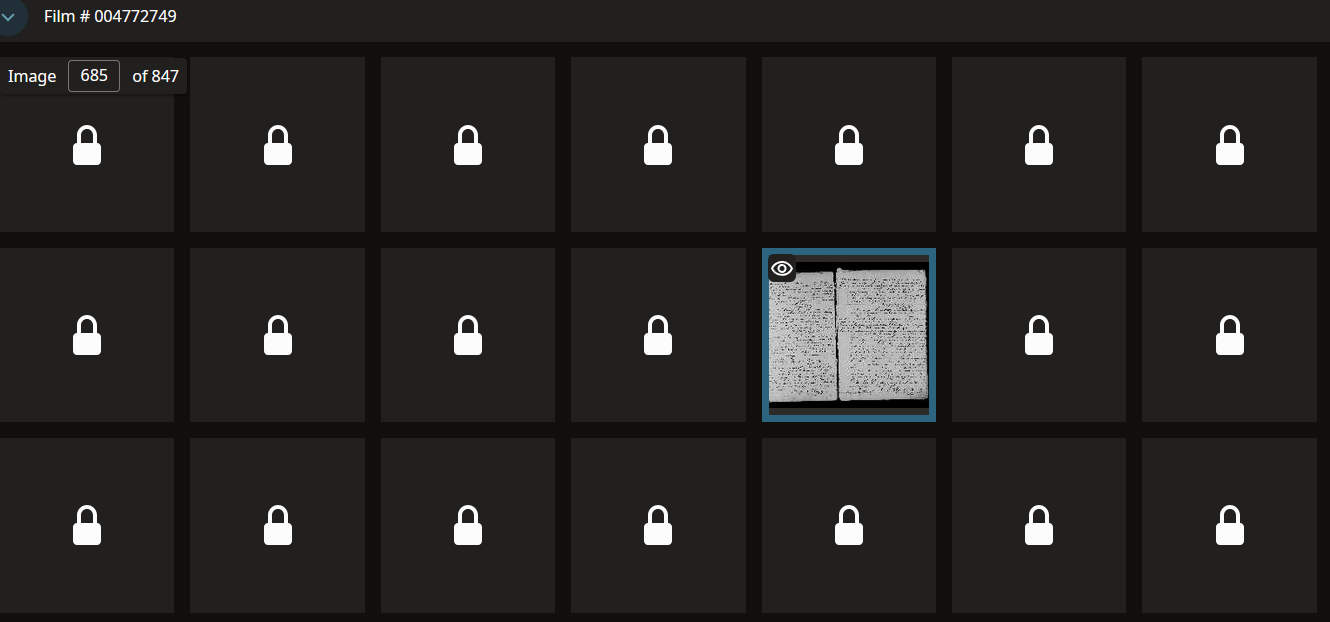
Picture as an example.
0 -
@SerraNola Thank you so much! I noticed this happening with several records. If helpful, I can try to provide a list of film numbers/records here.
0 -
@SerraNola Hello, hope all is well. I found several others affected by similar issues/restrictions. All are from before 1926:
4703090
4703091
4703092
4703093
4703094
4703095
4703096
4703097
4703098
4703099
4703100
4703101
4703102
4703103
4703104
4703105
4703106
4703107
4703108
47031090 -
Thank you for this information. It seems the issue in these films (and others in Peru) may be different. It appears that in these films records are currently being assigned permissions at the image level rather than at the film group level, with a cutoff date of 1876. I will verify whether this configuration is correct, as it is—at the very least, confusing.
1 -
Thank you. I have checked several other films (all Peruvian) and it seems that there are 3 different issues:
1) Some images sporadically restricted in a film that has mostly unrestricted images, and is listed as viewable in the catalog.
2) Most images restricted in a film that has very few unrestricted images, and is listed as viewable in the catalog.
3) All images unavailable and restricted in a film that is listed as viewable in the catalog.
I have several examples for each of these issues, ranging from the 1500s to the early 1900s, but I would like to hear what the actual cutoff date is supposed to be, to avoid sending ones that aren't supposed to be visible altogether. I was under the impression that privacy restrictions extended 100 years, to 1926. Is that not the case?
Also, for what is worth,I would happily volunteer time to comb through these, and assist with any troubleshooting that may be needed.
0 -
I apologize for not providing an update for you earlier. I did confer with engineers on this issue with Peru Civil Registration.
I do want to be upfront about one thing: I don't have access to the contractual or internal details that would explain why 1876 is currently the cutoff date, so unfortunately I'm not able to address that specific question. However, the other concerns you raised can all be explained, and I hope this helps.
Unlike most of our collections, these records have date coverage at the image level. Thus, permissions are also assigned at the individual image level rather than at the film group level. This means access can vary from one image to the next within the same film. Looking ahead, the plan is that images falling outside the cutoff date will eventually be redacted rather than restricted, which should make the situation clearer for everyone.
How this becomes a Catalog Issue:
When even a single image on a film is accessible, it triggers the catalog to display that film as accessible — which can make it appear that much more is available than actually is. To make matters more frustrating, those one or two accessible images might be found several hundred images into the film, while everything before them shows a padlock. We understand how confusing that is, and we have discussed the need for a clearer on-site explanation. That is currently being explored.
I want you to know that your findings have been valuable — they align with and support my own investigation. Thorough patron feedback genuinely helps us improve.
1 -
@dmrodri2 said "... I was under the impression that privacy restrictions extended 100 years, to 1926. Is that not the case?..."
For your information: Peruvian restrictions may very well be based on a 100y cut-off (I don't know either way), but in general, 100y is not the basis for global privacy restrictions. Basically, each country, and potentially each data controller, is at liberty to set their own limits. That's surely part of the reason for FamilySearch's workload in this area. 😕
The figure of 100y is indeed quite typical and since bureaucrats tend to follow precedent (I would!) use in one area gets copied further. The UK uses 100 for many purposes, but it varies. The ongoing release of our post WW1 military records is using figures bigger than 100 simply because there may be mentions of younger descendants of soldiers who would themselves be over 100 years old. I am also totally convinced that our census cut-off of 100y will be extended soon.
So, it's a bit all over the place
0 -
@SerraNola thanks so much for the additional context.
Given then that 1876 is the cutoff date, is there a tentative timeline to remove the restrictions from images of records prior to that year that are not viewable? As mentioned earlier - outside of the civil records - I have come across several instances of those being sporadically restricted.
0