How to properly add Indentured Servants to Other Relationships

I found a record where my ancestor had an Indentured Servant who had a "**** child." My ancestor paid the Indentured Servant's fine, and the court extended her Indentured servant contract by another year, and bound her child to her "Master."
The indentured servant has the same last name as my ancestor. I'm not sure if there's a blood relationship, but I did want to add the indentured servant relationship. In Other Relationships the only option that seems to fit is "Employer" since enslavement doesn't fit. Is Employer the best fit? Why is there no option for Indentured Servant?
Answers
-
Apprenticeship may be the closest of the available options. Apprenticeship agreements are sometimes referred to as "Indentured servitude contracts."
4 -
That's a tough question. That is definitely no evidence that there is a blood relationship there. I recommend putting in "neighbor." I would like more relationship options there. There are so many possibilities.
-2 -
@S Thompson_1 Thank you for your post. We have moved your post to the Family Tree Group in the Community.
1 -
"Other Relationships" is the place for those indentured servants.
-1 -
Yes, it's in the post's title.
The debate is which of the limited options to choose from: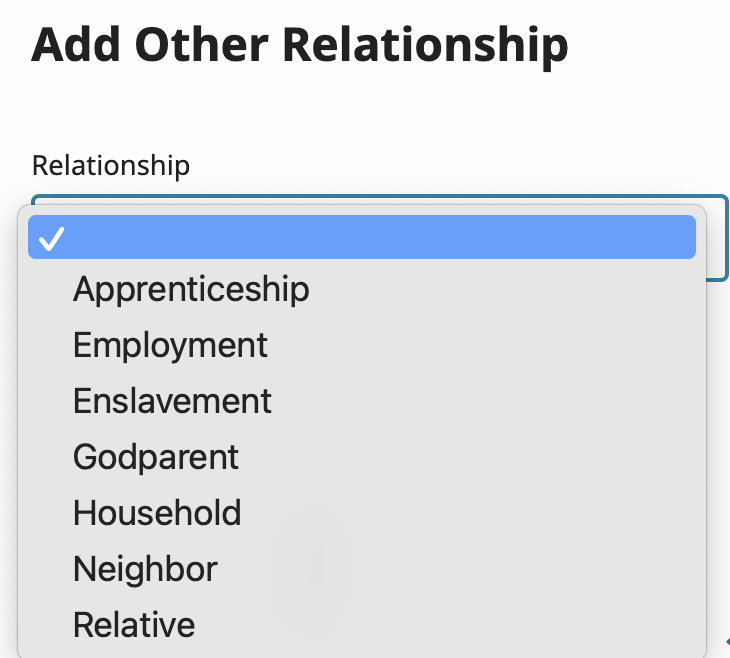
Apprenticeship is probably the closest to Indentured Servant, but is not quite accurate.
3 -
FamilySearch propose actuellement seulement sept catégories de « Other Relationships » : Apprenticeship, Employment, Godparent, Household, Neighbor, Relative et Enslavement. Il n’existe donc pas, pour l’instant, une catégorie distincte appelée « Indentured Servant ». �
FamilySearch +1
Dans votre situation, je ferais ceci :
Apprenticeship : à envisager si le contrat de servitude était juridiquement lié à une forme d'apprentissage ou de contrat similaire.
Employment : possible si le document décrit essentiellement une relation de travail, mais cela peut être moins précis pour une servitude sous contrat.
Enslavement : à ne pas utiliser simplement parce que la personne était liée contractuellement ; FamilySearch réserve cette relation aux personnes réduites en esclavage et à leurs esclavagistes. �
FamilySearch
Relative : ne pas l'utiliser uniquement parce que les deux personnes portent le même nom de famille. Il faudrait une preuve qu'elles étaient effectivement parentes.
Je vous conseille surtout d'ajouter le document comme source à la relation et d'expliquer clairement dans la note que le terme historique du document est « indentured servant ». FamilySearch permet d'ajouter des sources, événements et notes aux Other Relationships. �
FamilySearch +1
3 -
I can't see how 'neighbour' can be appropriate here.
5 -
Here is what I found on FindMyPast:
In its simplest form, indentured servitude works like this: An employee, (the indenturee), signs an agreement (the indenture) to work without pay for the owner of the indenture for a period of time. Common reasons for agreeing to these terms would have been for transportation to a new location or to pay off debts. On completion of the contract, the indentured servant was given their freedom.
https://www.findmypast.com/blog/history/indentured-servants After reading this, I would say your ancestor would be the employer, and the indentured servant would be employed or under employment.
2 -
Employee = paid full wages, usually no contract
Apprentice = paid reduced wages, has a contract
Indentured Servant = no wages, has a contract
Slave = no wages, owned for life
In the Findmypast blog link provided by @dancingintherain , it states:
"Servitude status did not pass on to your children. They were born free. Slaves' children were enslaved upon birth and for life"
The OP stated that the Indentured Servant's child was bound to the master per a court order.1 -
I am slightly concerned that someone might get the impression that apprentices are nothing to do with indentures. An indenture is simply a legal agreement - the original document has two identical sets of writing and is divided by a wavy cut - hence the reference to teeth implied by the word indenture. Many apprentices had their agreement recorded on indentures. .
I'm happy that the term "indentured servant" applies to something different from an apprentice, but the reason for the difference is not that one has an indenture and the other doesn't.
I'm sure that many of you knew this already but I did worry that some people might be misled about the relationship between apprentices and indentures1 -
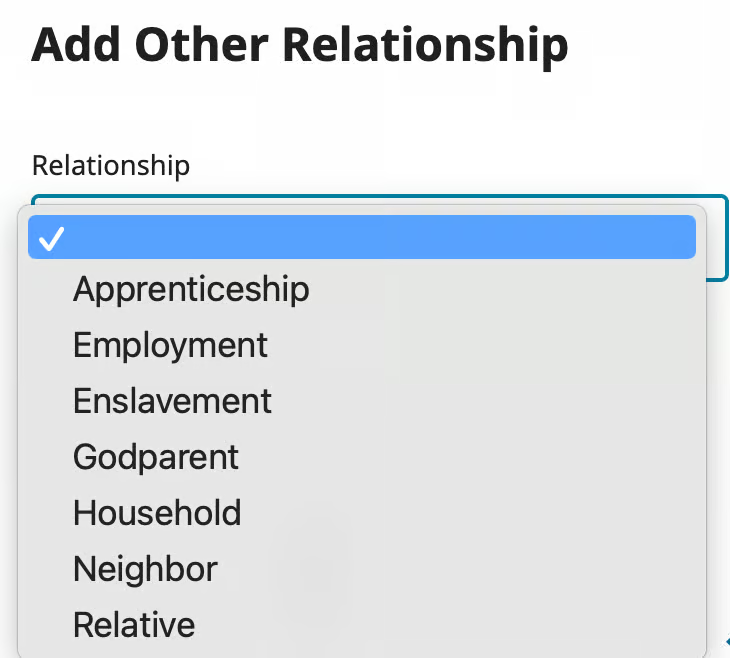
Would FS consider adding an Other category, with space to enhance description??
There are other relationships that should be considered:
- Ritual co-parent (what in Latin America is called compadre)
- Manumitted individual (such as children born free from slave mothers, and who were still living at the plantation),
2 -
An Other category would be great and would cover so many relationships that are currently lost in the limited selections. For example a little boy found in the 1880 census in my great grandmother's house. Since he is of unknown origin, why can't the relationship be "Unknown." Right now he is in the child category of "Guardianship". I inherited a business ledger of my 2nd great grandfathers bulk transactions for his store. There are names and dates associated with bulk purchases he made, and I've looked up and linked most of those people. The relationship should be "business associate" but I had to use "employment". I've seen lots of servants and lodgers in censuses, but those relationships are not available either.
Other is such a good idea!
1 -
@Gail Swihart Watson stated:
1— I've seen lots of servants and lodgers in censuses, but those relationships are not available either.
2— . . . bulk purchases he made, and I've looked up and linked most of those people. The relationship should be "business associate" but I had to use "employment".
1— Those relationships are available:
Servant (if paid and not indentured) would be "Employee" in "Employment"
Lodger would be "Occupant" in "Household"
2— I agree.
In one family of interest to me are several lawyers. "Associate" would best describe business partners, suppliers, etc. plus several other relationships not currently available in "Other Relationships".
"Associate", which has a broad definition, is available when indexing households on records and I use it often since "Other" does not work.0