Please ban AI generated images

The Upload Guidelines and Policies should explicitly disallow AI generated images.
Perhaps some people really like to see AI generated images of their ancestors. That's OK! But uploading an AI generated image to FamilySearch is not a service to anyone. If I really wanted to see an AI generated image of my ancestors, I could generate it myself!
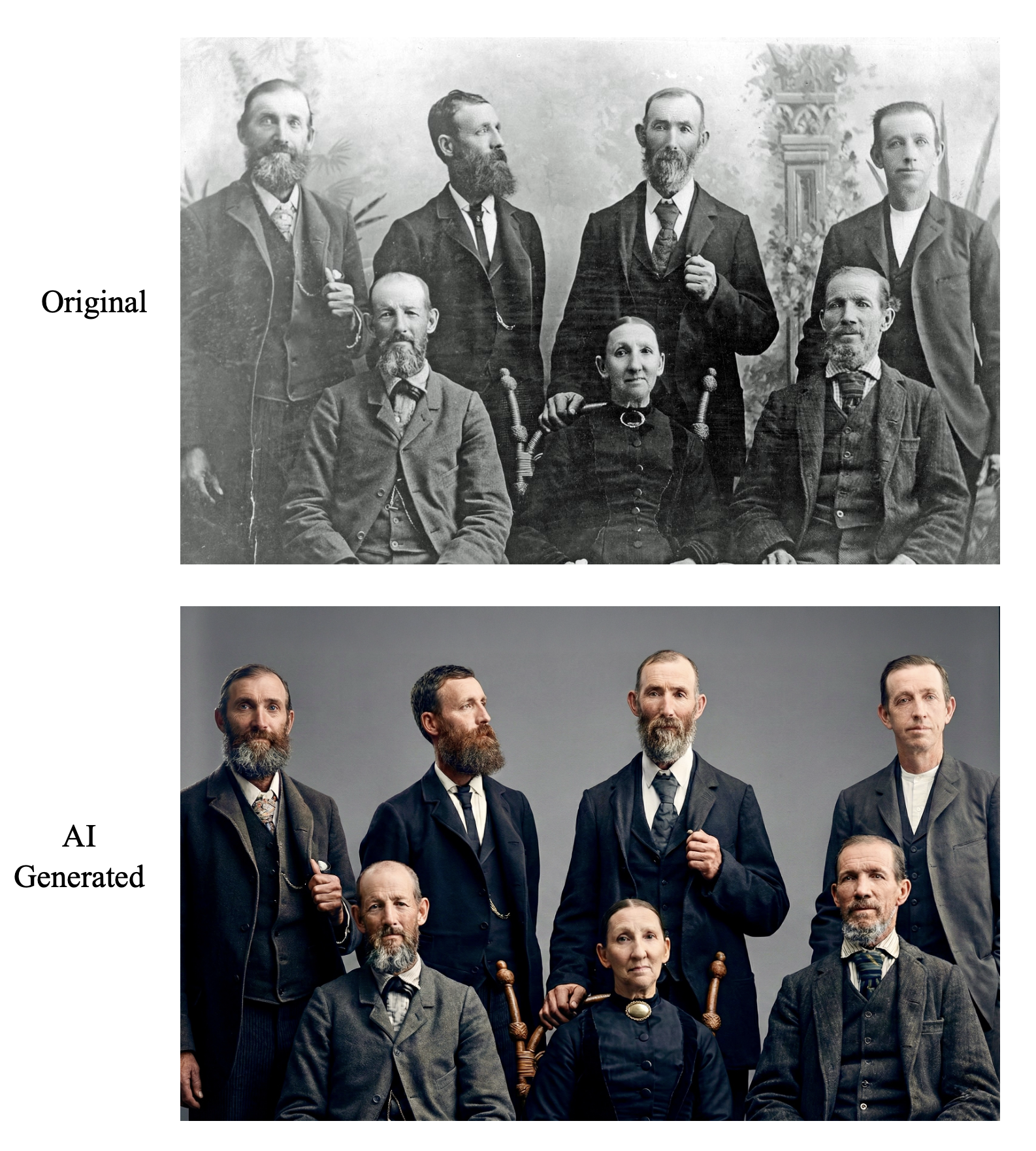
The above images were added as memories to my ancestors. The original photo was already a great memory of my ancestors. There's no reason why it needed to be "enhanced" by generative AI.
A real photograph is evidence of a real moment had by my real ancestors. AI generated images are a fabrication of what that moment might have looked like. They are not "memories," they are fiction.
"By its nature, artificial intelligence is in some ways always artificial." -Elder Gong
Answers
-
@JonoT you may find this old discussion helpful:
1 -
Originals are the best — some of us older users actually had personal knowledge of ancestors born mid-1880's thru early 1900's and we appreciate seeing those worry wrinkles and balding spots of wisdom generated by the experience and courage of these family members
0 -
@JonoT I happen to agree with you…… however, I imagine that the original image is still a part of your memories and will be there for you to enjoy. You also might want to take advantage of the "Suggest an Idea" category here in the community, the suggestions and ideas there are read and often taken into consideration. Thanks for being a part of the community!
1 -
This 2-page thread also contains a good discussion I think:
@AmberML1 did you ever get any feedback re the Upload Policy? I see that it has not been changed since 2017.
1 -
@JonoT suggests that "The Upload Guidelines and Policies should explicitly disallow AI generated images."
One of the problems in evidence in the 2 linked threads is the difficulty in defining an AI generated image. At one extreme is the complete concoction generated by a prompt such as "Create an image of a typical medieval peasant in the fields". At the other end is someone who uses a website that removes dust specks from a photo. That person probably has zero idea whether the site is using AI or old fashioned Photoshop algorithms. And if all that has been done is the removal of dust specks, why exactly should we care if the underlying software uses AI? Is it that different from using non-AI Photoshop algorithms that deal with issues with contrast and brightness via histograms?
Frankly while I dislike a lot of the AI related images, I'm also having a hard time understanding why I'm supposed to dislike them more than the genuine WW1 photo attached to someone who died in the 1880s because the owner of that tree (not on FamilySearch) can't recognise WW1 British Army uniforms.
I don't have any simple answers.
4 -
@Adrian Bruce1 You make an excellent point about the distinctions in how an image is touched up. I completely agree that it makes no difference whether AI or some other technique is used in removing dust specs or making any other adjustment. AI is simply a tool, and we should be much more concerned about what a tool does than about any particular tool.
My preference is to disallow any changes that are imaginative. I put in that category your example of creating an image of a medieval peasant, as well as colorization, adding facial expressions, adding a person who wasn't even in the image, etc. I'm totally fine with using tools to remove things that were added to a document prior to scanning or during scanning, such as dust specs, creases, tears, water stains, etc. I'm also fine with removing bleed-through from the reverse side of the paper and other such artifacts that may have been in the original but decrease readability.
In my opinion, the guidelines should not refer to any particular tool — that is irrelevant — but rather what kinds of changes are allowed. I know that any guidelines will still run into edge cases where fine judgments are made and people may disagree, but I'd like to see a reduction in imaginative or outright fictional images or such adjustments to actual images.
As for your last point, I don't see any conflict in improving the guidelines for image adjustments while also pushing for accuracy in tagging. I'm for better accuracy wherever we can achieve it, so let's make improvements in all areas we can.
7 -
In summary of above posts plus some of my opinions:
1 — The current rules for uploading memories need to be updated.
2 — The rules must include clear definitions of the variations of AI features, end products, etc.
e.g.:
I am against images that are AI "created" or "generated" from a prompt.
I'm also against original photos that are AI "manipulated" that change facial expressions, body positions, etc.
I'm ok with AI "enhanced" images that would be considered light "touch-ups"3 — The rules need to state that anyone who posts images that utilize AI, photo shop, etc. must clearly indicate it as such.
e.g.
The specific photo in question and linked in the OP would meet that proposed requirement since it clearly states "AI enhanced" in the title.3 -
My opinion, not necessarily that of FamilySearch:
The current restriction on AI‑generated or AI‑altered images is rooted in genealogical integrity. FamilySearch Memories is intended to preserve authentic historical artifacts—photos, documents, audio, and stories that represent real people, real events, and real objects. When AI‑generated or AI‑corrected images are uploaded as photographs, several problems arise:
- Even with labels, future users often treat images as historical proof.
- AI reconstructions can introduce details that never existed, such as clothing styles, facial features, backgrounds, or objects that imply a location or social status.
- Once uploaded, these images can be copied, cited, and spread without context.
- FamilySearch has no mechanism to prevent downstream misuse.
- AI‑generated portraits of ancestors who were never photographed may look convincing but remain fictional.
- AI sharpening, colorization, or restoration can unintentionally alter ethnicity, facial structure, or historical context.
- FamilySearch’s custodial agreements require that images hosted be authentic representations of the original artifact.
For these reasons, AI‑modified images cannot be uploaded as photos. They can be included within Stories, where interpretive or creative content is allowed.
A possible compromise:
FamilySearch could consider allowing AI‑restored images only when the original image is also uploaded and the AI version is clearly labeled as an enhanced or interpretive derivative. This approach would preserve the authentic artifact while still allowing families to benefit from modern restoration tools. It would also maintain transparency and reduce the risk of misinterpretation.3 -
@sc woz said:
… The current restriction on AI‑generated or AI‑altered images is rooted in genealogical integrity …
An admirable principle which I would agree with. However… what "current restriction on AI‑generated or AI‑altered images"? The current "Upload Guidelines and Policies" makes no mention of AI. (There might be something that FS has in progress but we have no visibility of that).
As @AmberML1 pointed out in November of last year re those Guidelines and Policies:
The best it offers is "Photos, Documents and Audio Recordings may not be edited in such a way as to make them inaccurate, false, or misleading."
In all honesty I'd be tempted to leave it at that since misleading editing is not confined to AI software - the Soviets didn't need AI to remove persona non grata from photos.
4 -
The difference between using a photo editor to remove some specs vs using generative AI is that a photo editor can apply targeted, limited edits whereas generative AI, by its nature, recreates every single pixel, which inevitably leads to subtle but unnecessary changes.
Just look at the example photo in my post. The AI didn’t just colorize the photo, it also made little changes to their hair, clothes, faces, etc.
3 -
on a slightly different topic, I have recently noticed an increase in upload "caricature" photos (including infants with wings, and other fictional characters, and symbols such as Mayflower, Flags, Family Crests, etc) and tagging them to appear in the individual profile photo. I thought this was not allowed by policy.
,,, just sayin'
5 -
@JonoT said "The difference between using a photo editor to remove some specs vs using generative AI is that a photo editor can apply targeted, limited edits whereas generative AI, by its nature, recreates every single pixel, which inevitably leads to subtle but unnecessary changes."
I don't doubt that's what happens with some tools - however, the write up for the AI facility Generative Fill in Adobe Photoshop clearly states that the resulting effect can be confined to a specific area of the image. And if I'm wrong now, it seems to me to be a trivial advance for it to do so in future given Photoshop layers etc.
The only reason that I'm going on about this particular angle is that a blanket ban on AI might end up banning the equivalent of an AI Generative Fill confined to a specific area of an image. That would seem over the top given the potential of current non AI tools for smearing images. It can't make sense to ban one tool when the other can bring in equally rubbish results. And that's before we actually wonder if users even know whether AI is involved in their software or not.
Personally, I suspect that the best that we will be able to do is record a dislike of disruptive editing of any sort - that way we catch non AI smeared images and (say) colourised images that have redrawn the whole image without the user realising that AI is involved.
I am, to be clear, totally in sympathy with the idea that the sample image at the top is pretty horrible - not only are there subtle differences in the faces and speculative colourisation, but it's thrown away the studio background - I love those studio backgrounds, which tell us something in themselves!
PS - I could happily agree with banning colourisation of any sort, as it has to be speculation.
4 -
We appreciate this feedback regarding AI concerns. We want to assure you that these discussions are not being ignored.
However, FamilySearch does not currently have any policy restricting AI images. Creating new policy is a task for FamilySearch’s legal team and leadership. And as technology continues to rapidly change and expand, FamilySearch will also continue to consider and adapt their policies as necessary.
For now, FamilySearch does not ban AI images. Anyone can still report abuse as necessary, and we hope they will do so. But banning all AI enhanced/created images is not currently an option in FamilySearch.
One “Best Practice” that I think we can all agree on: If you are uploading a Memory and you use AI in any way, please write that detail in the description. Mentioning your AI use is polite and appreciated.
Thank you all again for sharing your thoughts and concerns.
3