Why doesn't US Census Source Linker include the Date for "Marital Status" and "Occupation"?

When attaching US Census records, the Source Linker does not automatically include the Date for "Marital Status" and "Occupation" events like the "Residence" event does. Why is that?
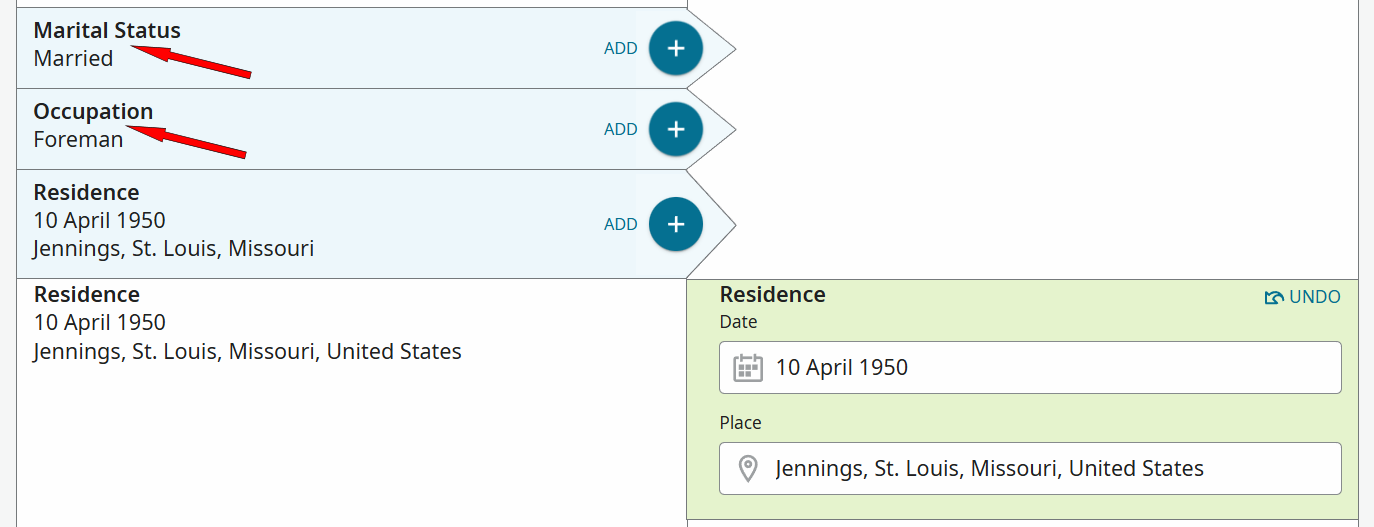
After attaching, I always go back to the Details Tab and manually enter the date (which is time consuming), but some users may not even notice that happens and simply move on, which results in incomplete Details.
Please advise.
Thanks.
Best Answers
-
I suppose the answer to my question is: "That's the way it was programmed"; which allows the researcher to use their personal preference. They can either:
A. Choose to not even move the information over when attaching (letting it remain hidden).
B. Only move the information over and let it: " 'float' amongst all the other Events."
C. Move the information over and go back to enter any dates they feel will help to provide a sequential timeline.Thanks everyone for your input to this discussion.
And thank you @sc woz for the explanation.
0 -
FamilySearch Source Linker does not include a date when it adds Marital Status or Occupation from U.S. Census records. This is working as designed.
The U.S. Census provides a single enumeration date, but it does not give specific dates for when a person became married, widowed, divorced, or when they began or ended an occupation. Because those details are not dated in the record itself, Source Linker treats them as undated attributes rather than events. To avoid creating information that could be misleading or interpreted as a dated event, Source Linker leaves these fields without a date.
If you want to include a date for context—such as “1900” or “as of the 1900 census”—you can add that manually after attaching the source.
0

Answers
-
If I had to guess, it would be because marriage and occupation are not just one-time statuses, limited to the snapshot of a census, but rather ongoing aspects of a person's life.
4 -
@TGoymerac and @Áine.ní.Donnghaile - I have a vague idea that I encountered something similar a couple of years ago, when I think I proposed that various attributes on a census line should be associated with that person with a date of the census instead of being undated (this being as you propose).
The mods sensibly took the idea away to be discussed but came back with the verdict that a senior FS genealogist had said that because there was no date associated with the occupation (or whatever) on the census line, then there shouldn't be a date in Source Linker.
My response in that thread was that there was a date associated with the occupation - it was the date of the census. But, that was that.
Because I am working from memory, having failed to find my thread, it is possible that my recollection is garbage. But, it would line up perfectly with Áine's suggestion that occupation etc are ongoing aspects and that therefore someone might think that a date was not appropriate. Personally, I stick by my suggestion that the date of the census (rounded off to the year, perhaps) is entirely appropriate.
4 -
Hi @Áine.ní.Donnghaile I agree that marriage and occupation are not just one time events.
That's exactly why including a date for the event can become important in order to better understand the person's life history.
Examples:
A persons occupation could be: Farmer in 1930, Butcher in 1940 and Tavern Owner in 1950. By including the date with the occupation helps to understand the persons life timeline. Without the dates, you will only see 3 completely different occupations at the end of the Events Tab.A person could also be: Married in 1920, 1930 and 1940, but Widowed in 1950. Or, Married in 1920 and 1930, Widowed in 1940 and Married again in 1950. Without the dates, having different marital status' at the end of the Events Tab is confusing. (I don't add Single for children that are less than 16.)
I agree with @Adrian Bruce1, that including the date for marital status and occupation events (if / when either one changes) is appropriate.
Having the date option available for those events via the Source Linker makes sense to me.
2 -
My personal preference, I would rather the source linker not offer to bring those fields over. I have seen so many profiles that have several marrieds, several singles, and a few widoweds, along with multiple variations of race and occupation. That just looks cluttered to my minimalist eye.
5 -
And those entries typically have no date so they just 'float' amongst all the other Events. Even if dates were added, the Marriage Event would still be added multiple times each with different dates. Yes… it confirms an individual is 'Married' at a certain point in time, but not necessarily to same person. I end up making an entry in the 'Description of Residence' field if it serves to explain some change such as 'Divorced' or 'Widowed'
'
1 -
0
-
I agree that that linking the Married Status to the date of the census could create confusion as to whether this actually represented the year of marriage, rather than the status (in this example) in 1950 (the year of the census). However, I believe it would be clear enough that the Occupation date of 1950 represents the nature of employment of the individual specifically in that year.
To provide two examples of the use of the marriage status and the occupation appearing / being carried over to the main profile page:
Firstly, "Single 1920, Married 1930, Married 1940, Widowed 1950"
This would help trace a missing marriage event down to the 1920-1930 period and the year of death of the spouse to the 1940-1950 period.
Secondly, for Occupation, "1920 Carpenter, 1930 Laborer, 1940 Carpenter, 1950 Carpenter"
would suggest the individual was a carpenter throughout a large part of their adult life, but perhaps was finding it difficult to find work in that trade around 1930.
This subject was raised recently, albeit in a slightly different form, the suggestion there being that it was rather pointless being able to carry over Marital Status and Occupation without there being a date to indicate at what year / period that might have applied. In any case, I have found the marriage status detail to be frequently incorrect - a "Married" person often having been widowed, or divorced, and (similarly) a "Single" person being separated, divorced or widowed.
As far as misleading information is concerned, dates are often carried over incorrectly in the source linking process. For example, in the 1911 England & Wales census a "years married figure" is often given - except this is carried across as an actual year (e.g., 1893) whereas the actual marriage is often one year adrift from this. Also, in marriage records, the age at marriage is usually indexed as "21", even though the original document shows "over 21" - meaning the individuals could have been anything between 21 and (say) 99, of course!
In conclusion, my preference would be (especially regarding marriage status) that we should not have the opportunity to carry this across, under the present practice (showing the one word, Like "Married" or "Single" that can, at present, be carried across), as that is one word appears rather meaningless once it is gets on the main profile page. True, one can add a year later: but, likewise, a reason statement ("Marital status shown in census") could be added later to avoid any ambiguity over whether the individual was a married person in (say) 1950, or if they actually did get married in that year.
I suppose many of us will just have to continue in "agreeing to disagree" with our fellow Family Tree users on this matter, as there is definitely more than one side to the argument(s) over this issue!
1

