AI Research Assistant?

Not sure I like this or can get on board. Too many people getting lazy with AI in many areas of life and this just opens the door now for people to click and collect without doing any kind of valuable research. Bad idea in my opinion.
Answers
-
@StephenDespot - I share your concerns about click and collect, but how is this different from ordinary hints? If the answer is that the AI produced hints are significantly worse than hints produced using conventional algorithms, then there needs to be feedback from us about specifics.
So, since I have never touched these AI hints, my question to the Community would be: How do we give feedback on this mechanism?
2 -
To provide feedback on the AI Research Assistant, there is a dedicated group here on Community that anyone can join: AI Enhanced Help Center Searches, Ask A Help Chatbot, AI Research Assistant
0 -
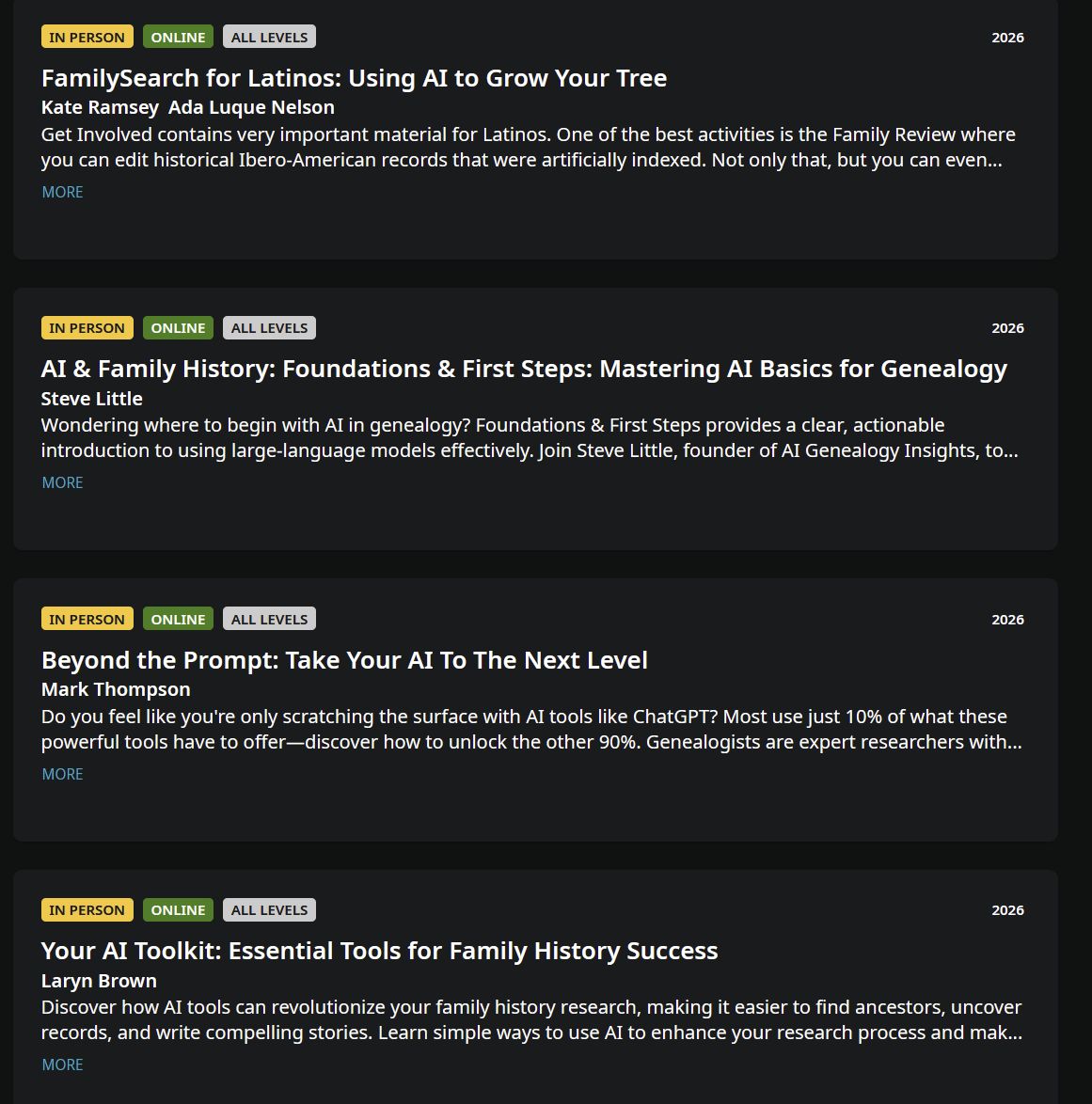
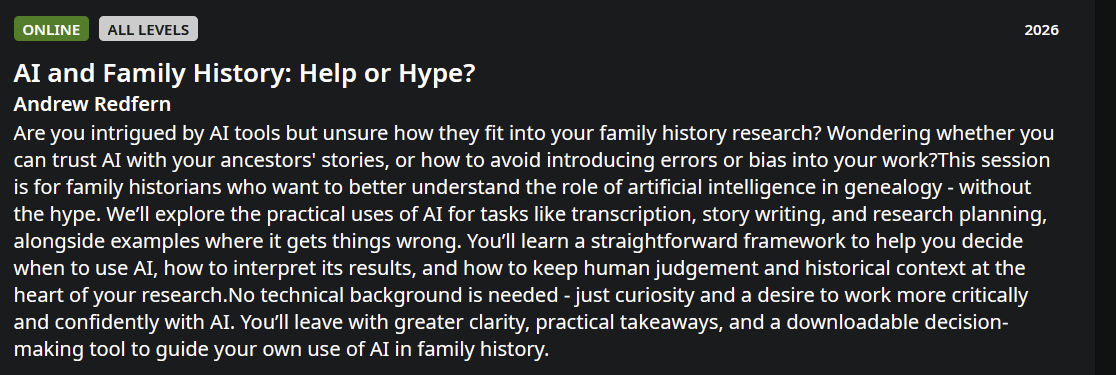
I see multiple Rootstech Online sessions. Would be worth tuning in….
 0
0 -
I still am against it. AI is making people lazy and unable to think for themselves. I just don't like it, especially in this type of research. We got enough problems trying to police our branches from errors every day and I'm afraid this is just going to muddy the waters everywhere.
0 -
@StephenDespot I understand what you are saying. AI is now "the way of the world," in FamilySearch and everywhere. Have you considered turning the experiment off so it does not show on your personal pages? At least you won't have to look at it! https://www.familysearch.org/en/labs/
0 -
Unfortunately, turning the experiment off doesn't keep us from seeing the product. I've recently seen the profiles of my direct and close family "decorated" with AI Discussions that have no factual basis.
2 -
Áine Ní Donnghaile
- Oh no, that's not good.
1 -
AI is going to ruin the world and how things are done, including Family Research. We're looking at sad times ahead I'm afraid.
0 -
After watching the last class about a month ago about using AI in our Family History Research (that is on YouTube, created by FamilySearch) , I am sold! It was such a good class, and using AI to assist me in answering questions on the migration patterns of my ancestors (4 times great-grandfather was a hemp mill worker, according to one of his biographies on FS) I put that information in to ChatGPT and found that there were hemp mills/factories in each of the three locations where my ancestors moved between, which were in a 30 mile radius of eachother. Mystery solved. It also showed me where to find additional information about those mills and that one of them still has payroll records that might contain my ancestor. It has helped my husband and I on other family lines where we have brick walls, by putting in what information we have, and it helps to find new resources. I even uploaded six pictures of my 4 times great grandfather's children, and asked ChatGPT to create a picture of these grandparents based on the features of their children, and it did! I think that AI is going to help us in so many ways with our Family History research, and I am grateful!
1 -
@DanetteBennett said
"… using AI to assist me in answering questions on the migration patterns of my ancestors … I put that information in to ChatGPT and found that there were hemp mills/factories in each of the three locations where my ancestors moved between, which were in a 30 mile radius of each other. …"
That's not the first time that I've seen migration patterns mentioned as successfully highlighted by AI.
I don't have a problem with those sorts of things, as they are very much approximations - the answer is (at best) about likelihoods.
Hints, on the other hand, need to be explicitly and precisely determined - it's no good if an AI hint suggests Aloysius Bucket's father is Septimius Bucket simply because the only other Aloysius Bucket in the system has a father named Septimius. (The example is not intended to be precise). After all, this is what pattern recognition is about - it's not about logic…
1 -
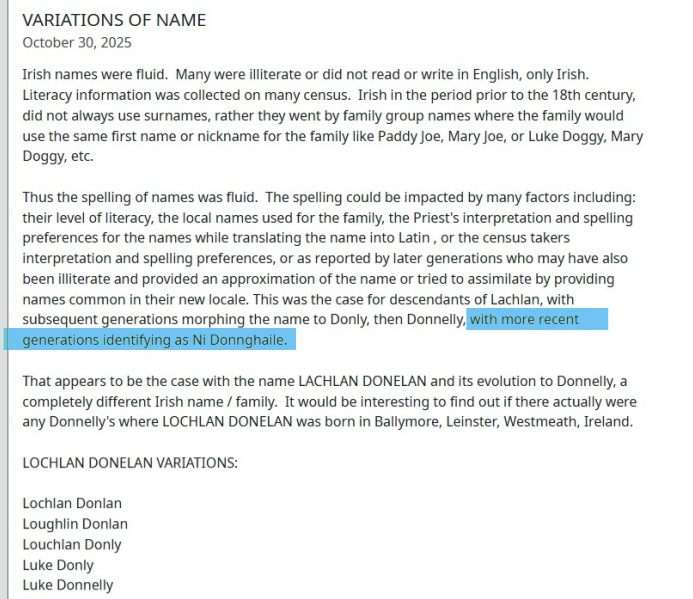
Here's an example of a recent AI-assisted post attached to one of my direct ancestors, a 2nd GGF.
The "logic" applied would indicate that the family of @Adrian Bruce1 identifies as the Bruce1 family these days. A FamilySearch display name has been interpreted as a family surname. (Apologies, Adrian, for using your username as an example.)
 1
1