Guidance on

My great-great-grandmother Carrie had two children out of wedlock in the late 1890s (Herbert and Dorothy). On both of those children's birth records, Carrie listed a fictitious name for the father's name (John). She also listed fictitious maiden names (but different ones) on the birth records. She probably did this due to the stigma of being an unwed mother. Carrie used variations of family names as her fictitious names used in the birth records.
Carrie later went on to marry a man named Isaac several years later and had 3 more children with him. Recent DNA research has proven that Isaac was both Herbert's and Dorothy's biological father - meaning Herbert and Dorothy were full-siblings with my great-grandfather. I added an alert note to the children's profiles, and marked Isaac as the biological father. However, John is still listed as a person and as a father - even though John was a fictitious person. I am certain that Carrie was never in a relationship with this fictitious John nor did John ever exist. Should I delete John? Or merge him with Isaac? Or do something else? Thanks for any input. Cheers!
Answers
-
Interesting @eep - since fictitious names appear every so often in the original real-world source records, logically FamilySearch ought to have some principles about how to deal with them. However, I'm not aware of any - indeed, I don't even remember the topic arising before in the Community. So what I'm about to say is very much from first principles, thinking out aloud. And therefore all comments welcome…
Point 1 - if "John" is a profile in FamilySearch then it's fairly unlikely that he can be deleted. IIRC, deletion is available to you if, and only if, you created the profile that you want to delete and no-one else has contributed to that profile since you created it. If someone else created it or updated it since its creation, then deletion is not available.
Point 2 - since "John" is in the original source records, then it is possible that someone else comes along, reads the data about him and goes to see if he is in FamilySearch FamilyTree. If the "John" profile has been deleted (or even something as simple as the name has been removed), then the worst case scenario is that our "someone else" triumphantly creates a profile for the missing "John", thus putting us firmly back in the mire of having a fictitious "John" in FS.
So… What I suggest that you do is as follows:
Treat the fictitious "John" as being an alias of the real Isaac; merge the two together; and give Isaac an Alternative Name of "John" (plus whatever the surname is from the records).
Put various warning notes in explaining what's going on, including an Alert Note on Isaac.
Create a report Memory explaining as much as you can of the DNA stuff but don't mention living people - probably best to refer to them as "X" and "Y" - and attach the Memory to everyone in question.
I would justify this by saying that really Carrie knew full well who the children's father was. She's giving him a fictitious name, not creating a fictitious person - it's not a "John Doe" that we're looking at. It's a fine distinction but I think it's justifiable.
By creating the Alternative Name, you make the fictitious name searchable so that if our "someone else" looks for "John" in FamilyTree, they will see "John".
I may have missed things so all further thoughts gratefully received.
4 -
Yes, the same thing in German with Johan, Johann, Johannes, JohanneSS (suaw). As I work my way UP branches, I find root spellings and then seed them down.
I know my Grandfather was baptized with an "umlaut" u, but in English and "below him" it's spelled "ue", so I try to guide my way. It populates instantly in the Ancestry dB.
I'm just starting on this site. I'm also comparing things on "MyHeritage". The newspaper.com, Find-A-Grave, and other links are so valuable. You can find enriching things like 4H awards and other things that end up in newspapers. I know where many of my branches and bushes are "planted". I'm going to use Google Earth/Maps to plot exact coordinates. On my to-do list! :)
I find data in Ancestry of German records is EXACT, if the English/Welsh/Scottish/Irish were. I see a wedding after a person's death. English, IMHO, is awful.
I also correct dated geographic names. Alsace was German in the 1600s. Not French. The British American Colony pre 1776, Virginia, and West Virginia, a la West Virginia, June 20, 1863. The details matter.
My German vowels table, I think I'll use it as a "signature" :)
Activate Num Lock on your numeric keypad.
Press and hold the Alt key.
Type the four-digit code using the numeric keypad.
Release the Alt key.
ä: Alt + 0228
Ä: Alt + 0196
ë: Alt + 0235
Ë: Alt + 0203
ï: Alt + 0239
Ï: Alt + 0207
ö: Alt + 0246
Ö: Alt + 0214
ü: Alt + 0252
Ü: Alt + 0220-1 -
@jhuebner0504 Thank you ever so much! Best wishes Mary
0 -
@jhuebner0504 Mmm, Alsace was not really German (as we understand it today) in the 1600s either. It was part of the Holy Roman Empire, after 1512 also known as Holy Roman Empire of the German Nation.
1 -
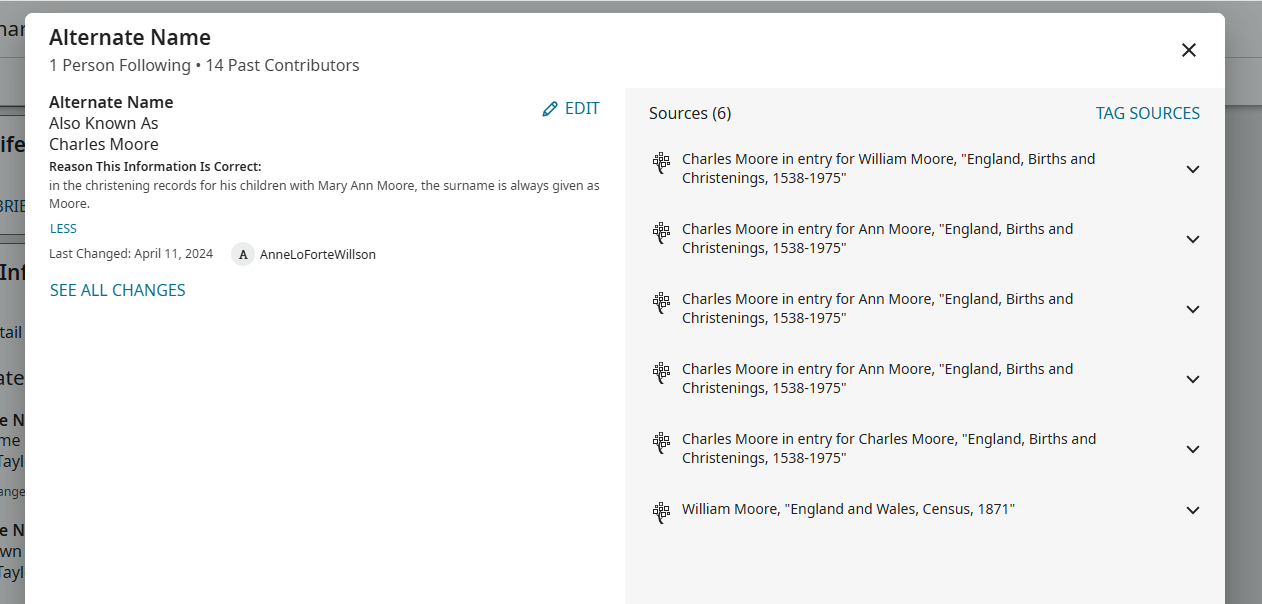
@eep I really like what @Adrian Bruce1 explained. I would probably go the path that he has suggested. With the ability to link sources to alternate names, you can explain the situation in both the reason statement for the name and the reason statement for the attached source. That way you can link the specific records that show this difference to that 'version' of his name. I'd also add a note explaining it as well. I've found that the more places you can log the information the less likely it is to be changed.
 2
2 -
Yes, still made of the "German Fifdoms" eventually the "German Federation" …wonder why our ancestors left?
-1