Does it Make Any Difference What Calendar We Use?

Family Search provides users with no guidelines for entering dates of Americans living during the era from 1582 until 1752 when three similar but different calendars were used: the traditional Roman Julian Calendar, the British variant of that calendar that began the new year on March 25 and the Gregorian Calendar that was finally adopted by Britain and its colonies in 1752.
Although the inconsistent use of these three calendars is widespread on all FS profiles in this era, the lack of guidelines is evident in the read-only profiles controlled by FS of George Washington and Benjamin Franklin.
George Washington’s (KNDX-MKG) date of birth was recorded in the family Bible as February 11, 1731/32 but on his FS profile his birthday as a Gregorian date of February 22, 1732. Washington’s baptism was recorded in the Bible as 5 April and on his FS profile it is 5 April. Consistency would require his baptism to be entered as the Gregorian date 16 April 1732.
As a general rule, historians record dates of significant historical figures as Gregorian dates. But as a general rule genealogists are warned to always copy dates exactly as they appear in the original records.
Another school of thought is that it makes no difference which calendar you use but always explicitly indicate for every date in this era which of the three calendars is being used.
But FamilySearch provides no guidelines on these dates.
Historians record Benjamin Franklin’s (LJLQ-WRC) date of birth as January 17, 1706 – a Gregorian Calendar date. This date is equivalent to the British Julian date of January 6, 1705 that was recorded in the “Registry of Births Within the Town Boston.”
However, the FS profile for Benjamin Franklin has his date of birth and his baptism as January 6, 1706, a Roman Julian Calendar date.
Answers
-
Put them all in! And label them correctly.
One way to do this would be:

One of the great aspects of Family Tree is the way the designers and engineers have provided the flexibility to enter whatever we want however it needs to be. This helps accommodate for just how messy both history and research can be. It also helps in finding good compromises when there are battling schools of thought.
And, yes, that main date is fully, completely, and correctly standardized. We are not limited to a bare date. We can add just as much explanatory information as we need. Why else would FamilySearch allow 140 characters in a date field? Are there any languages in which the month uses 131 characters?
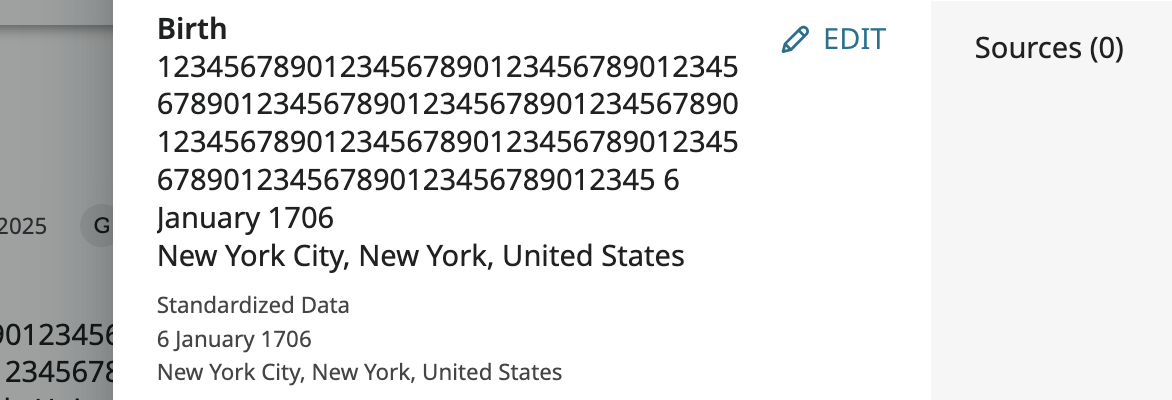
So go ahead and be creative. Just be clear.
4 -
@RobertTest - I would fully support @Gordon Collett when he says:
Put them all in! And label them correctly
On this topic, I usually end up repeating an anecdote from another place, where someone was being scathing about a bit of genealogy because two siblings were impossibly close in birth. Fortunately, someone located the original source text for the earlier birth and it stated that the birth was in (say) early 1706. That had then been entered as 1707 by "standardising" on the 1 January New Year format. I have a distinct suspicion that it was later standardised again from 1707 to 1708 because "obviously" the 1707 had been entered against a calendar with the 25 March New Year format. Except, of course, it hadn't been. All this time the first birth was getting closer to the second.
In none of those cases had anyone been explicit about what calendar and / or New Year was being used. Hence the confusion and the resulting dates being too close.
2 -
As for the original question, I think a bit of critical thinking is need.
Firstly, I have never heard reference to "the British variant of that [Julian] calendar that began the new year on March 25".
This wasn't a British variant - this was the original (in genealogical timescales) standard practice across much of Europe. Further, it should not be linked with the terms Julian / Gregorian. The change from Julian to Gregorian was about the length of the year (driven by a revised algorithm about whether centuries are leap years or not). The change from 25 March to 1 January as New Year's Day was independent of the change from Julian to Gregorian. It just so happens that in England & Wales, both changes happened in the 365 days following 31 December 1751.
You may notice that I have been writing "England & Wales", not Britain - that's because Scotland adopted 1 January as New Year's Day in 1600, while retaining the Julian Calendar. To quote Wikipedia:
Most nations of Europe and their colonies officially adopted 1 January as New Year's Day somewhat before they adopted the Gregorian calendar. Most of Germany changed to 1 January from 1544, the Netherlands did so from 1556 or 1573 according to sect; Spain and Portugal from 1556, France from 1564, Italy (pre-unification) on a variety of dates, Sweden, Norway and Denmark from 1599, Scotland from 1600, and Russia from 1700 or 1725. England, Wales, Ireland, and Britain's American colonies adopted 1 January as New Year's Day from 1752
So if you wish to enter a date in January thru 24 March where it's not clear what the New Year is, I would recommend entering the date as (say) "18 January 1727/28" and standardising it as "18 January 1728". An alternative might be "18 January 1727 OS 1728 NS" and standardising it as "18 January 1728". I know the system will easily accept the first option because that's the convention I follow - it seems to cope with that pattern of OS / NS.
As for George Washington’s date of birth being recorded in the family Bible as "February 11, 1731/32", but entered on his profile as "February 22, 1732", I'm afraid I find this misconceived. I will bet that people just add 11 days to convert from a Julian date to a Gregorian date. But the further you go back in time, the less the mismatch becomes. At some point the conversion will be just add 10 days. Further back still, it'll be just add 9 days. Anyone got a ready reckoner with the changing conversions? No, thought not… (I'll bet someone has but…)
So I have only ever used the contemporary dates and months and I don't need to wonder how many days to add for my ancestor born in the 1590s. So I'd enter GW as born on "11 February 1731/32" and standardise it as "11 February 1732".
And follow Gordon's advise of writing the explanation in the note.
2 -
Yes, we can add the variant calendar dates in the Reasons Section — and I agree that the displayed date should be the Gregorian date.
I've added explanations by referencing the calendar used to many profiles. That Quakers refused to use the names of the months adds a new wrinkle. When they give a date, prior to 1752m as 1st month they mean March not January.
Those, like me, who work with FS in English cannot use months other than January thru December. I've tried entering months from the Persian and Mayan calendars and they won't work.
My preference is to convert all Julian dates and enter dates by the Gregorian Calendar. So when one of my ancestors has a birthday I recognize the date on current calendar. A note or a check box should appear on the entry form for pre 1752 dates that requires us to indicate that the date is by the British civil Julian, the Roman Julian or by the Gregorian Calendar. A button with link to a short explanation of each calendar should appear as a pop-up for those unsure.
I don't expect most users to care about any of this. It affects only those dates before 1752. To see the three calendars used indiscriminately in read-only files when these profiles are about our family members and we have no effective way to comment or to suggest corrections is frustrating to me.
1 -
@RobertTest - re
"… A note or a check box should appear on the entry form for pre 1752 dates that requires us to indicate that the date is by the British civil Julian, the Roman Julian or by the Gregorian Calendar …"
I can only assume that you are using the terms "British civil Julian" and "the Roman Julian" to distinguish between when the New Year starts. However, as I tried to explain, the change to 1 January did not happen at the same time throughout the British Isles (so no such thing as a British Julian), nor did it happen at the same time across Europe. There is, therefore, no possibility of a simple check box, drop down or whatever to say which calendar is in use. There are too many options for that.
In fact, unless I'm missing something, it's not necessary - the use of dual dating for ambiguous dates in the early part of the year is all that's needed, plus perhaps a note to say when New Year was in the calendar used for the data.
You are certainly correct to be concerned about the unclear manner in which much of this data is entered.
1 -
Persian calendar? I can think of a couple of options:
If you want to standardize on the Persian year, just enter the date. It only standardizes on the year but that is all the Family Tree routines use anyway:
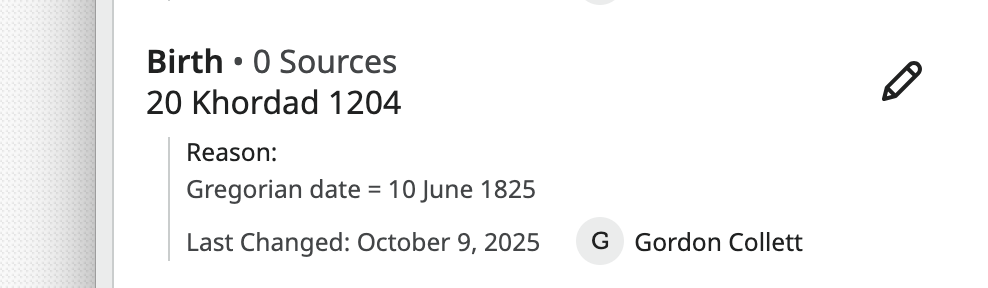
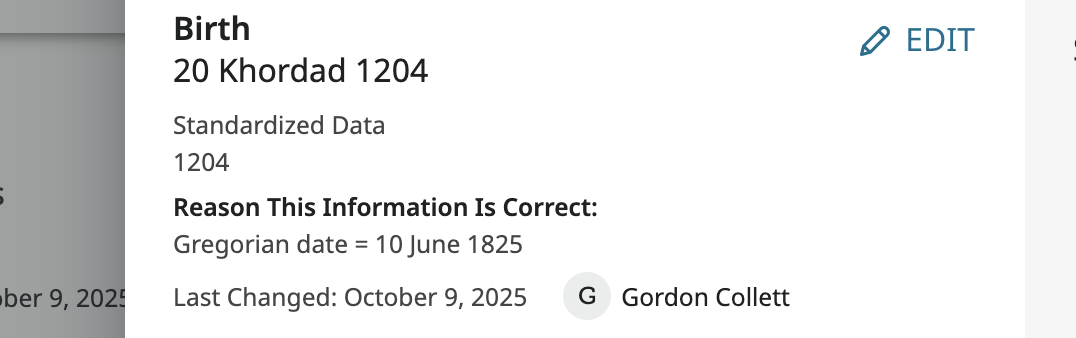
Or if you want to standardize on the Gregorian date and make sure people who never check reason statements don't get confused, you can enter the date this way:

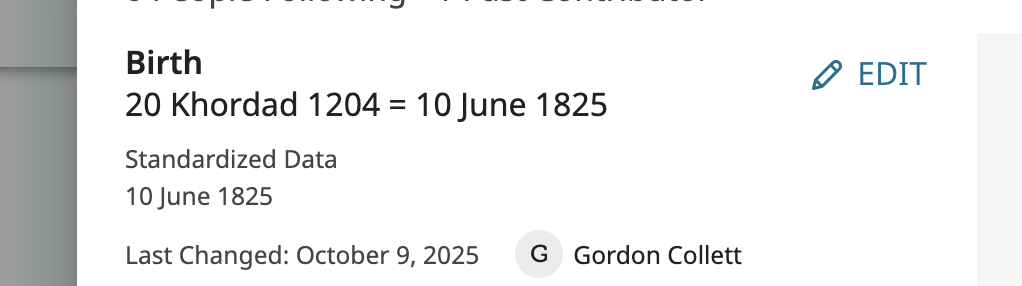
Mayan dates? I just spent far too little time on what looks like a fascinating subject and it appears it would be a challenge for any genealogy database. To get any kind of standardization would, as far as I can see, require my second choice of date entry above. Taking that same 10 June 1825 date, would this be correct?

Having check boxes is an intriguing idea, but when would they appear? Always? How would the program know they were needed? What type of place triggers would needed? Norway, for example, used the Julian calendar until 18 February 1700. The next day was the Gregorian calendar and it was 1 March 1700. So for Norway such check boxes would only be needed for pre-1701 dates. Sounds pretty complicated to build in all the possible variations needed.
2 -
@Gordon Collett said "... if you want to standardize on the Gregorian date..." (my emphasis)
I'm slightly surprised by the implication that there is a choice. Surely we should be standardising on the Gregorian? Otherwise stuff cannot be compared if someone is born on a Mayan date and died on a Spanish Gregorian date? (Unlikely though that might be!)
I do wonder if I am contradicting myself when I refer to standardising on the Gregorian, given that I would prefer to record George Washington's birth date with its original Julian ddmm parts and only alter the yyyy part in the standardised date. However, Gordon says that only the year is used behind the scenes by software so I don't think that ddmm in Julian and yyyy in Gregorian is going to cause any issues. Or if it does, those issues will be less than attempting to convert a Julian ddmm to a Gregorian ddmm when you actually don't know what the conversion factor is because it's not 1752.
0 -
I can't believe there aren't algorithms and reference data out there to translate between an original (e.g. O.S. or Mayan) date as used on historical records in a particular jurisdiction (or religious observance) and the date as it would have been had the Gregorian Calendar and 1 January New Year been in place globally at the time. So the first version of the date matches the historical record, while the second is clearly essential for comparison and data quality purposes.
FS already has a standardised-format date as well as an entered date. Ideally we'd have another data item for a 'comparisons' ('canonical'?) date, maybe accompanied by some sort of completion wizard.
Not everyone working in FT is going to know the history of all this, so maybe a first step would be to clarify onscreen that the 'standardised date' on the screen is standardised in format but not in calendar terms.
I feel a couple of Suggest-an-Ideas coming on here.
1 -
I really do enjoy discussions like this, especially when - as appears to be the case here - nobody gets too dogmatic!
I believe I am correct in assuming all events that occur, say in the US, are recorded according to the time zone in which they occurred - please correct me if that is not the case. So, as an example, if someone from San Francisco, whose entire immediate family lived there, died in New York, I assume they would record the time (in their Family Bibles, etc.) according to death location, as opposed to their local time - even if that meant a difference of a day, if the two zones were different sides of midnight at the time of death. (Excuse my clumsy way of expressing this.) One could perhaps argue GMT should always be the basis for recording the time of an event, but I expect that would be highly unpopular worldwide!
Reverting to the main topic being discussed here, Adrian is correct in highlighting there are really two issues being discussed here - the change in the Julian calendar to Gregorian and the change in New Year's Day from 25 March to 1 January. The common point of discussion, however, is how we should record these dates: as we would regard them now, or how they were recorded at the time.
Personally, I would always add the event to the family Tree "Vitals boxes" according to how they were recorded at the time, with two provisos:
(1) Allowing the option (in the George Washington example) to be entered with the double-year date, as 11 February 1731/32 (meaning it would be standardised as 11 February 1732 in Family Tree), rather than as 11 February 1731. (Some events were actually recorded - even in parish registers - with, in this example, the "1731/32" format, but generally as "1731" for events prior up to 24 March.)
(2) Recording both Julian and Gregorian dates, as Gordon illustrates, seems a great suggestion.
My difference with one main argument being put here is that I would always standardise on the Julian date, rather than the Gregorian. Simply because (leaving aside events involving the famous) that is probably how 90% of such cases are recorded in Family Tree. This is because (with one or two exceptions, which proved highly controversial at the time) project instructions for FamilySearch indexing projects were to index exactly what was seen in the original document. (One exception I remember was where a project involved the provision of a calculator to convert the Julian date to Gregorian, which led to a general outcry from most experienced indexers.)
I agree consistency should be the key - in which case, the different treatment of Washington's baptism and birth dates (that Robert highlights) really does seem poor practice.
Having made that point (about consistency), I admit I don't intend to start converting the many events I've recorded in Family Tree according to how I've found them indexed (nearly always, I expect, with the Julian calendar date) to the Gregorian one, even though most historians would probably do that today. So, as long as FamilySearch instructions do not demand we enter such dates to a set format, I'm afraid consistency is something we are very unlikely to achieve in the foreseeable future .
2 -
Regarding converting between calendars, there are all sorts of calculators out there like this one: https://www.fourmilab.ch/documents/calendar/
Then there are calculators like this one that I use very frequently: https://dinslekt.no/helligdager.php
Regarding time zones, if my brother-in-law's son born on June 30 in Norway had been born at 4 am (instead of 2 pm), would I ever record or try to convince him that he was actually born on June 29? No. If my family had a birthday celebration for him over here in the States would we hold it on the 29th? No. Not even if we were holding it in the evening it was July 1 in Norway by then.
Likewise, if I were to celebrate a distant ancestor's birthday, I would celebrate it on, for example, July 15 if he was born on July 15 on the Julian calendar and not move it to the equivalent Gregorian day because if I traveled back in time to celebrate with him, that is the date we would. And I doubt either of us would care if the sun was not quite at the right place in the sky and the seasons were off a few of days.
Ignoring any indexing rules, when I work out of the original records, I record the date the record shows such as Dominica 4 post Trinitas 1675. The main reason for that, is that the records are hard enough to read that if I record the converted Gregorian date of 7 July 1675, it just makes it that much harder to find the record again since I'll be looking for the wrong date. I enter this in Family Tree as "Dominica 4 post Trinitas, 27 June 1675" so I know exactly where to go to look at the record again.
Maybe I'm sloppy in my thinking, but even if someone was born in Norway on 10 July 1660 (Julian at that time in Norway) and died 10 July 1750 (Gregorian by then) I will record those dates as they are even though it makes it look like he made it to age 90 when he was really only 89 years and 20 days.
1 -
Does anyone know which historian decided that recording everything in Gregorian was a good idea and why? And how he convinced all other historians that it was required? That could be another interesting example of ever changing standards.
To answer my own question:
From ChatGPT:
By the 1500s, the Julian calendar had drifted about 10 days out of sync with the solar year.
That drift increases by roughly 3 days every 400 years.So, for example:
- The Julian 4 October 1582 was followed by Gregorian 15 October 1582.
- By 1752, when Britain adopted the Gregorian calendar, the difference was 11 days.
- Today the difference is 13 days (since 1900–2099).
If historians quoted dates directly from old Julian calendars without converting them, it would make events appear to have occurred at different times in different countries — an enormous source of confusion.
That makes sense. If a historian recorded that Norway declared war on England on 15 October 1720 and then England replied with it's own declaration in return on 4 October 1720, even though those were the dates in each country respectively, that would be a really confusing article to read.
But when it comes to Family Tree, we are generally dealing with local family and community events instead of worldwide so I think I'll stick with recording dates as they are in the records and let others worry about whether someone was born on the day the British captured Port Royal in Nova Scotia or whether they were born ten days before or after that event!
1 -
Replying to Gordon before he edited the ChatGPT stuff in…
Err - did anyone decide that? George Washington has always struck me as an awkward so-and-so (even if he did take the Colonies off our hands! 😉 ) when he (apparently) converted his birthdate from Julian to Gregorian. It does mess up the relationship with contemporary sources, especially if the system in use isn't made explicit. Certainly it's entirely sensible that FamilySearch software tries to work off a common view of things - normally IT systems convert things in the background into a common coding system - the date might be converted into the number of days since … insert geek-significant event here. But you never see that sort of value unless you have the ability to deliberately expose that data.
But for historians - well, I just checked the Wikipedia article about King Charles I (of England and Scotland) (because his execution is in the ambiguous part of the calendar between 1 January and 25 March) and it says:
All dates in this article are given in the Julian calendar, which was used in Great Britain and Ireland throughout Charles's lifetime. However, years are assumed to start on 1 January rather than 25 March, which was the English New Year until 1752.
So notice the deliberate separation of Julian v. Gregorian from the consideration of New Year's Day. I think this Wikipedia principle matches what Gordon is suggesting for FamilySearch data.
2 -
And now I'm really in a quandary. If my 6th great-grandmother from England and my wife's 6th great-grandmother from Norway were born on the same day in 1722, do we hold one party for both of them or two parties ten days apart?
1 -
" … do we hold one party for both of them or two parties ten days apart?"
@Gordon Collett - goodness, do you need to ask?! Two parties! What was the question again? 😀
3 -
I didn't realize this would stimulate such an interesting discussion.
While watching baseball games I wrote the following but I had decided not to post it until I saw the note that began "I do enjoy discussions like this...."
Hopefully I can avoid dogmatism which I too abhor. Actually nothing here is to the real point of the matter except for the last two paragraphs so you won't miss anything if you skip to the end.Yes -- I use Steve Morse's calendar converter and I have even made my own Julian Calendars starting on March 25 and ending on the following March 24. You can see one here: https://testgenealogy.net/FamilySearch/Calendar/BenjaminFranklin/frame.html
This is a reply to Adrian Bruce1 who said
"Firstly, I have never heard reference to 'the British variant of that [Julian] calendar that began the new year on March 25'."I'm not sure what you mean by that sentence. Do you mean you've never heard of the reference to "the British variant of that Julian Calendar" meaning you never heard it called or referred to that way? Or do you mean you've never heard of the calendar year beginning in Britain on March 25?
It seems you know that there were many different starting dates for the year in Europe through the middle ages and Spain, Portugal and parts of Gaul even started their calendar with year 1 on year 38 of the what is sometimes called the Historical Year or the Roman civil Year (See Cheney, Handbook of Dates, p. 4). Until as late as 14th century and even for Portugal the 15th century one had to add 38 to the Spanish Calendar year to align it with, what I call, the Roman or Historical Julian Calendar year.
I think you mean you've never seen the British use of the calendar referred to as the British variant of the Julian Calendar. My terminology may be idiosyncratic.
I call the original Julian Calendar as adopted in 45 B.C.E. by the Romans as the Roman Julian Calendar or the Historical Julian Calendar. It measures the year as being 365 days and 6 hours long and increments the new year on January 1.I consider the Gregorian calendar to be a variant of the Roman Julian calendar. Both use the time it takes the earth to complete an orbit around the sun to determine the length of the year, the year consists of 12 months, and the week is 7 days on both calendars using the same names for the months and the days and both beginning the common era at the same time.
I agree "the change from Julian to Gregorian was about the length of the year." By empirical observation it was realized that the Julian Calendar year had drifted. The vernal equinox had drifted from around March 21 to March 11. The Julian year was 365 days 6 hours. The new measurement of the year showed it was closer to 365 days, 5 hours and 49 minutes -- 11 minutes less than 6 hours. This could be calculated to show that every 400 years there were 3 too many leap days added to the calendar. So the Gregorian Calendar limits leap years of century years to only those divisible by 400.
The Julian calendar caused the British "numerous inconveniences" to quote from the Calendar Act of 1750. But it wasn't just the Julian Calendar. The use of March 25 as the first day of the year added to the inconveniences.
You say that "The change from 25 March to 1 January as New Year's Day was independent of the change from Julian to Gregorian." I agree that when the year is incremented is logically independent. It is independent logically but not empirically. The British changed both in the same act. The British could have retained Lady Day as the first day of the year. So in that sense the New Style or Gregorian Calendar is independent of when the year begins on March 25 or January 1. The British could have adopted the Gregorian or New Style Calendar in 1582 by dropping 10 days and aligning the calendar with the solar year and they could have retained March 25 as the first day of the year.
It could be argued, however, that the Gregorian Calendar is the formal name of the calendar that was adopted under Pope Gregory. That calendar increments the year on January 1. So, if you don't increment on January 1 its not the Gregorian Calendar. On this view, incrementing on January 1 is essential to the Gregorian Calendar. On the other hand, Saul Kripke who wrote about names being ridged designators without meaning and without necessary and sufficient conditions would reject that understanding of names.
None of this has anything to do with what I originally said about three calendar systems and the practice of not referencing a calendar system when we enter a date between the introduction of the Gregorian Calendar in 1582 and its adoption by the British in 1752. If the same day, Franklin's birth apparently can be properly measured, described, named or designated as January 6, 1705, as January 6, 1706 and January 17, 1706. All are correct under some sort of description whether those descriptions can or should be called three different calendar systems with three different names or not is somewhat irrelevant.
As for a solution -- I can only propose possible solutions -- its a matter of trial and error to determine which if any proposed solution will work.
0 -
@RobertTest said "… I think you mean you've never seen the British use of the calendar referred to as the British variant of the Julian Calendar. My terminology may be idiosyncratic. …"
Yes to both sentences! 😉
Re Franklin's birthdate of "… January 6, 1705, as January 6, 1706 and January 17, 1706 …"
Yes. in fact I'd add a 4th option (at least) of entering the date as "January 6, 1705/06" and standardising on "6 January 1706" (sorry - not sure what the order is for an American user!) This gives two dates on his profile's birth event - the former is always displayed and the standardised version only appears when the pencil icon is clicked IIRC. The dual dating of the year as "1705/06" makes it clear which New Year is being used - both of them! But, as we've said - whatever happens, we need to be clear, and we can be clear in several ways…
0 -
It has been suggested you might have been a bit pedantic in one of your comments, but one of my English teachers certainly earned that description. Not least for his insistence we should always record a date in the form 6 January, as January 6 implied (without the year) it was the sixth January "ever"!
Whilst we in England generally do think of the month-before-day format being an American practice, I have been looking at English newspaper headings going back to the 19th century and that format was the far more commonly used.
(Here's an example I found within seconds of writing the above)
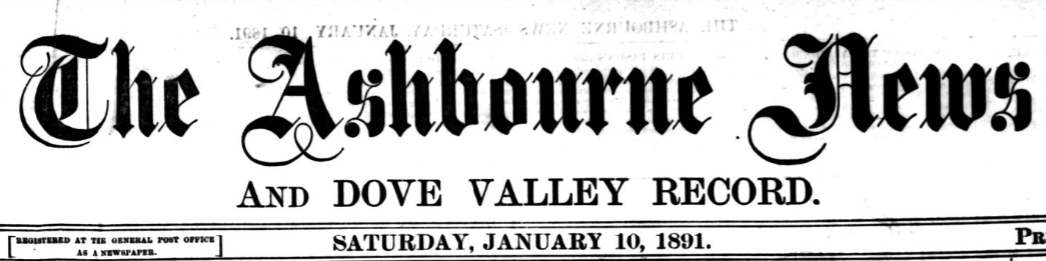
Having said that, here's how "FamilySearch" just standardised my January 16 1920 input:
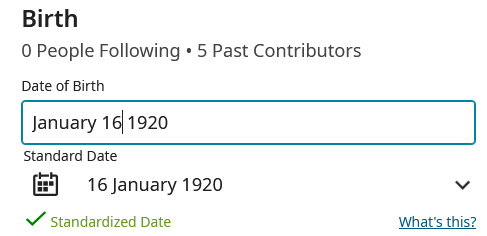
So, allowed only as a display date in the Family Tree program!
1 -
@Paul W - I am also fairly certain that the UK originally used "month day" - I notice it on gravestones…
1 -
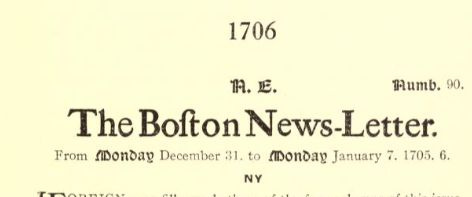
As for photos to newspapers (here I am being pedantic) I would prefer the Boston Newspaper for the day after Franklin's birth. Unfortunately this is just a transcription.
[" rel="nofollow
noopener ugc" target="_blank">" alt="placeholder image">](<img src=)
0 -
Submitted Idea:
Title: Clarification of Calendar/New Year date handling by FamilySearch
SITUATION:
This Idea relates to the calendars (Julian, Gregorian, Mayan, etc.) and New Year dates (1 January, 25 March, etc.) relevant to dates held within FamilySearch.For any date held in FS, there potentially exist:
a) the date as it was understood in the particular jurisdiction (and/or religious observance) at the relevant time ('historical date' in the below), and
b) the date as it would have been shown had the Gregorian Calendar and 1 January New Year been in use at the time ('canonical date' in the below).At present there is nothing, either in the relevant data standards or explicit on FS displays, that allows the user to distinguish between these two types of date, or to identify or specify the specific calendar/New Year applicable to a 'historical' date.
Knowledgeable users may well clarify such situations when entering unstandardised dates, but this information is lost when the date is standardised; and many users will be unaware of the impact of calendars and New Year dates on the information they are looking at/editing.
Accurate date comparisons, e.g. for data quality assessments, are as a result realistically impossible.
NEED
The needs are:
a) to explicitly identify, in the data and on the display, whether a date is 'historical' or 'canonical',
b) to explicitly identify, in the data and on the display, the calendar and New Year in use for a specific 'historical' date, and
c) to provide functionality permitting conversion of a 'historical' date to a 'canonical' one.OUTCOME
If the above were in place,
a) Everyone viewing or editing date information on FS displays would be clear what they were looking at from a 'historical' versus 'canonical' perspective, and why.
b) Date comparisons, e.g. for data quality assessments, could be carried out in a meaningful manner.BENEFIT
a) Better Family Tree data quality.
b) Improved understanding among FS users of the importance and impact of differing calendars and New Year dates.
c) Improved user perception.I've linked to this thread in the 'Examples' field of the form.
4 -
Thank you Mandy for these recommendations.
Accurate dating of events prior to the 19th century is a problem -- very few reliable sources are available.
Looking at FS profiles for the date of birth on the 55 or 56 (all Men --one signed it apparently much later than the original signers) who signed the American Declaration of Independence yields some interesting data.
Two thirds of the signers have no source for their date of birth. This suggests there is no reliable record of those births. A date is still recorded on the profiles with no sources cited as supporting evidence -- we can't tell whether the date is Gregorian or Julian.
Thirteen of them have dates that can be determined to be recorded on their profile as a Julian Calendar date using March 25 as the first day of the year.
Two have their dates recorded as Roman or Historical Julian Calendar date using January 1 as the first day of the year.
A reliable date of birth for these men is rare and valuable. Perhaps we might consider for a moment what sort of measure of care and respect the treatment of those dates in FamilySearch profiles deserve? The record seems to show that FamilySearch has little interest in this matter.
0 -
I'm not sure it's fair to say FamilySearch has little interest. it's more that they do not see themselves as the final arbitrator of much of anything in Family Tree. They have provided us users the platform and opportunity to work together to develop the best possible profiles that can be developed using available records and research.
Unfortunately their utopian view of researchers forsaking personal theories, personal standards, and their own set in stone conclusions and working collaboratively together doesn't always seem to working out they way they hoped. Charlemagne the Great's profile is an example of this. Last time I looked his name was getting changed a couple of dozen times per day.
Another thing to keep in mind, is that Family Tree is a combination of all the various databases of user contributed and historical record extraction databases FamilySearch has ever had. This data goes back to 1894 with the original founding of FamilySearch, then known as the Genealogical Society of Utah. To take your example of the signers of the Declaration of Independences, some of the data in Family Tree could have been submitted by various decendants in the 1890s and early 1900s. Other versions may have been sent in by various researchers through the mid-1900s. Then other descendants for a few of them may have sent more data in in the late 1900s. All these various researchers and descendants may have had their own views of the correct data and how it should be entered. That is why you are finding such inconsistency between how information about them is recorded in Family Tree.
As a personal example, in the immediate predecessor to Family Tree, a system known as New Family Search, my great-great-grandfather had a couple of hundred entries. Through work in that system and then in FamilyTree, he is now there just once. Fortunately he lived late enough that reconciling and combining all the various profiles was pretty straightforward.
3
