Direct Database Queries

At a high-level I am trying to determine the population of Bisbee, Arizona around 1917 and specifically the breakdown by Nationality. The only official way to do that is to look at Census records where it lists birth location and from that you can derive nationality.. I'm doing this as a project for the Bisbee Museum.
As we know on Family Search, one can search census records for a specific time period and download up to 100 people at a time in a spreadsheet. The challenge is that there are lots of records for jBisbee(over 200,000) !
The downloaded spreadsheet of 100 includes various columns/headers based on the census itself but I'm only interested in column j identified by the header "birthLikePlaceText". I do not need an entire spreadsheet but rather I just need the results of that column.
Here is the deep link: https://www.familysearch.org/en/search/record/results?count=100&f.recordType=3&q.anyDate.exact=on&q.anyDate.from=1910&q.anyDate.to=1910&q.anyPlace=Bisbee%2C%20Cochise%2C%20Arizona%2C%20United%20States
As all of this information is stored in a database on AWS in order to serve and support webpage display; my request is simple and that is whether or not someone on the Family Search database development team could run a database query and extract that information for me? Perhaps (name removed) could help run and execute a simple query?
Rather than manually going 100 records at a time a simple query run aganist the DB by an internal knowledgable resource would be much more efficient.
Answers
-
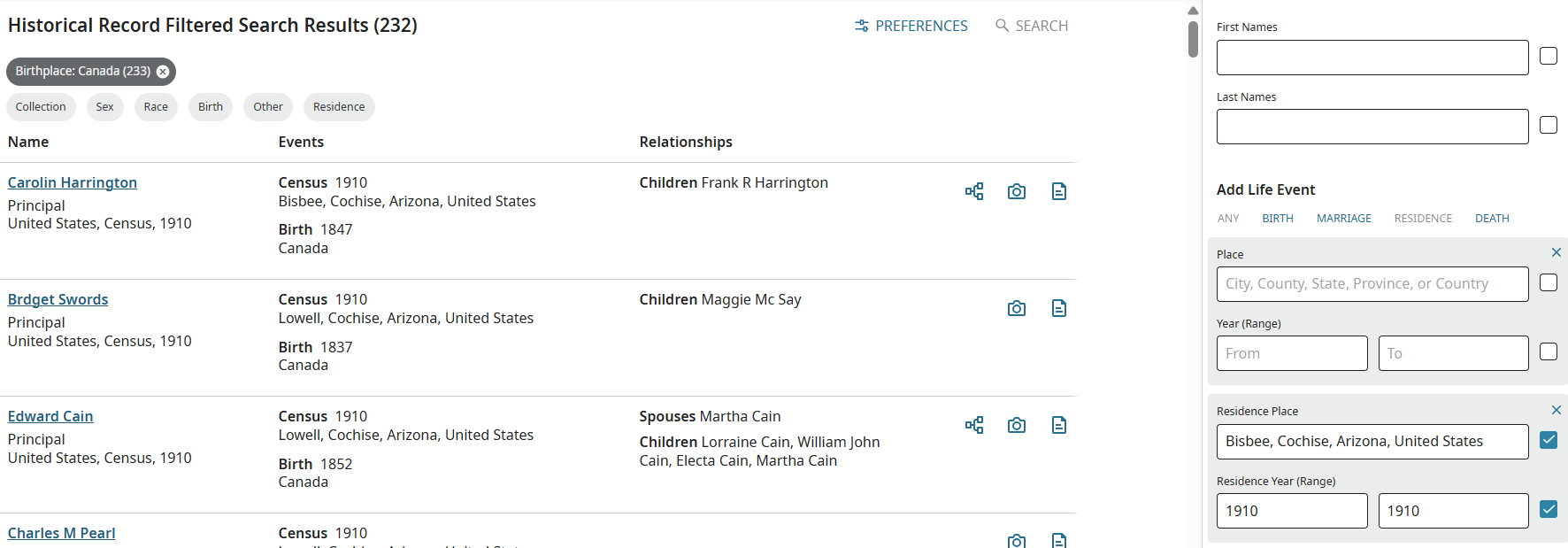
Can you not use the Birth filter button on the relevant census collection(s) to get this information? It will drill down geographically, listing counts in each case (it uses that same field you mention as its source).
My main concern would be that you may encounter a lot of blank birthplaces, and/or perhaps incorrectly standardised ones, but it's impossible to tell in advance.
Another possible route might be the BYU Record Linking Lab's Census Tree data (based on the same collections, though I am not sure how standardised the placenames are) to which as I understand it they give researchers access and which may well suit your needs. I haven't got the link handy, post again if you need me to look it up.
0 -
@Gary962 Mod note: Community is a public online forum. Your post was edited to maintain the privacy of a living person. Please see the Community Code of Conduct for more details.
0 -
@MandyShaw1 - Thank you for your reply but I'm sorry not entirely following. In the link I provided for a specific location (which has multiple enumerations for Bisbee) how would I do that exactly? Could you try clicking on the deep link I provided in my original post and perhaps guiding me as to how to do that? Lets see if between the two of us we can get this to work first before the BYU lab.
What is most unfortunate is the data is there and a very, very simple DB query run by someone on Family Search's engineering team could easily output it…but there you go…0 -
@Ashlee C. - I am sorry for inadvertently breaking any community rules.
0 -
I wonder how much duplication lies in the search for which you have provided a link that gives that 200,000 figure?
An alternative search through https://www.familysearch.org/en/search/record/results?count=100&f.recordType=3&q.anyDate.exact=on&q.anyDate.from=1910&q.anyDate.to=1910&q.anyPlace=Bisbee%2C%20Cochise%2C%20Arizona%2C%20United%20States&q.anyPlace.exact=on&f.collectionId=1727033 produces around 13,000 results and I read the population of Bisbee never exceeded much more than 9,000. The other problem seems to be that it seems impossible to leave out the residents of nearby Lowell, although maybe you would wish to include that.
Doesn't help in answering your question, I know, but it doesn't appear your problem should extend to 200,000 records.
2 -
@Gary962 Paul W is correct about the number of your search results. 204,000 is the population of the entire state of Arizona in 1910. There is not a duplication problem, just need to tweak the search parameters. Usually when searching censuses you would want to use "Residence" for the place name. In this case, you get the same results using "Exact" since the full name of "Bisbee, Cochise, Arizona" would only be found in the event place. (Birth would only give a state or country name.)
Lowell is officially an alternate name for Bisbee so it will always be included in the search results. I'm assuming your project has something to do with the 1917 deportation of mine workers so it seems logical to include the mining town of Lowell. Best of luck to you.
3 -
The 1910 census showed Bisbee had about 9,019 folks, with tons of immigrants—Mexican-born likely the largest group, followed by Serbs, Italians, Finns, Swedes, and more. Sadly, FamilySearch won’t run backend queries for individuals. But if you're tech-savvy, their API might help automate pulling "birthLikePlaceText" fields. You can also check AZGenWeb’s transcriptions for Cochise County!
And don’t forget to check YourRoots too, they may have relevant search tools by state or country:
YourRoots search by state/county:
https://yourroots.com/search-record/state-province-county0 -
Apologies @Gary962, I omitted to post the link to the Census Tree data: https://www.censustree.org/
FamilySearch Genealogies has a snapshot of it (though obviously you can't run queries over this, it might be useful in seeing what sort of information is held):https://www.familysearch.org/en/search/genealogies/submission/10000130/MMJZ-JR7
0 -
@Paul W @SerraNola - indeed both of you are correct and I subsequently noticed my mistake. It
actually did strike me as very odd given what I know the population of Bisbee to be at the time.
Lowell is actually an unincorporated area adjacent to Bisbee itself. Only a small part of once
was a thriving community still remains for as the pit expanded in some cases houses were either
moved or razed and yes I am indeed researching the deportation.@SerraNola - thanks for the tip on the filter that actually was very helpful. Now if only I could
build a spreadsheet without manually going through and looking at each individually to catch the
"Aus Slovenia" example.@Carol45908 - I actually am very tech savy :) and to be honest I had made the assumption that
Family Search did not expoose an API but from your comments that does not seem to be correct? Do
you happen to have a link that explains this API? That would be incredibly helpful.@MandyShaw1 - thanks for the links but I'm not sure honestly how to use the Census Tree for my task
as it seems to be a collection of sources separate from Census records? Further depending upon the
collection the numbers are all over the map.Thanks everyone for the guidance.
0 -
@Gary962 I understand the Census Tree to be extracted specifically from FamilySearch's relevant US census records, certainly this is borne out by the Genealogies snapshot which even shows all the relevant FS Record URLs (it also links to the FT profiles to which these Records are attached, where relevant). (But do you have a link indicating otherwise? Happy to be proved wrong.) I have not pulled Census Tree data myself but I would have thought it would be worth at least a quick chat with BYU about your use case.
@Carol45908 I am pretty sure there is no documented API to automate the pulling of data from Record Search results; none of the APIs appear to be aimed at analytics - their main purpose is to enable the 3rd party products in the Solution Gallery (RootsMagic etc.) to exchange family tree information with the FS Family Tree on a profile-by-profile basis, pull Record hints, list person matches, and so on. See https://www.familysearch.org/en/developers/docs/api/resources (The option on the Record Search Preferences panel to export search results as TSVs etc. will provide the BirthLikePlaceText column, but will only export the first 5,000 results for a given search.)
0