Why are records not available for Kilmarnock parish in Ayrshire

Baptisms for 4 sons to Thomas McFADYEN and Margaret CRAIG appear on the Scotlandspeople index between 1815 and 1828, the first 2 in the parish of Kilmarnock, the others in Monkton and Ayr. The latter 2 appear on Family Search, but not the former 2. After exhausting spelling variants and other tricks, I tried specifying the parish of Kilmarnock, but found that I was unable to select said parish. Have I overlooked something, or are the records for this parish unavaliable for some reason?
Answers
-
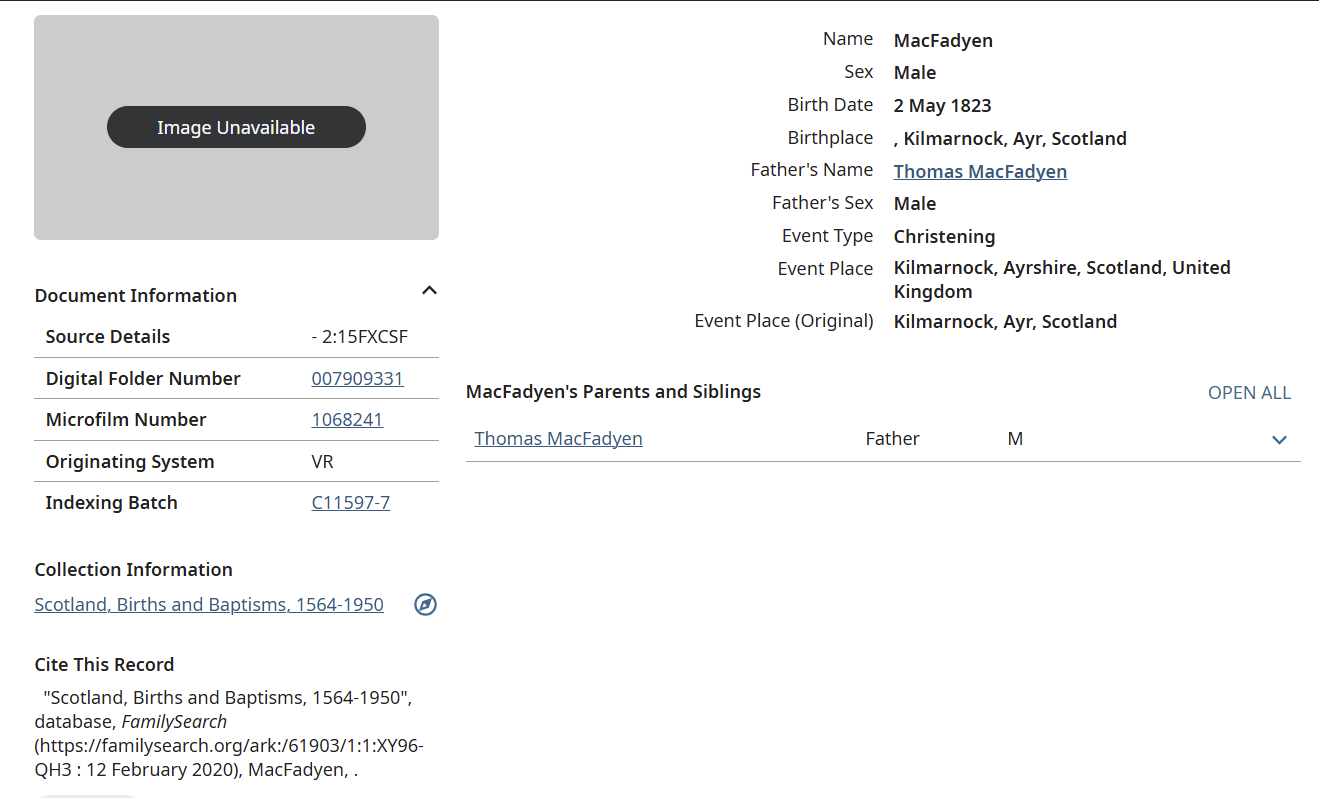
Kilmarnock is in the index collection Scotland, Births and Baptisms, 1564-1950. There is even a male (no first name) born in 1823 to Thomas MacFadyen at Kilmarnock, viz;
Name
MacFadyen
Sex
Male
Birth Date
2 May 1823
Birthplace
, Kilmarnock, Ayr, Scotland
Father's Name
Thomas MacFadyen
Father's Sex
Male
Event Type
Christening
Event Place
Kilmarnock, Ayrshire, Scotland, United Kingdom
Event Place (Original)
Kilmarnock, Ayr, Scotland
This child does not appear in ScotlandsPeople! But I can't find the two Thomases (b 12 Apr 1815 and 9 May 1822, according to ScotlandsPeople). So frankly, I'm afraid I can't add much more - I did wonder if they'd been allocated to another place but there's 8 pages if I remove the place-name altogether…
1 -
Thanks Adrian. I didn't try the index, just used the main record search and 'more options'.
Family Search is a great service for which I'm forever grateful, but some of their frequent upgrades require quite some adjustment, and its especially disappointing when some record collections are removed or made complicated to acess. I have to wonder if this issue with Kilmarnock records arose from an unintended consequence of an upgrade. Its not a whole record collection, just the one parish - as far as I am aware.
0 -
Scotland, Births and Baptisms,1564-1950 is a legacy collection and only a partial index. It was compiled from various sources and may include information previously published in the IGI, which would explain both why the earlier two baptisms are missing and why there is an entry that doesn't appear on Scotland's People.
Entries generated from the IGI prior to the 2020 split into Community Indexed and Community Contributed categories can be iffy, as user contributions did not necessarily have a known original source and are subject to human error. It's important to verify any information you find in collections like this with original records, where possible, so having found the four children on SP is evidentially stronger in any case.
If you're wanting to add the children to the tree whose baptisms aren't in the Scotland, Births and Baptisms,1564-1950 collection, I would just past the Scotland's People information in the "reason this information is correct" section under their baptism details. It may not be as tidy as having an attached source, but it's still a verifiable citation of their existence and the veracity of the information.
0 -
@RaniM - ah, thank you for that information about the origins of that collection. I had incorrectly assumed that the contents of that collection would have come out of a "professional" (standard) indexing project. You mention that split of the IGI which, so far as I remember, consisted of straight register indexes plus bits of local genealogy for want of a better term. If I recall correctly, there was a gotcha at the time of the split. In order to save space, at some time, entries in the pure index that were "duplicated" in the bits of local genealogy, were actually removed from the pure index. Hence they don't appear in the legacy collection derived from the split off pure index.
At least, that's what my fallible memory tells me. But it's certainly a plausible explanation here, even if it's next to impossible to prove for this particular case. (Maybe...)
0 -
@Adrian Bruce1 no worries. Easy assumption to make, I've made it myself with certain collections in the past. I may be wrong but my general experience is when a collection has a somewhat generic label such as Scotland, Births and Baptisms, 1564-1950, or England, Marriages, 1538-1975 they're usually a legacy collection, amassed from various sources, aren't complete, and may contain IGI information of unknown origin. Obviously it's best to check on a case by case basis but, rule of thumb. Still very useful but I tend to use them as a secondary source where possible.
Truthfully I find the IGI a bit frustrating due to the errors introduced by the local genealogy contributions, as you nicely put it, and historically have tried to avoid it. As I understand it, it was close to a 50/50 split user contributions and actually indexing, and it was the user contributions that were, for a short time, removed in the duplicate reductions, but I may be entirely wrong in that. I'm not super across the minutiae of the IGI history.
1 -
Thanks Adrian and RaniM for your further comments. I go back to the IGI and OPR index on microfiche, and I recall the rationalisation of duplicated information. That was done with good intention, but some things were lost in the process. I couldn't agree more about these indexes as being only secondary sources. I would normally view the images of the original records, but I can't justify that for the project I'm now working on. It will be up to the users to verify the data. Either way, I like to compare what is on the FS index with that I have already found on the Scotlandspeople index. The search engines are different, so sometimes they give different hits. Often, the FS index gives a date of birth (either with or without a baptism date) whereas one can't tell if the date is birth or baptism on SP without downloading the image.
BTW, the cases I mentioned for Monkton and Ayr gave both birth and baptism dates. I had hoped for the same with those from Kilmarnock.
Something has changed in the meantime. I just found a baptism in Kilmarnock for another family, so revisited the McFADYENs. Kilmarnock 1801-1896 now appears in the place options, but neither of the 2 Thomases previously mentioned appears. The marriage of Thomas snr and Margaret CRAIG does. Selecting or not selecting Kilmarnock makes no difference to the search results. Thomas married Janet STAKER in 1839. That marriage also appears on FS.
2 -
@Bruce McDowall It sounds like you have a solid system in place. If you're mindful of the fallibility of the Scotland Birth and Baptisms collection on FS, I don't see any harm in cross-referencing collections across both platforms. Similarly, I find the Scotland, Civil Registration 1855-1875, 1881,1891 collection on FS to be hugely helpful for that, as each entry contains far more information than the SP Index.
Where FS gives a date of birth without a baptism date, I wouldn't take that as definitive of birth date though. The originating records are baptism records after all, so the baptism date is the one that is consistently recorded. Where there is only one date, some FS entries more correctly index it as "event date" but some do index as "birth date" which I think is more quirk of the indexing preferences at the time the record was transcribed, and less a true reflection of what the date itself indicates.
Similarly, there are FS entries where a birthdate and baptism date are both recorded, but the "birthdate" is a single number, as opposed to a complete date. That number usually corresponds to the month of baptism (eg 8 for August). When I have purchased original copies of those records, there isn't actually any indication of birthdate recorded at all. Of course there are some instances where full dates are given for both events, but sadly it's inconsistent.
With that in mind, I have always worked with the understanding that church records on SP are indexed by baptism date. If the baptism records you mentioned in Monkton and Ayr give complete birth and baptism dates it world be interesting to know under which of the two they are indexed on SP.
0 -
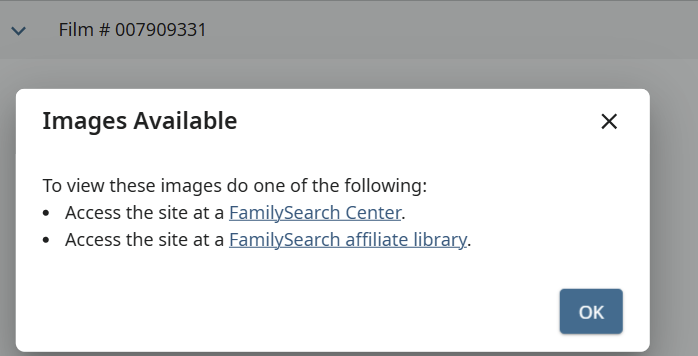
Some of the Scottish records on FS can be accessed at either an affiliate library or FamilySearch Center.
DGS 7909331, containing the MacFayden record @Adrian Bruce1 mentioned above, is available. If you don't have an AL or FSC nearby, I'll be happy to do lookups on my next visit - likely next week.
The "Image Unavailable" message is somewhat misleading, as it means not available online from current location.
When I drill down to the DGS, this is the message:
 1
1 -
Thanks for the offer Aine, but I do have access. Our genealogical society is an affiliate. That is more convenient for me than any of the 7 FHCs in this city. The hours open for starters.
I still find it puzzling why the FS search engine was not allowing me to search on Kilmarnock AYR when I first posted, but it is doing that now.
Those cases where the FS index give a numeral in the date field indicate that a birth date was not recorded by the session clerk. They can't simply leave that field blank.
Yes, the Church of Scotland baptism registers are primarily that, so if there is only one date given, it is usually that of baptism. If you are downloading an image of a single page from Scotlandspeople, it is usually hard to be sure, unless the session clerk specified it in his wording or in a heading at the top of the page. On FS, one can trawl back however many pages to where it is usually made clear. If both dates are given there is no doubt, and I love the session clerks who did that. There are so many variations in style, form parish to parish and from session clerk to session clerk.
Many people don't understand that the Marriage register was primarly to record proclamations (of intent to marry). The majority of those that I've seen only record that date. Some session clerks did also add the date when the couple married (assuming that they, as sometimes they didn't). I really love it when they also recorded the place of the marriage. That is such a great clue as to where the bride's parents were living.
Note that on SP, it is not specified whether the dates are Baptisms or Births for the Church records. Sometimes they are births, but you won't find that out until you see the image, and as above, sometimes doubt remains. However, if you find a FS index extract which shows the date to be a birth it is most likely just that. You are absolutley correct that it is no guarantee, so you still have to view the image (and possibly more). There are other good reasons why one should view the image of the original anyway.
I am planning on a visit to the genealogical society in a couple of weeks. I have a list of lookups to do, and Thomas MacFADYEN will be one of them.
2 -
@Bruce McDowall - excellent point re dates in Marriage Registers.
So far as I can see, sometimes it's the actual dates of the proclamation(s), sometimes it's when they put their names forward for proclamations and only occasionally is it a marriage date. I nearly missed a marriage date of one of my relatives - I had the proclamation date in late 1854, thought that was it but only much later did I realise that they actually got married in January 1855 - I think that they were the second marriage in the book of Civil Registrations started in 1855. A rare occasion when both dates were visible.
3 -
Unless otherwise specified, it is the proclamation date, but then I ask what the proclamation date is?
The intention to marry had to be made 3 times in the church, which I undestand was usually on 3 consecutive Sundays. Not all of the congregation attended church every week, so the 3 occasions gave fair chance for all to know of the intention, and the chance to raise an objection. Sometimes the session clerk recorded the date on which the couple submitted their names for proclamation, and sometimes the fact that they had paid their required 'deposit'. Sometimes they recorded the fact that the proclamation had been made 3 times and that no objections were recived. I've even seen it added that "their money was returned". Sometimes all that the session clerk recorded was a list of the couples' names and a date. So, which date was it? It was only the actual date of marriage if specifically stated.
I love the fact that if the bride and groom to be lived in different parishes, that they had to have their intention proclaimed in both parishes. Sometimes there is no surviving record of such a proclamation for either parish, sometimes for just one, and sometimes both. If it is just the one, you can feel grateful of the record keeping of that parish. When it is both, you sometimes get additional information from one of them.
2 -
I presume that proclamations in the Church of Scotland are equivalent to banns in the Church of England, but whether there are any differences, subtle or otherwise, I don't know.
3 -
I think the differences between the two churches essentially comes down to constancy of record keeping and semantics.
The Church of England uses the term "Reading of Banns", whist the Church of Scotland uses "Proclamation of Banns" (in itself a tautology). They're both banns, the abbreviation just differs. I don't know whether 'proclamations' is how they were informally referred to historically, or if that has emerged via common use by researchers over the years. It's possible the differentiation occurred because, as Bruce points out, it was more common for the proclamation of intent to be recorded than each separate reading, as is found more commonly in Church of England records.
2 -
@RaniM - "Reading of ..." versus "Proclamation of..." Yes, I like that, it makes sense.
1 -
Yes, banns and proclamation are the essentially the same, and the purpose was the same fo Presbyterians and C of E. I agree that proclamation of banns is a tautology, but the Scotlandspeople help page uses that expression. My understanding is that the proclamation would have bee read to the congregation in the church.
There certainly were more differences between Presbyterian and C of E procedures and organisation than just the words they used. C of E was a top down organisation whereas the Presbyterian Church was bottom up. That shows up in the fairly rigid record keeping of the C of E c.f. the differences from parish to parish senn with Prebyterian records. The marriage law was also different between England and Scotland. In Scotland it was lawful to be accepted as married without a formal marriage. There was a fascination court case following the death of Col Andrew McDOUALL in 1834. Inheritance of his estate by his eldest son James was challenged on the basis that James was born in England and that his parents were not married. The challenge was lost because his parents were living as man and wife when he was conceived in Scotland, and they continued to live as man and wife until his father's death. The property was in Scotland, so Scots law was deemed to take precedence.
1 -
Of course, I agree. I wasn't suggesting the two churches as entire denominations were the same. Nor the secular laws of the two countries. Simply that the role of banns and how they were enacted, in a practicable sense, was essentially the same. Apologies if it appeared I was suggesting otherwise.
0 -
No, I wasn't reading any more than your correct statement. I just added some further comment.
There were some other diffences between those Churches, but as you said, Banns or Proclamation is a matter of semantics. The procedures were much the same and served the same purpose. There ceretainly was a difference in the way records were kept. Being a top down organisation, the C of E marriage records were more consistent in both format and the recording.
1 -
That's grand. Glad we're on the same page.
0

