DNA relationship vs. Cousin Chart

The question we are trying to resolve is whether two brothers have the same father.
There is a common Ancestor who is MH's grandmother and TP's great-grandmother. A cousin chart shows the relationship between MH and TP should be 1st cousin once removed.
The DNA relationship calculated based on matched CM shows 2nd cousin once removed.
MH's father's birth certificate does not list a father. TP's grandfather has a father listed on his birth certificate.
Could the difference between the two relationship calculations be explained by the assumption that they had two different fathers?
Best Answers
-
One of the troubles with DNA is that it is not as precise and accurate as a lot of people seem to think. It is fuzzy just like a lot of statistical methods. This is because of the way DNA recombines during gamete formation. DNA relationship calculation has to take that into account. If you are looking at a calculator that only gives one relationship, then you need to get a better calculator.
The chart shown at the DNA Painter is a good example of what DNA testing can tell. See: https://dnapainter.com/tools/sharedcmv4 Do visit the "Read more about this tool" page to clearly understand how this chart works. And pay attention to the warning that the statistics are valid only if the two people being compared are related in only one way.
To take your example, according to this chart, 1st cousins once removed currently have been shown to share between 102 and 980 CM while 2nd cousins once removed share 14 to 353 CM. That means that for the range of 102 to 353 CM the relationship could be either one. In fact, if you take a spot in the middle of that range and put it in the chart, you get this:
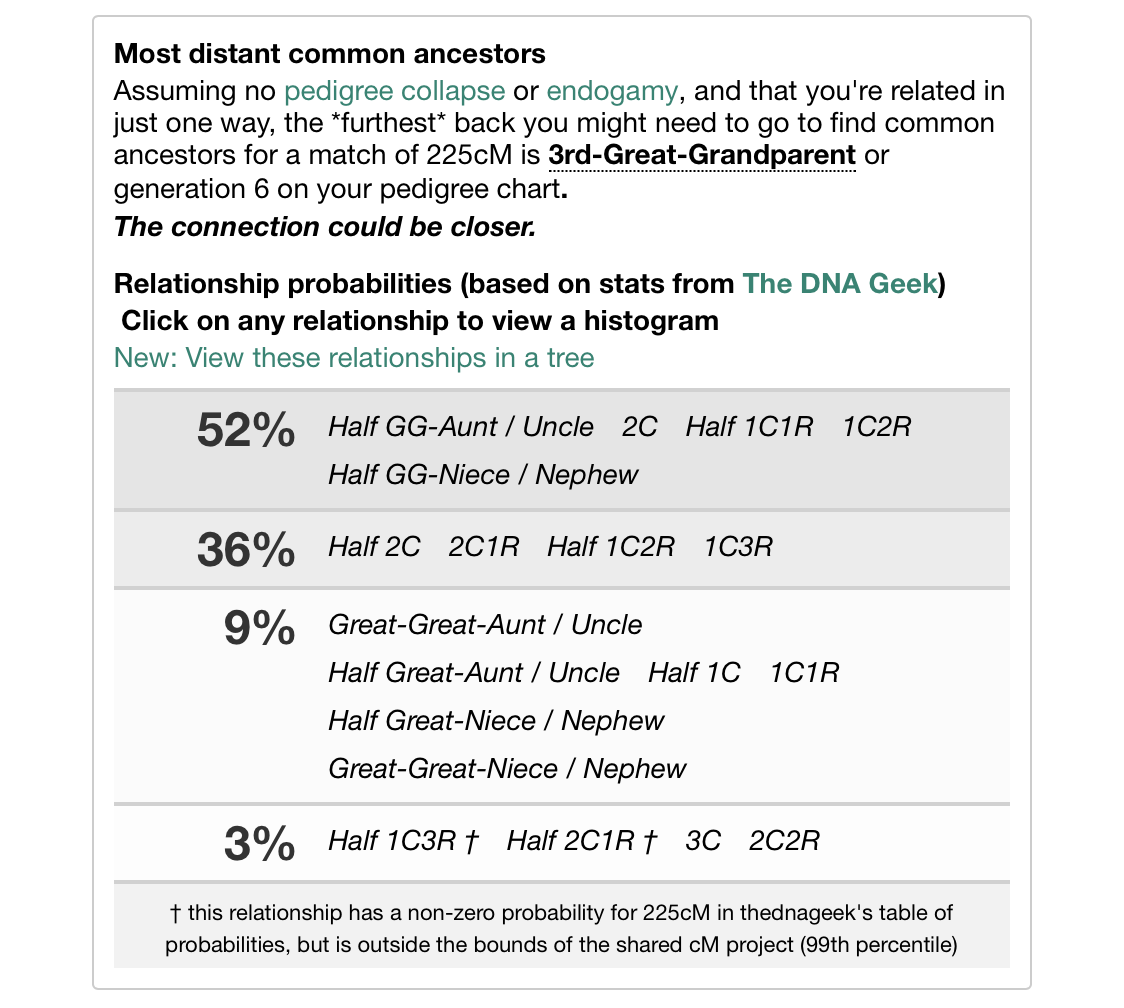
or visually these possibilities:
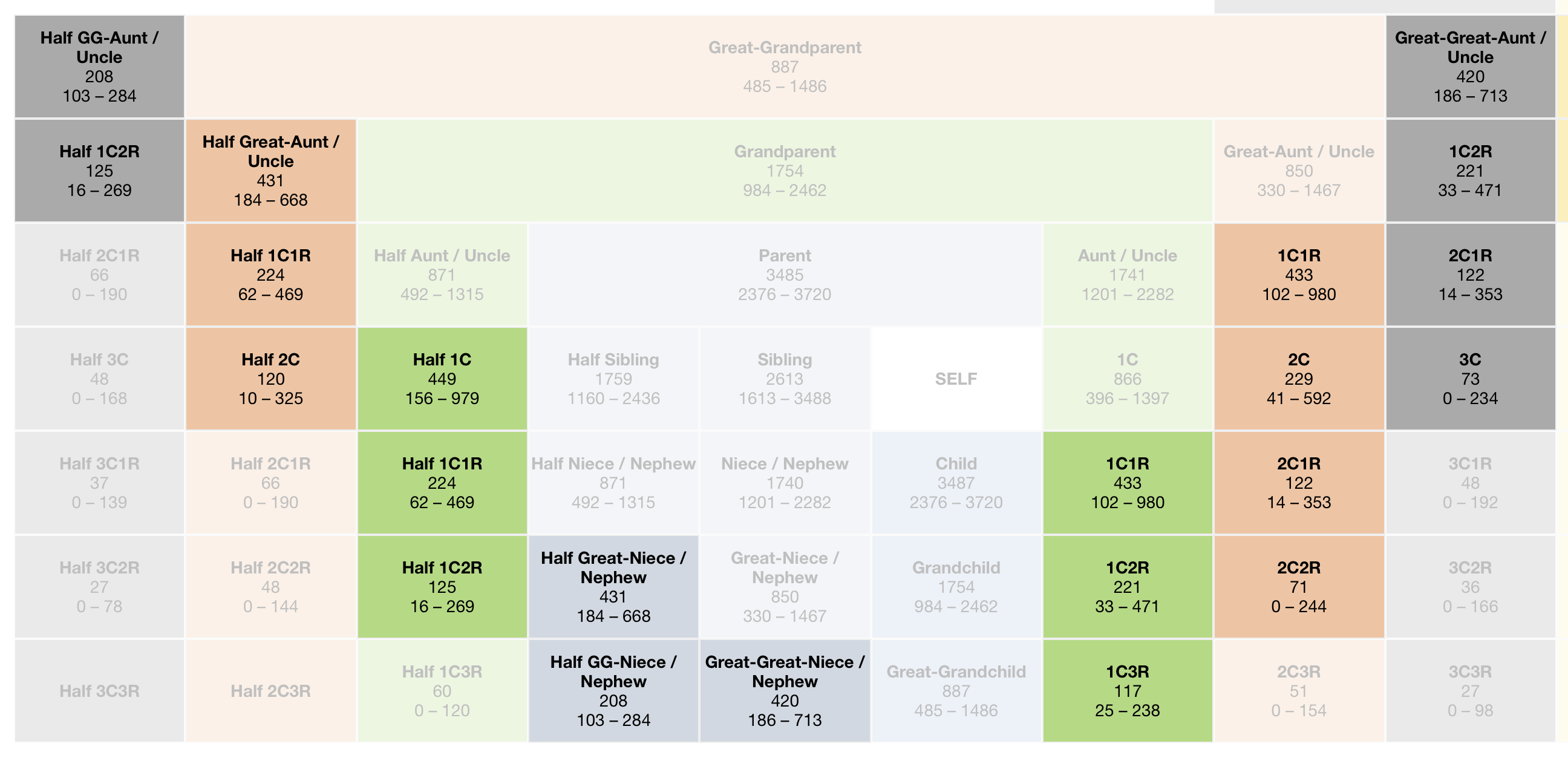
Exactly what amount of CM do MH and TP share? What does this chart show when you put in that number?
And you still need to keep in mind that this shared CM project is subject to revision as they get more data and that they have set a boundary of the 99th percentile for their statistics which means that 1% of the time a real relationship will have an amount of shared CM that is outside of the ranges the chart shows. That 1% chance cannot just be ignored.
This is why DNA relationships are much more vague than paper relationships which have only four possible values. An example of those four possible values would be:
- A birth certificate states A is the child of B and that is true.
- A birth certificate states A is the child of B and that is false.
- A birth certificate shows that A is not the child of B and that is true.
- A birth certificate shows that A is not the child of B and that is false.
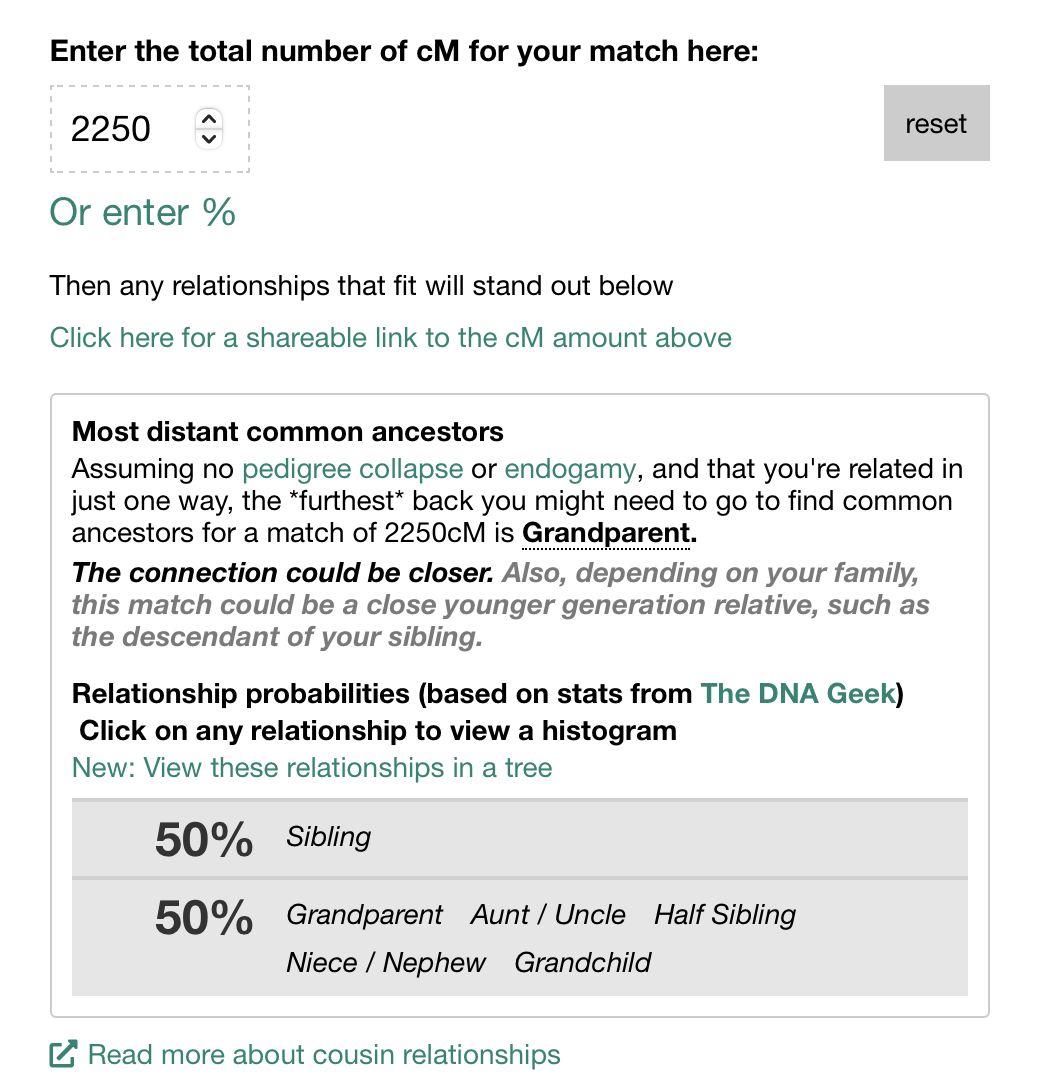
Instead, DNA states that if two people share 2250 CM, it is a coin toss whether they are siblings or half siblings:
 3
3 -
Now you need a real statistician!
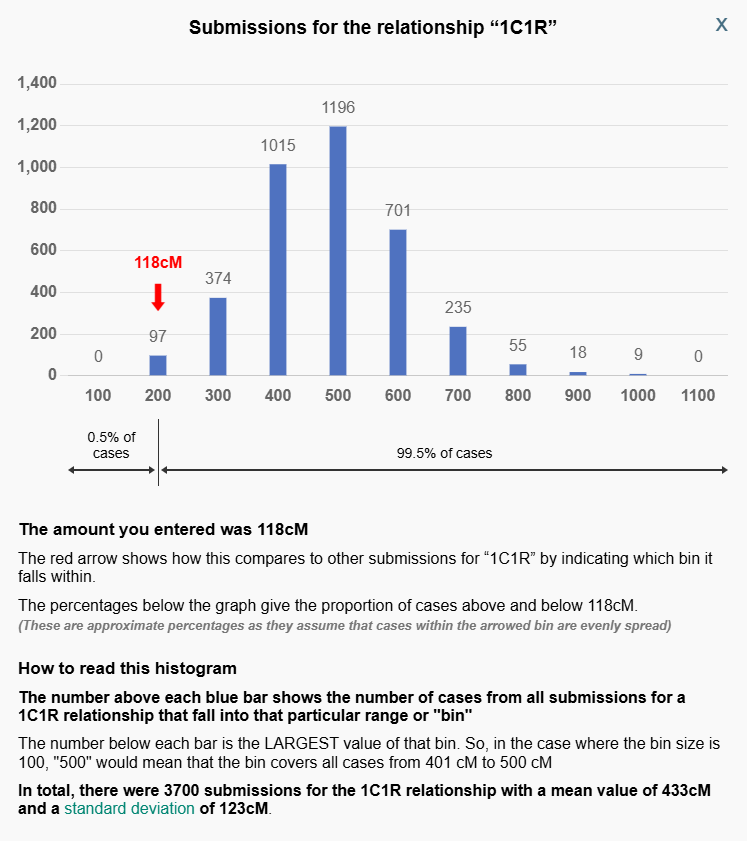
So of the 3700 data samples they received in which it is certain the pair were full siblings, then 99.5% of the time they shared more than 118 cM.
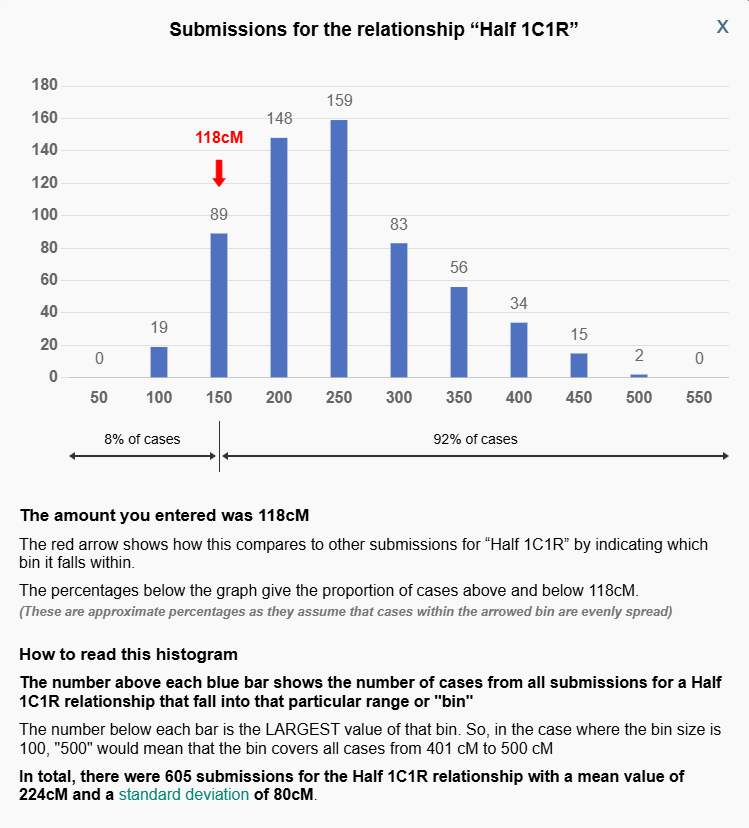
And of the 605 data samples they received in which it is certain the pair were half siblings, then 92% of the time they shared more than 118 cM.
This certainly does not disprove the theory they were half-siblings but is it enough to prove they were?
I kind of think that missing father's name on the birth certificate is more convincing evidence that they were half sibling than this DNA evidence taken by itself. Taken together they could make a pretty good case.
Are you lucky enough to have any direct male lines to those two brothers? Y-DNA testing would not be able to prove anything if they have the same Y-DNA because you would have to wonder if the two fathers shared a common male ancestor. But if the Y-DNA traceable back to the two brothers was different, then that would pretty well seal the cases:
- No father's name on one birth certificate.
- Autosomal DNA consistent with being half siblings.
- Different Y-DNA being direct evidence of two different fathers.
This is why a good lecturer on genealogy and DNA will always stress that DNA is just one tool and you need multiple tools to build a good story.
1
Answers
-
Good morning: Can you provide the PID's and a copy of the chart you are using to try and establish the links? We may be able to see better what you are looking for. Thanks
0 -
@Ken Blackmore
Although not extremely active, this group may be a place to ask this question also1 -
Gordon, thank you for your response and the link to the DNA Painter tool. The DNA match was 118 cM.
Here's the screen shots of what the DNA painter provided: 1C1R vs. Half-1C1R.
If I'm reading this correctly there is a very slim chance that the boys were full siblings, it is statistically more likely that they were half siblings, although not definitive.
 0
0

