What is the proper procedure - standard best practice.

I'm working on a new person, and the Quality Score is just a medium. I looked at the reason and it suggests that the county is where the birth city is located is not correct. The indexed record is using the county name that came into existence in 1919, but the birth happened in 1901. See the clips below that show the indexed data and the standardized location options.
So, the indexed data is mostly correct, just at the wrong due to the time slot.
So, the questions are:
1- Should I just leave the entry for city, county, country as indicated in the source or fix it to match the more accurate historical fact?
2- Will changing the county (amt) information to match the historical truth improve the probability of finding a duplicate person or additional records?
3- Because he lived before and after the county name change, will altering the county to the more correct historical county name increase or hinder the search engines looking for records from later in his life..?
I know it doesn't matter that much, given the common city name will correctly identify the person… I'm looking to get to best practices for research and making records accurate.
Please let me know.
THANKS
R

Answers
-
Good afternoon.
There is a dedicated group for Data Quality Score Feedback and questions. You may find it worthwhile to post your queries there.
https://community.familysearch.org/en/group/323-data-quality-score-feedbackHope this helps!
0 -
Your image didn't make it onto your post, just a couple of blue squares. That happens sometimes if you edit a post after originally posting it. Sometimes the images show up in a couple of days. Your options are to try reposting them or to post the ID so people can look at the profile directly.
Since you are talking about pre- and post- 1919 Amts I assume you are talking about Denmark or Norway.
I've worked a lot in Norway so I'll give a couple of vague opinions and suggestions based on there.
A. I would leave the index alone. FamilySearch indexes generally use just the post-1919 names. The Norwegian Archives does the same. Editing the index will give a couple of entries that don't match the rest of a set and that could goof up the search results.
B. Generally the advice is to have places names on a FamilySearch profile be the historically accurate name at the time of the event. However, there are some typical exceptions. I hardly ever run across any users on Family Tree and other sites that switch from, for example, Søndre Bergenhus to Hordaland, on January 1, 1919.
C. The Places database, in order to not get way too overwhelming, often picks one name to use for larger areas for which names have changed but the boundaries did not. For the country of Norway, they just use Norway to keep a single top level name. They do not triple the size of the database by having everywhere in the country have an entry for Norway until 1660, The Kingdom of Denmark and Norway from 1660 to 1814, then Norway again from 1815 on.
D. They do change upper level names if there are major boundary changes. So there is Hordaland until 2019, even though it was not called Hordaland until 1919, but then Vestland in 2020 since merging with Sogn og Fjordane more than doubled the area of the county.
E. The Places database assigns an ID to each particular place in the world that has been entered in the database. When we enter a place name on a profile, it is that ID that is used to compare place names. Index place names have also been keyed to those ID numbers. That was a major project a few years ago which unfortunately did not always go well but let's assume that in your case that is not an issue.
When I enter a place name such as Mehammer, Stord, Hordaland, Norway, all the computer actually sees and uses is 10912424, 551080, 5929, 40. When the computer does a search for additional records, it uses 551080 because the indexes do not go down to the farm level, just the community level. All indexed records for Stord until 2020 should be keyed to that Place ID. This is why it is important to make sure that entered places names are linked to the correct standard place.
The place name you enter and the linked standard do not have to look identical because the Names section in the Places database allows for a wide variety of historical names and spellings for a place to be linked to the proper standard. That is why you can enter the farm of Haavig with that spelling if every record you have found for your relatives spells it that way even though the standard has the modern spelling of Håvik.
F. All that is why you can enter a place name as historically correct and it should not affect the search engine at all.
G. Regarding the Data Quality Score you have to keep in mind that the routine is checking the quality of the data in both the Family Tree profile and in the associated FamilySearch database. You may be running into a situation where an appropriate name variant is missing from the Places database. The solution is not to degrade the profile by changing the profile to what the database says but rather to get the database fixed so there is no longer a conflict between your entry and the Places database. To see if that is the issue, I'll need to see your specific example.
2 -
Gordon, I was hoping you would come along to this post with your knowledge of the region.
BTW - I can see the images.
0 -
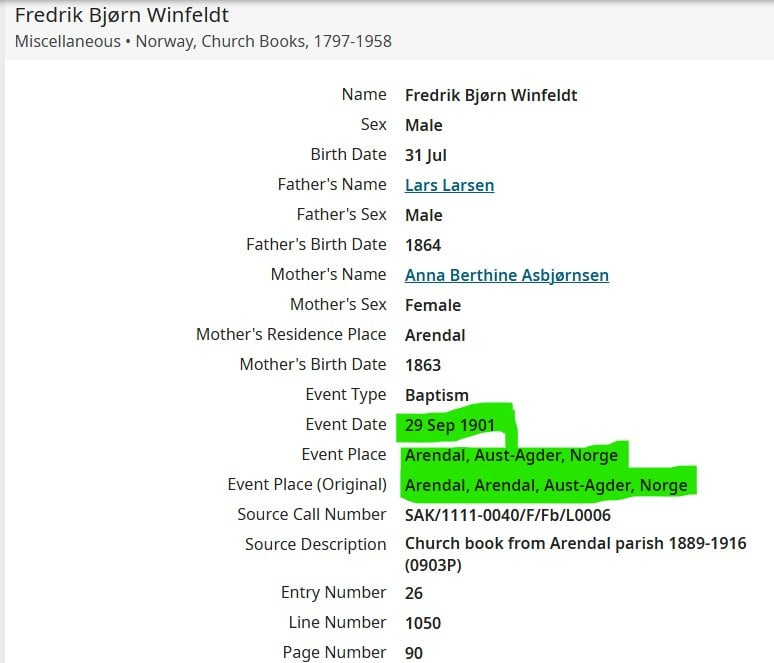
Pasting copies of the images here, in case that helps.
2 -
Your images have appeared and I have found the proper profile. I'll stare at things for a bit and come back with more thoughts.
0 -
One nice feature of the Places database is that it can contain useful historical information about a place. Here is the set of entries for the city of Arendal: https://www.familysearch.org/en/research/places/?focusedId=12349303
Here is some basic history:
The town of Arendal was founded sometime in the 1500s
In 1838 when parishes were all converted in to civil municipalities, large cities could not be contained inside a municipality. A few years later there were some adjustments to this law however Arendal must have been pretty good sized because it remained an independent city not contained in any municipality.
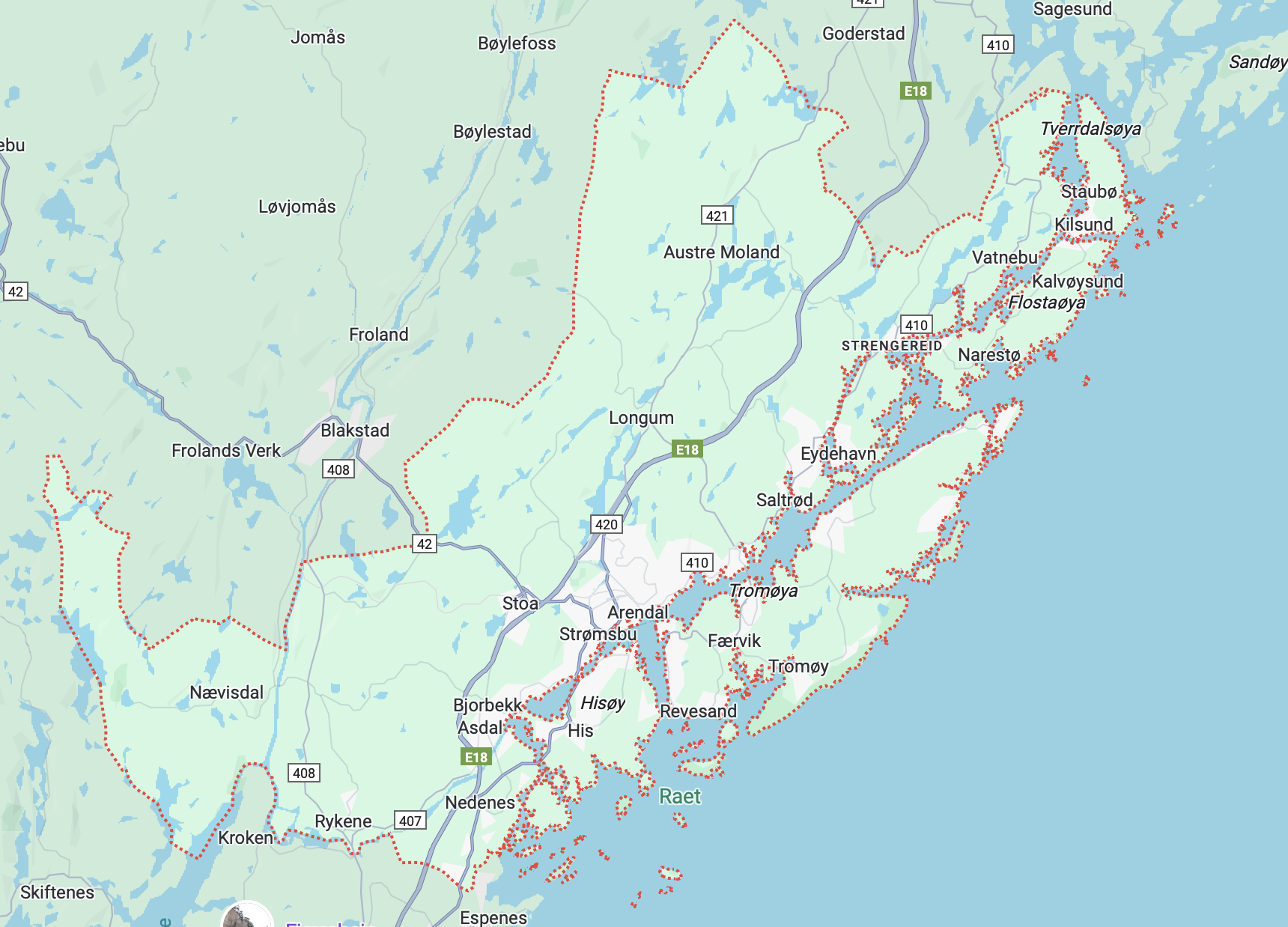
In 1992, the city of Arendal and the municipalities of Hisøy, Moland, Tromøy, and Øyestad were all merged into a single municipality called, and this is where things can get confusing, Arendal. As of 1992, the city of Arendal went from being an independent city to being a city within a municipality of the same name.
Here is the current city of Arendal:
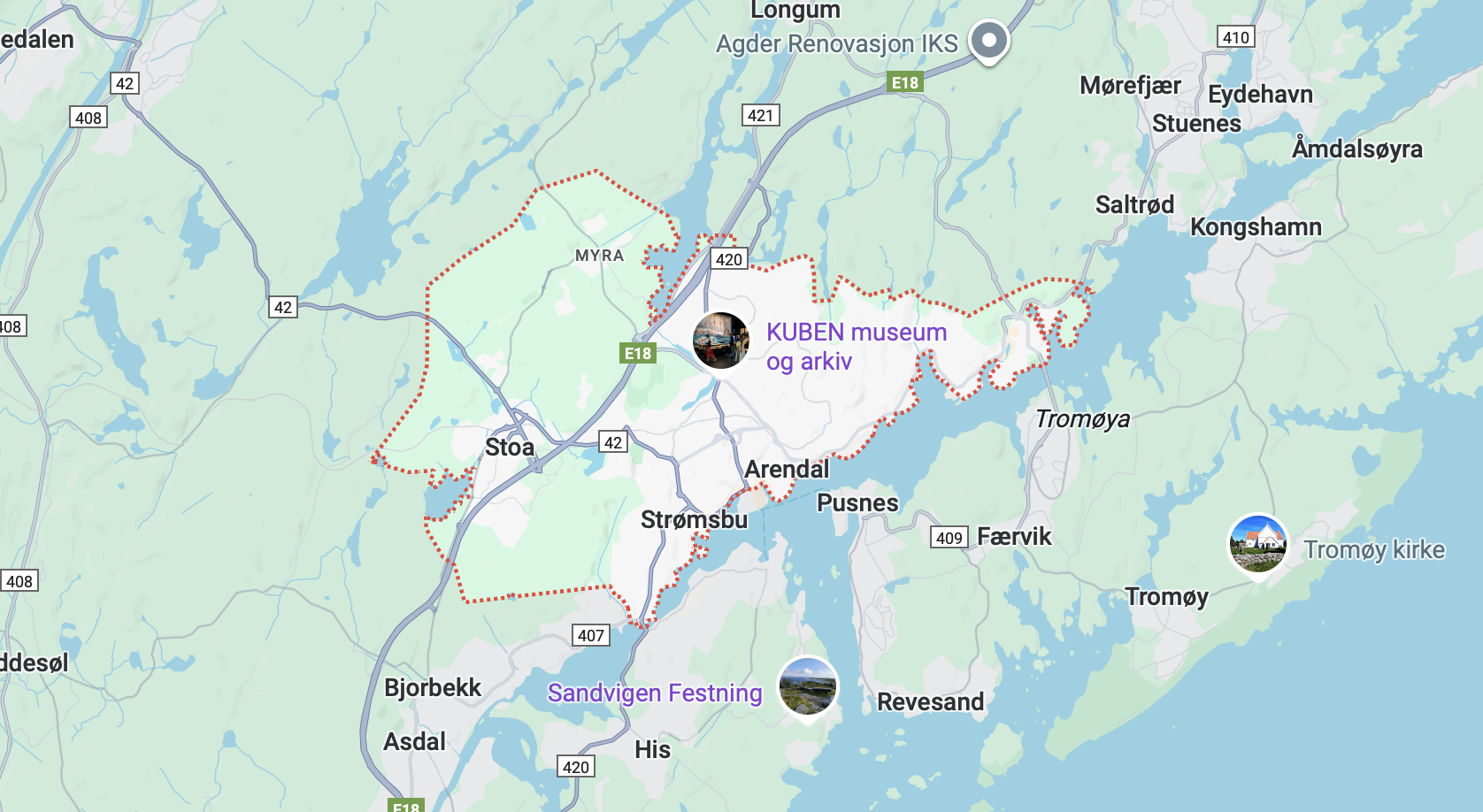
Here is the current municipality of Arendal:
What the Data Quality Score is currently complaining about when it says:
- The standard "Arendal, Aust-Agder, Norway" (ID: 2241489) is used for 1992 to 2019. This conflicts with the christening date of 29 September 1901.
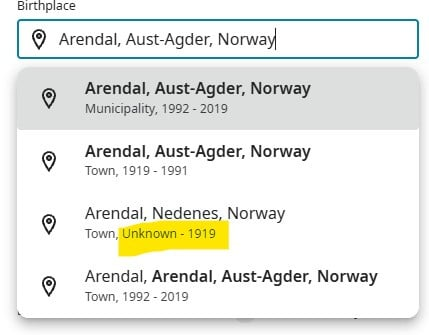
is that you (potentially the source linker did this for you without you noticing) have standardized the place name of Arendal, Aust-Agder, Norway to be Arendal, Aust-Agder, Norway (ID: 2241489) the municipality which did not exist until 1992. Instead it needs to be linked to the standard Arendal, Aust-Agder, Norway (ID: 12349305) which is the town.
You can see the difference when entering or editing place names:
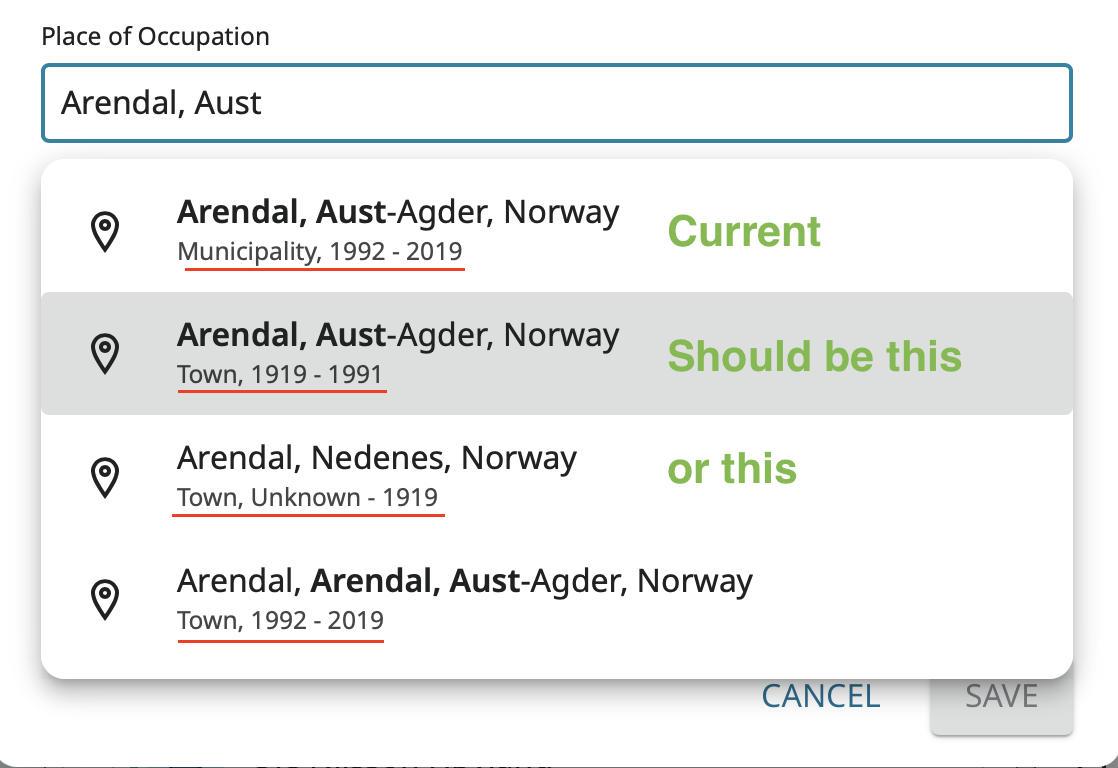
I'm not sure if the data quality score will still complain if you use Aust-Agder for pre-1919 events. It shouldn't since Aust-Agder and Nedenes are listed as alternate names for each other.
Also, the process of combining place name entries so that there is just one entry for the pre-1919 Amt designtion and the 1919 change to Fylker instead of two is ongoing. If you choose to use Arendal, Nedenes, Norway, as a small percentage of users do, at some point in the future the standard will change to Arendal, Aust-Agder, Norway but your entry will still stay the way you entered it.
If you choose to use Arendal, Aust-Agder, Norway for his 1901 birth and the Data Quality Checker still complains, you can just dismiss the flag with an explanation of why you are using Aust-Agder. But do correct the standardization to be a version of the town. Not doing so could throw off the search routine.
One of the things I like about the Data Quality Checker is it ability to pick out very subtle data errors like this place standardization error that are basically impossible to see just looking at a profile.
4 -
I've submitted a request to have the 1919 start date for Arendal, Aust-Agder removed so that it is consistent with current Places database practices. When that is done and it syncs through the systems, the DQS should definitely not complain about whether you use Arendal (the town), Aust-Agder (flyke) or Arendal (the town), Nedenes (amt).
There is no "best practices" I have ever run across for which to choose. I do see most people use Aust-Agder Fylke for all time periods. I see a few that use Nedenes Amt for events prior to 1919. I have never seen anyone use Agdesiden Len for events prior to 1662. It's your choice. Shouldn't have any effect on finding more records or finding duplicates.
0 -
One issue I see here, is too much emphasis on ENGLISH-centric place names.
Non-English genealogists don't like the idea of English-centric being forced on them.
(By the way Norge is correct native-centric name and part of my direct ancestry so I enter them as Norge, not Norway, like wise I do with other countries Deutschland, not Germany; Polen, not Poland; Magyarország not Hungary; Österreich, not Austria; România, , not Romania, Danmark, not Denmark; Schweiz, not Switzerland; Italia, not Italy; Espana, not Spain; Brasil, not Brazil)
How do you think I was able to contact my cousins over in Europe in first place and able to get them to contribute to the TREE in first place? (My ancestry is very wide spread not only in Europe but also in South America, especially Brasil, Argentina and Chile where some of my Deutsch descendant cousins are.
Yes, you can force the Tree to accept specific spellings with ease.
1 -
Even better, the Tree can force you to accept specific spellings with ease and allows you be to whatever-centric you desire.
@Randy J Steck , if you are not familiar with the Place database, you should spend some time looking around in it. It's home page is https://www.familysearch.org/en/research/places/
One thing you will quickly discover is that it contains, or can contain, versions of places names in many languages. Here is a small section of what is currently included for Norway:
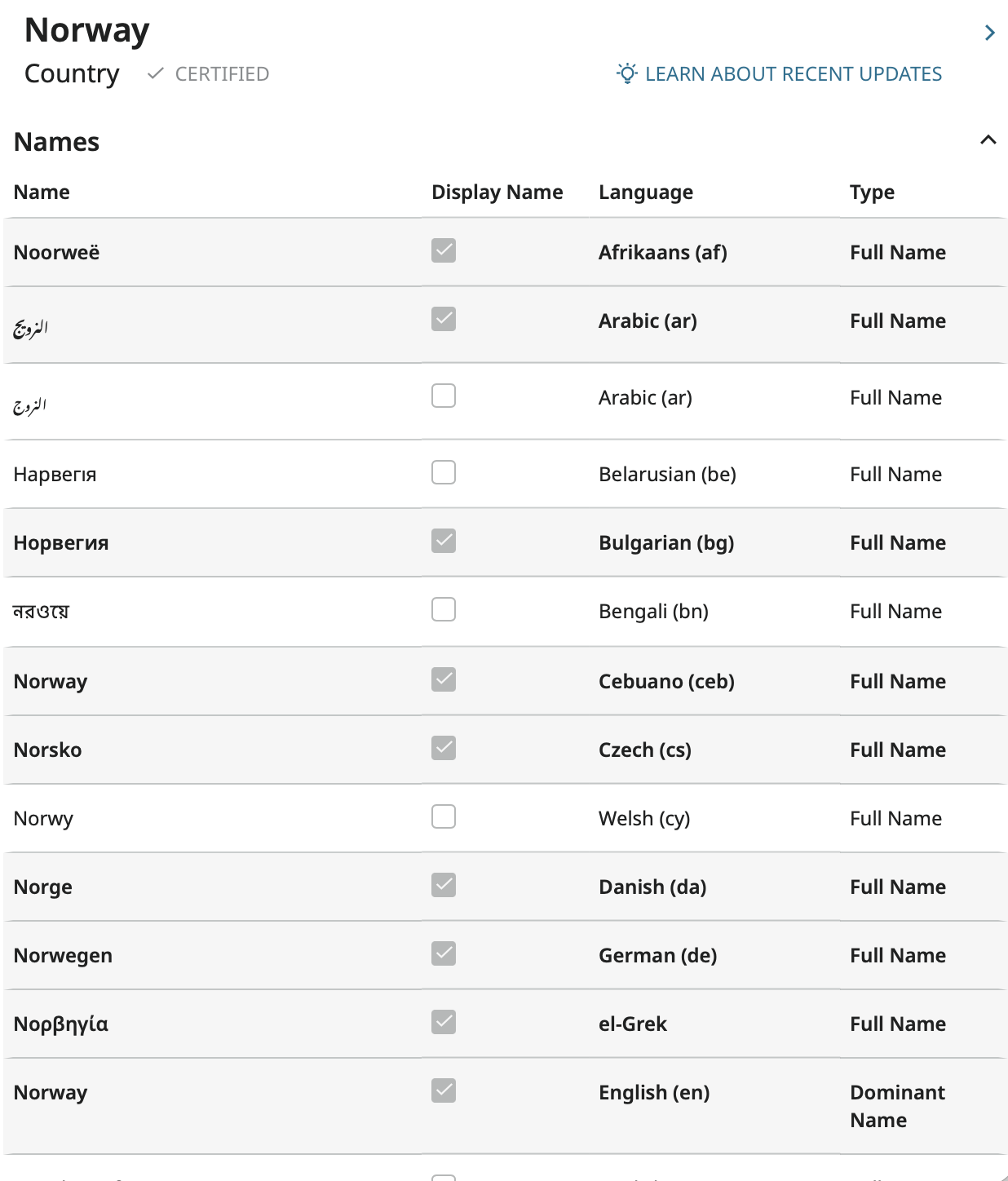
If Display Name is checked, that means that that is the version of the name used as the standardized version when the FamilySearch site is set to that language. (Dominant Name, as seen marked next to the English version just means that when someone has the website set to English and types in Norway, the program puts the country at the top of the search results instead of some small village in Minnesota.)
It's very easy to enter a place name in the language of the time or place of the event. The best part is that you don't even have to know what the name is in that language. Just click on the globe at the top right corner of every page and pick the language you want to use:

If I set the site to Norwegian and repeat my example from above, I now see:
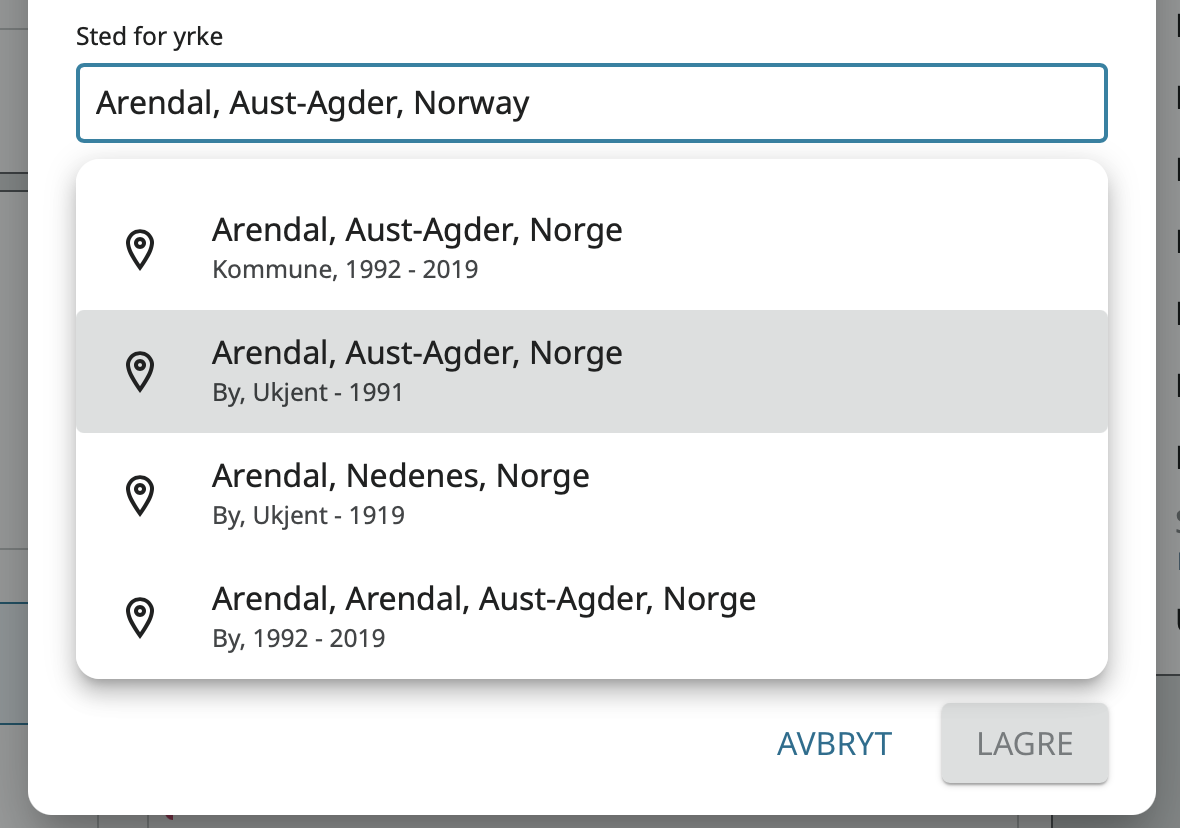
Even if I didn't know Norway in Norwegian was Norge, it comes up for me and I just have to click on the proper choice.
Of course, I usually don't have to type out the whole name. Just enough for it to appear as a selection:
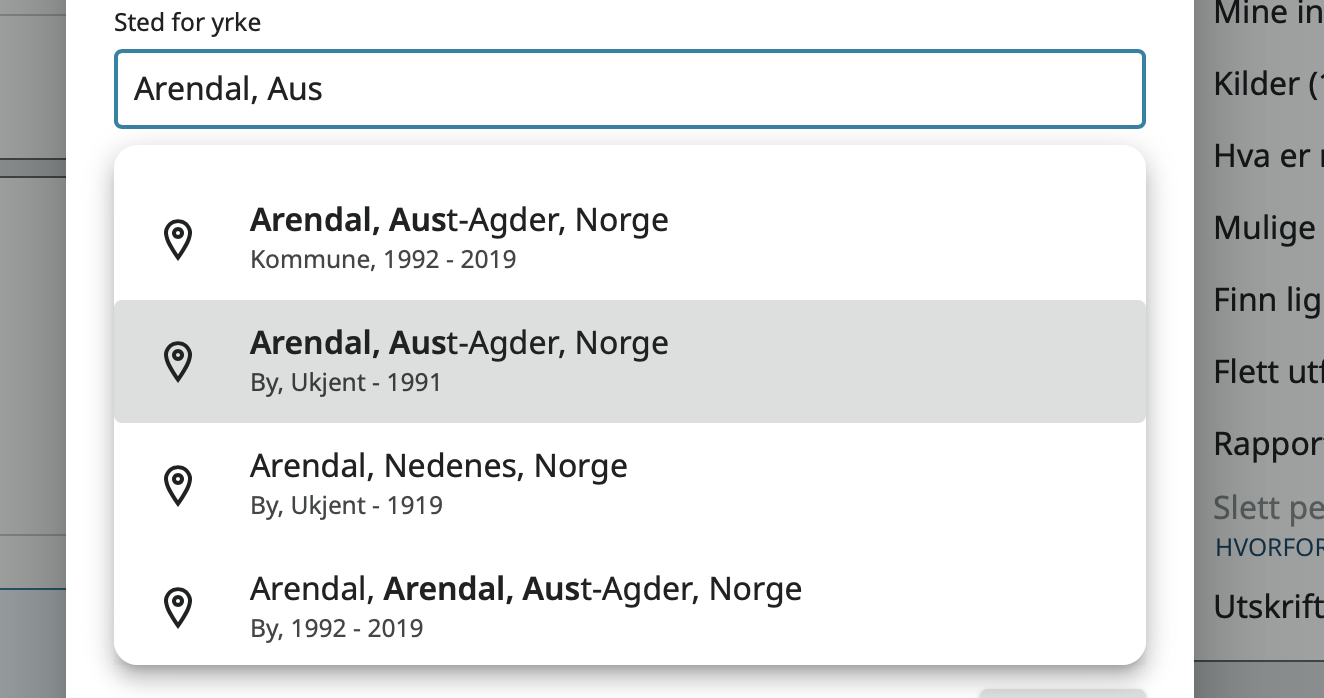
Note that when you change to website back to English or to any other language, your Norwegian place name does not change. It stays the way you entered it. If the next user to come along does not know what country Norge is, they can hover over the text and see the name in whatever language they have the web site set for. For example, if they are using Japanese, they will see this:
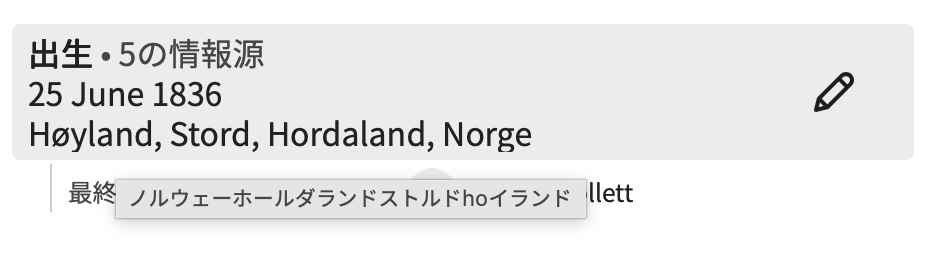
Or they can open the Data View popup to see the place name in the language they are using:
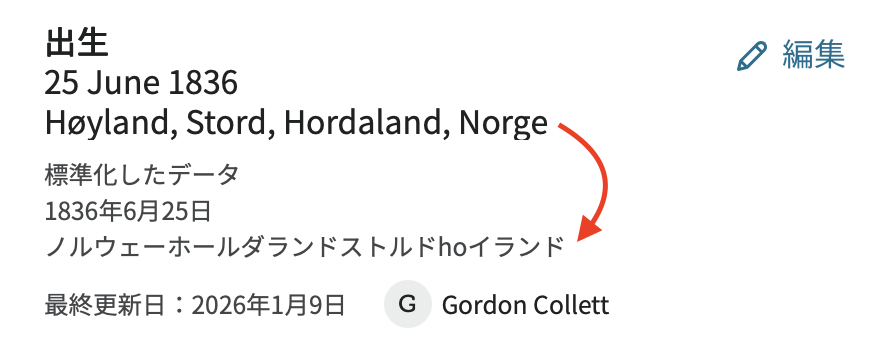
FamilySearch has been making great efforts to make the program world-centric.
(Follow up note: I see that the change in date range requested is in place so as soon as you change the place on Fredrick from the municipality to the town, the Data Quality flag will disappear no matter which province name you choose to use.)
3 -
@Gordon Collett said:
"… you (potentially the source linker did this for you without you noticing) have standardized the place name of Arendal, Aust-Agder, Norway to be Arendal, Aust-Agder, Norway (ID: 2241489) the municipality which did not exist until 1992. Instead it needs to be linked to the standard Arendal, Aust-Agder, Norway (ID: 12349305) which is the town.
"You can see the difference when entering or editing place names …"
Just as a comment, the warning is that if you only look at the person's profile and see "Arendal, Aust-Agder, Norway", you have no means (unless I'm mistaken, which is perfectly possible) of telling whether this is the municipality or the town of the same name. The type (municipality, town, etc) is only visible in the drop down list when updating the profile and by that point I don't think that you know what came before. It's for this reason that I always prefer to insert text like "municipality" in the display name while still standardising on the official form of the name. Sadly, in only some cases do we see a type visible in the standard placename - e.g "New York City" is actually standardised as that, contradicting those who claim that the official name of NYC is simply "New York" (I have no idea what the legal name actually is but that was the claim for ages).
1 -
"Just as a comment, the warning is that if you only look at the person's profile and see "Arendal, Aust-Agder, Norway", you have no means (unless I'm mistaken, which is perfectly possible) of telling whether this is the municipality or the town of the same name."
Exactly! That is what I find to be one of the beauties of the Data Quality Score. It can see things that we can't.
(I just checked google and found a statement that the official, legal name for New York is "The City of New York." I don't think I've ever seen that used on a genealogy site."
1 -
Perhaps off-topic, but I recently saw a Virginia county listed as "Fairfax County" in the FS place name database. I was shocked. The other Virginia counties I checked do not have the word "county" appended.
As a NYC researcher, it drives me a little nuts that the standard on FS, for New York City before 1898 (the year of consolidation), is "New York City, New York County, New York, United States."
2 -
We do have to have some patience with and sympathy for the Places Authority Team and their limited number of volunteers. I don't know how many volunteers there are, but the highest Place ID I can find as of right now is 13,675,773. Ignoring merging of duplicate places, that is how many unique place names there are in the database. Perfect consistency is going to be difficult. And there may have been a good reason, at least at the time, for the individual exceptions that crop up.
Also, if you go to the Places database, enter a state or country and filter for Provisional places, you can get an idea of their workload. Many of these provisional places will be those requested by users to be added for use in Family Tree. They need to be evaluated by a volunteer, given appropriate resources, and citations before they change to Accepted and can be accessed in Family Tree. But there are so many of them, I think some of these provisional places must include ongoing projects the team has in place that they created by doing something like adding bulk lists.
For example, here are a few random place and the number of Provisional places under them:
- State of New York: 2304
- State of California: 189
- Ireland: 1921
- Germany: 1808 (plus I have seen that Germany has a particularly severe problem with missing time periods)
- Mexico: 1045
- Russian Empire: over 5000 (the search engine only provides up to that many results)
- South Africa: 2275
To get all these places properly documented and cited so they can be used in Family Tree is a massive goal.
0 -
What so shocking about Fairfax County, Virginia? The problem is there is city of Fairfax, an independent city and the county has separate government despite the City of Fairfax being the seat of this same county.
Fairfax County isn't the only one with this concept, other countries in Virginia are like that.
1 -
This thread highlights the value of Community: shared expertise! I learn so much from all of you!
2 -
@W D Samuelsen contact me please
There are many, many, many counties that have the same names as cities/towns, and those do NOT have County appended.0