Verify places -- data is not from chosen country :(

Hi,
When trying to verify places in Colombia I keep getting raw data from other countries (like Italy, in this example).
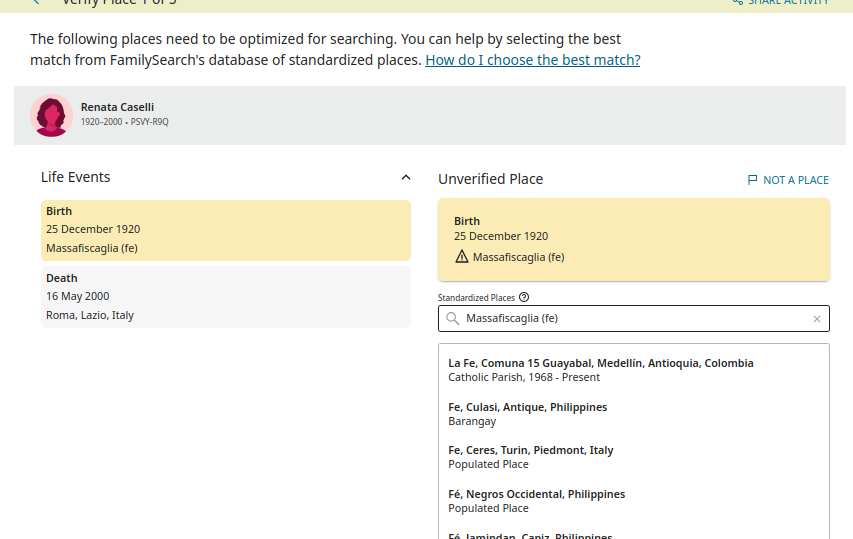
clicking Skip I get this next record (from Spain?)
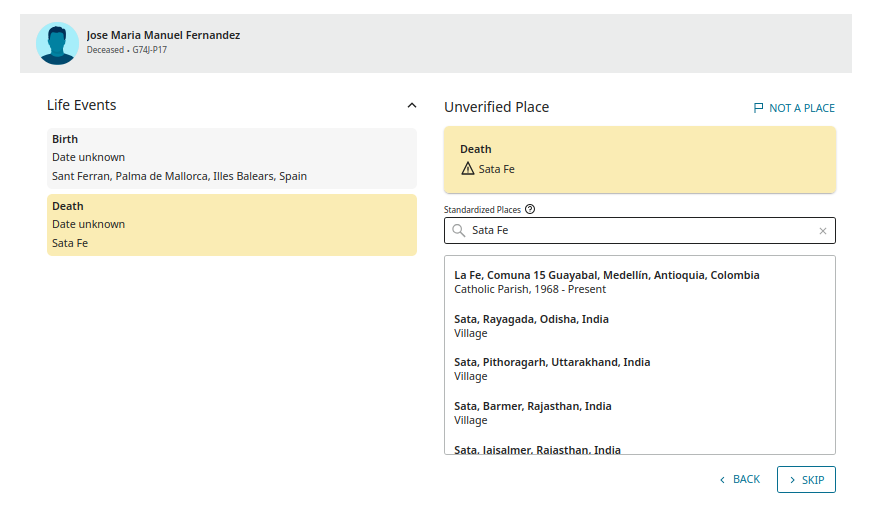
It seems that the system is choosing sets of data with items that approximately match a place name ("FE", matching «La Fe, Comuna 15 Guayabal….» ), but that a second filter (Colombian data in this case) is not being applied.
- This bug prevents and discourages potential volunteers from using their local place expertise to enhance and fix records and give good feedback to your Machine Learning systems.
Please take a look.
Cheers!
Answers
-
I have always been uncertain how it chooses the items to put forward. But I am fairly certain that , with non recognised locations, it's got to be hit and miss. I'm actually impressed that the first example picked up the Fe and realised that there was somewhere in Colombia with that in the name and gave it to you. But there is no means to do that second filter to Colombia. The fact that the death event comes from Italy doesn't, I'm sure, matter - it only looks at the birth event - after all, the guy could have been born in Colombia and moved to Italy.
Similarly the second example is a death in Santa Fe - that could be any Santa Fe in the world, and since there's one in Colombia, that's why you got it. Nothing says that death happened in Spain.
0 -
"…there is no means to do that second filter to Colombia…"
The indexed data is linked to an original microfilm roll, and the microfilm his tied to a country where it was photographed."Similarly the second example is a death in Santa Fe - that could be any Santa Fe in the world" —
I disagree: if it is a burial record, it is extremely likely that such Santa Fe is located in the country and province where the burial was recorded in a document, and where the document was photographed.[Added:] I notice that FS has chosen to do place verification on tree records (https://www.familysearch.org/en/tree/person/details/PSVY-R9Q), not on an indexed document. I ask FS to please reconsider that choice.
For instance, this specific tree record has no sources, it was not created by a FamilySearch but by a user (username removed). If (username removed) creates a badly formed place names,
- it would be helpful to ask (username removed), directly, about a better form for the name of that place.
- it would not be helpful to ask users with interest and expertise on place X about place Y.
- in the same way that Name Verification is based on original documents, it make sense to invite users experts in country X to verify places on original documents that come from X.
0 -
@JuanZuluaga3 Mod note: Community is a public online forum. Your comment was edited to protect the privacy of a living person. Please see the Community Code of Conduct for more details.
0 -
You are right, including your suggestion how to tie in locations to valid countries.
I (often) had a task to identifiy a burial place named "Utan" of a swedish born individual in Guam, USA
due to a remark set in the place's name "utan stadelig uppehallsort" (without permanent residence).
1 -
@HolgerKraft2 mentioned
a remark set in the place's name "utan stadelig uppehallsort" (without permanent residence).
Arguably the issue there is an indexing problem and nothing to do with Verify Places. That sort of phrase simply shouldn't be entered as a placename because it's not a placename. The placename should be left empty, the researcher should be looking at the image (I have no sympathy with anyone who doesn't look at an image if it's there) and they should read the remark on the image.
Now quite how we deal with existing indexing errors like that, I'm not sure, because I know that there are currently all sorts of garbage values in historic record indexes - mostly in people's names.
0 -
Stimmt. Diese (angebliche) Ortsbezeichnung ist in Wahrheit ein in Schwedischer Sprache gehaltener Text, der sehr häufig in Schweden von genealogischen Laien gebraucht wird, wenn es um Orte in Schweden geht, die zu Einwohnern ohne festen Wohnsitz gehören. Eine frühere Version des FS Datenbanksystems hat das einzig interpretierbare Wort "utan", deutsch "ohne", englisch "without", als Ortsbezeichnung umgesetzt und dem nächstbesten Ort auf dem Atlas zugeordnet. Dieser liegt auf der Insel Guam (US-Territory) im Pazifik. So kam es, dass sehr viele schwedische Staatsangehörige des 19. Jahrhunderts ihre letzte Ruhestätte (Grab) auf dieser Insel fanden, was reiner Unsinn ist. Leider kann man diese Insel nicht mehr bei "Verify Places" aufrufen, das wurde ca. 2023 abgeschaltet.
0 -
Google translatefor @HolgerKraft2remark
That's right. This (alleged) place name is actually a text written in Swedish, which is very commonly used in Sweden by genealogical amateurs when referring to places in Sweden associated with individuals without a fixed residence. An earlier version of the FS database system interpreted the only interpretable word "utan," German "ohne," English "without," as a place name and assigned it to the nearest location on the atlas. This location is on the island of Guam (US Territory) in the Pacific. This is how it happened that many Swedish citizens of the 19th century supposedly found their final resting place (grave) on this island, which is pure nonsense. Unfortunately, it is no longer possible to access this island through "Verify Places," as this feature was discontinued around 2023.
Thank you for your insight
0