Can this metadata error be corrected, please?

I would be grateful if you could pass this one to the team concerned. The usual practice when a period of time (e.g., a "Quarter", as in this case) is indexed is for the month at the end of the period to be used as the date. As seen below, this "Ireland, Civil Registration Index" collection appears to have had the first month in the quarter (October - December) used instead.
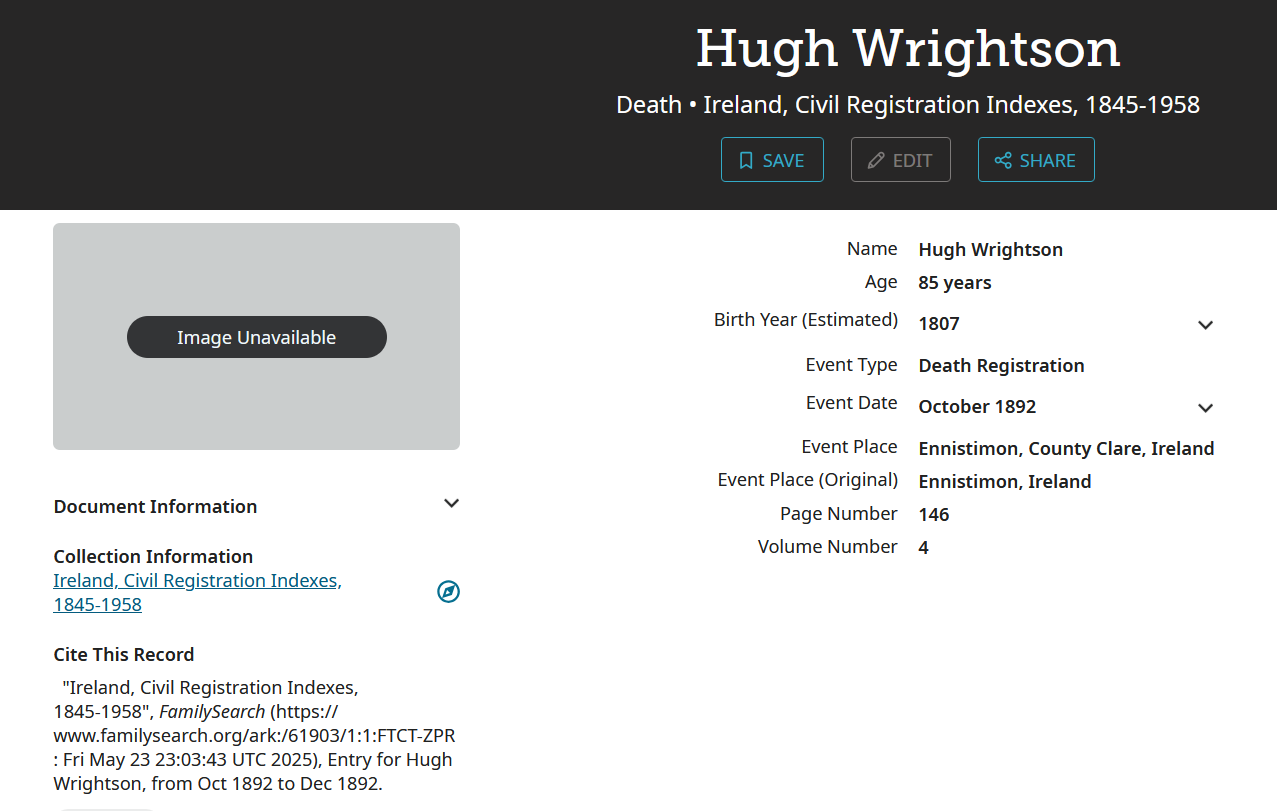
I appreciate it might not be high on their list of priorities, but the indexing of this collection goes against accepted practice, in particular with the way the similar FamilySearch collection relating to England and Wales has been (correctly) handled.
(In this example, the actual date of death - found on the official https://www.irishgenealogy.ie website shows the actual date of death as 6 December 1892.
Answers
-
@Paul W
Did you happen to notice, on the Search Results page, that the death is interpreted as "from October 1892 to December 1892"?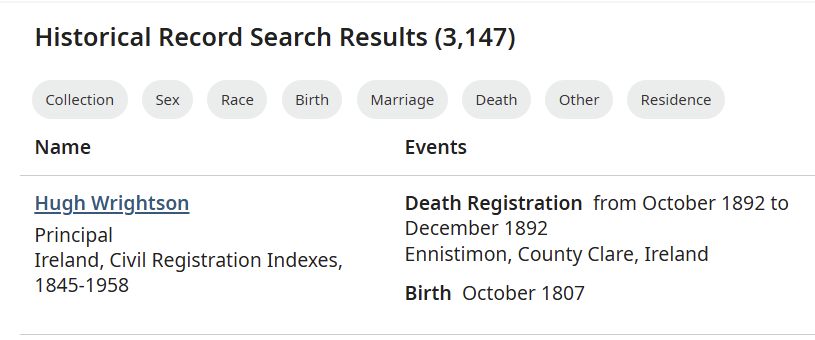
And if you expand the information (using the down arrow) on the individual index page, that detail is one of the former listed event dates:
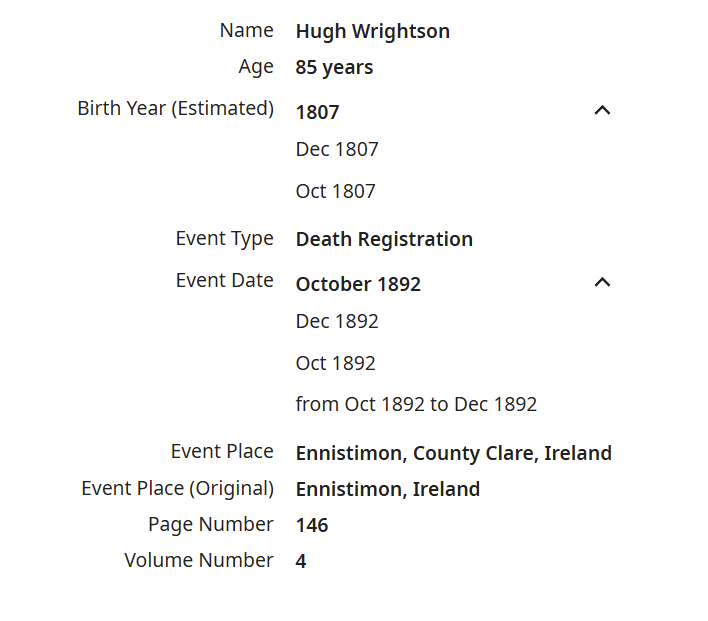 3
3 -
There's nothing like consistency and this is nothing like … 😉
Just for curiosity, I looked at the "England and Wales, Death Registration Index 1837-2007" for one of my ancestral names in the period 1990 - 2007. (A different collection from @Paul W's)
The dates are a mix of years, month-year where the month is the start of a quarter and month-year where the month is the end of a quarter.
Some are Death events, some are Death Registration events.
There appears to be no pattern about which is which - certainly there is no division of which is which by date.
I didn't spot any down arrows like @Áine Ní Donnghaile found so I've no idea whether there are multiple dates on the index record and no clue therefore whether the variations are derived from varying data on the Index records, or whether the variations are presentational only with the same underlying data throughout.
I'm happy to hack through the data myself but I do wonder if the lack of consistency might confuse less experienced researchers. And confuse Data Consistency checks…
2 -
One of the problems that cropped up in the Irish collection recently is shown in the previous birth dates listed on the example I posted above. For a while, those were being interpreted as a month and year of birth, causing the DQS to say the birth year or birth dates were in conflict. I reported those some months ago, and I believe that problem has been corrected. I wonder if the issue that @Paul W has encountered might be residual from that.
0 -
Thank you for added comments, @Áine Ní Donnghaile and @Adrian Bruce1 . Adrian is correct in highlighting the consistency issue, which was my main reason for my original post. Áine illustrates the alternative dates offered - found by clicking on the arrow(s), which I admit I had missed.
Looking again at the Ireland, Scotland and England & Wales records / sources, I find the "official" websites for the first two show just the year of the registration in their indexes, whereas for England & Wales the month ending quarter is shown after the year, e.g. "1892 D" (for December 1892 registrations).
In raising this issue, I was also highlighting the fact that "October 1892" was presented as the displayed Event Date, when the event actually took place in December 1892.
In summary, I think I'd probably prefer to see just the year in question displayed as the Event Date (for all these collections), allowing the researcher to delve deeper, if they wish, to find the precise date. This would also remove any doubts about whether the period in question represents "month ending" or "month beginning".
2 -
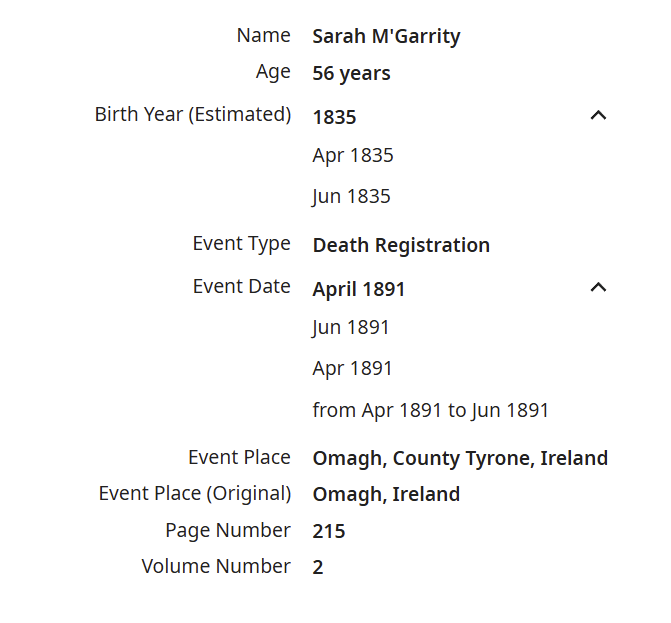
I've just reviewed an Irish death registration index, from 1891, and I found the problem I thought was fixed is not.
The DQS calls it out as an error: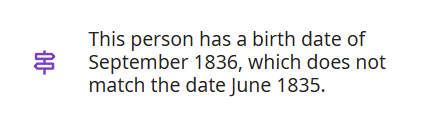
Sarah, of course, has no birth record. She has a baptism record from 24 September 1836. She died 10 May 1891. The algorithm has interpreted her approximate age of 56 years as being born in June 1835.
 1
1 -
Interesting how this thread has thrown up associated issues that affect the treatment of data from these records once they reach the individual's profile on Family Tree.
@Áine Ní Donnghaile raises the problem that the "Birth Year (Estimated)" causes in relation to the DQS, but I am illustrating (below) the problem in treating a Death Registration record as though it represented detail of the actual Death - which is the field into which the data is placed when carried across via the source linker.
True, the problem is not unique to this collection, but this illustrates how treating registrations in same way as Vitals can lead to incorrect detail being added to the profile.
Take this example: from the FamilySearch version of the record here is what we see:
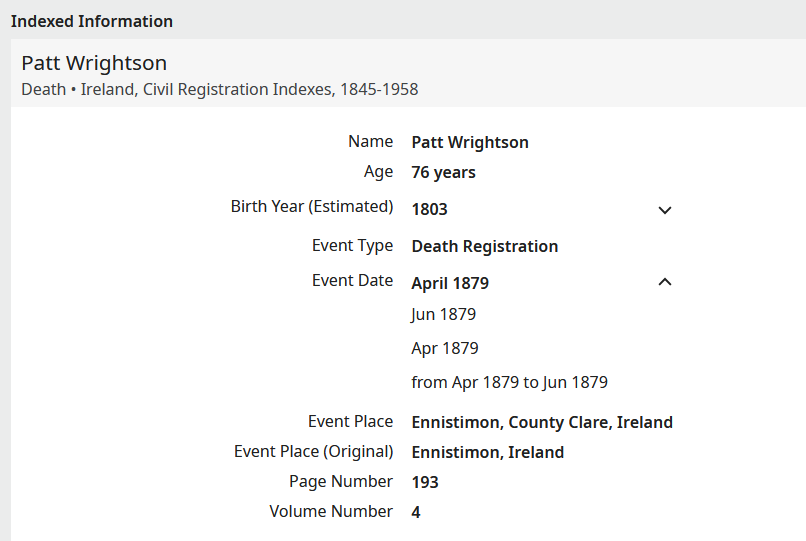
Without any "manual adjustment" by the FT user, this leads to a Death date of "April 1879" being placed in that field on his profile page (after completion of the source linking procedure). Also, the suggested date range is shown as "from Apr 1879 to Jun 1879" and alternative dates of "Jun 1879" and "Apr 1879" suggested.
In fact, none of those suggestions reflect the fact that the actual date of death was 15 February 1879, with the death registration date being 4 June 1879 (as shown in screenshot below).

Two points to consider here, then. Firstly, the effect the current estimating of the birth date has on the DQS and, secondly, whether it is was a good idea after all for the programmers to decide to treat a Death Registration in the same way as a known, exact date of Death. (As a reminder, when this change was made a few years ago, it did not affect Birth Registrations, which are not treated - in the source linker process - as though they represent Births - i.e., the data is not carried over to the Birth field.)
Perhaps the engineers / programmers might wish to consider the implications of :
(1) How the data is currently being presented in the record, then
(2) Subsequently treated via the source linker program: in relation to this specific collection, and perhaps other collections of this type.
2 -
@Paul W suggested
Perhaps the engineers / programmers might wish to consider the implications of :
(1) How the data is currently being presented in the record, then
(2) Subsequently treated via the source linker program: in relation to this specific collection, and perhaps other collections of this type.
In all honesty, I don't think the engineers / programmers can come up with many sensible improvements - other than to be a bit more consistent. Because there are so many possibilities, I think that it has to be up to the researcher to do a bit of logical thinking.
Warning - philosophy follows: The researcher needs to be aware of what the possibilities are for this data - I would have sworn that the chance of a UK based death being in February and its registration being in June would have been fundamentally zero, simply because authority to bury (not necessarily the completed certificate) needs to be supplied by the registrar to the minister, or whoever, doing the burial. But that's my understanding of the situation in England & Wales - maybe the situation was different in Ireland? Or maybe this is one of those "exceptions that prove the rule"…?
In practice, I would have said that in the UK the time difference between birth and birth registration can be several weeks, while the time difference between death and death registration will be a few days at most. Except I'm wrong here!
I think researchers need to be aware of the possible date issues and they need to be aware that DQS warnings can be dismissed (coding errors apart?).
This does militate against "drive by genealogy" - I sincerely believe that you need to have some understanding of the real life processes that your relatives lived through and you need to have a commitment to the profiles that you are updating - i.e. usually you should be updating your own relatives, although there are all sorts of good reason to expand that, e.g. one place studies, or updating people who look like your relatives (but aren't) with extra information to show that they aren't your relatives.
2 -
In Ireland - I think - the situation may have varied by time/place. In a rural location, where the registrar's office was at some distance, I believe there might have been burial, according to the rites of the church, (whichever one that might be) without sanction by a government official. I think that was especially true in the earlier years of civil registration in Ireland - between 1864 and say 1880 or so.
As my image above illustrates, Sarah (my 2nd GGM) died on 10 May, and the death was registered on 15 May. I suspect - but I don't have proof - that Sarah was buried before the death was registered. 5 days, in warm spring weather, without embalming, would be a long wait.
2
