Merging to a smaller tree already created/Help

While looking trough records of potential ancestors, I have noticed that small trees of about 3 people(usually consists of a mother/father/child) have been created/ had their ordinances done years back. While looking through the information, I've determined that it is the ancestors I was searching for, but when I go to add them, they already show up linked to a "smaller tree" that I mentioned before. What is the best way to go about linking it so it becomes part of mine?
Answers
-
How you link that mini tree to yours is done one of two ways:
If one of the people in the mini tree is a duplicate of a person in your tree, then you need to do a merge.
- Copy the Person ID for that duplicate person in the mini tree to your clipboard
- Go to the corresponding person in your tree
- Choose Merge by ID (found in the right-hand side of the person page, down a ways)
- When prompted for the ID, paste the Person ID you copied in step 1
- Proceed with the merge process
- When you're done, the relationships in the mini tree will now be part of your tree, and so the mini tree will no longer be isolated
If none of the people in the mini tree have a duplicate in your tree, then you need to add relationships. How you do this depends on how they are related to people in your tree. One common scenario is that the child in the mini tree is the parent of someone in your tree.
- copy the Person ID for that child in the mini tree to your clipboard
- Go to the person in your tree who needs to add that person as a parent
- Down in the Family Members section of the person page, choose the Add Parent button
- Choose the option to add them by ID, then paste the Person ID you copied in step 1.
- Finish the process of adding this parent relationship.
The process is similar if you are adding a person in there mini tree as a spouse, instead of as a parent.
2 -
@Aurora Ivett Salazar Ramirez - just to add to Alan's excellent answer, the scenario you have found - lots of trios - is typical of baptismal registers (and others). Further, you may have already found this but it's very likely that if the parents referred to in the baptism had several children baptised, then you'll find several duplicates of the parents, each of whom needs to be merged with whoever you decide is the primary profile...
It gets boring after a while, I'm afraid.
I worked out that if my ancestor had 6 children baptised, then I'd typically need to merge 8 profiles together - one for each of their children, a 7th for their marriage and the 8th for their own baptism. (For some reason FamilySearch never indexed burials for many years).
At least by the end of it, you'll understand merging a bit more...
4 -
To give you more information than you may have ever wanted to know, here are a few items that can be very helpful as you work to clean up this section of Family Tree you have stumbled into while tracing your family through it.
Between about 1970 and 2000 something, Family Search had the extraction program in which each line of a set of birth (or marriage) register, called a Batch, had the child's name, christening, parents' names and birth date if present transcribed out. These records would end up in the International Genealogical Index IGI) if ordinances were completed or the Vital Record indexes (VRI) if not. The IGI was imported into Family Tree and the indexed sources were attached to the associated IGI entry. This gives a way to find groups of family members in Family Tree who had several children in one batch of parish registers.
For example, say I have found one son in a family that is already in Family Tree in one of those twigs like you have found. If this is from the IGI, the profile will have a source that looks like this:
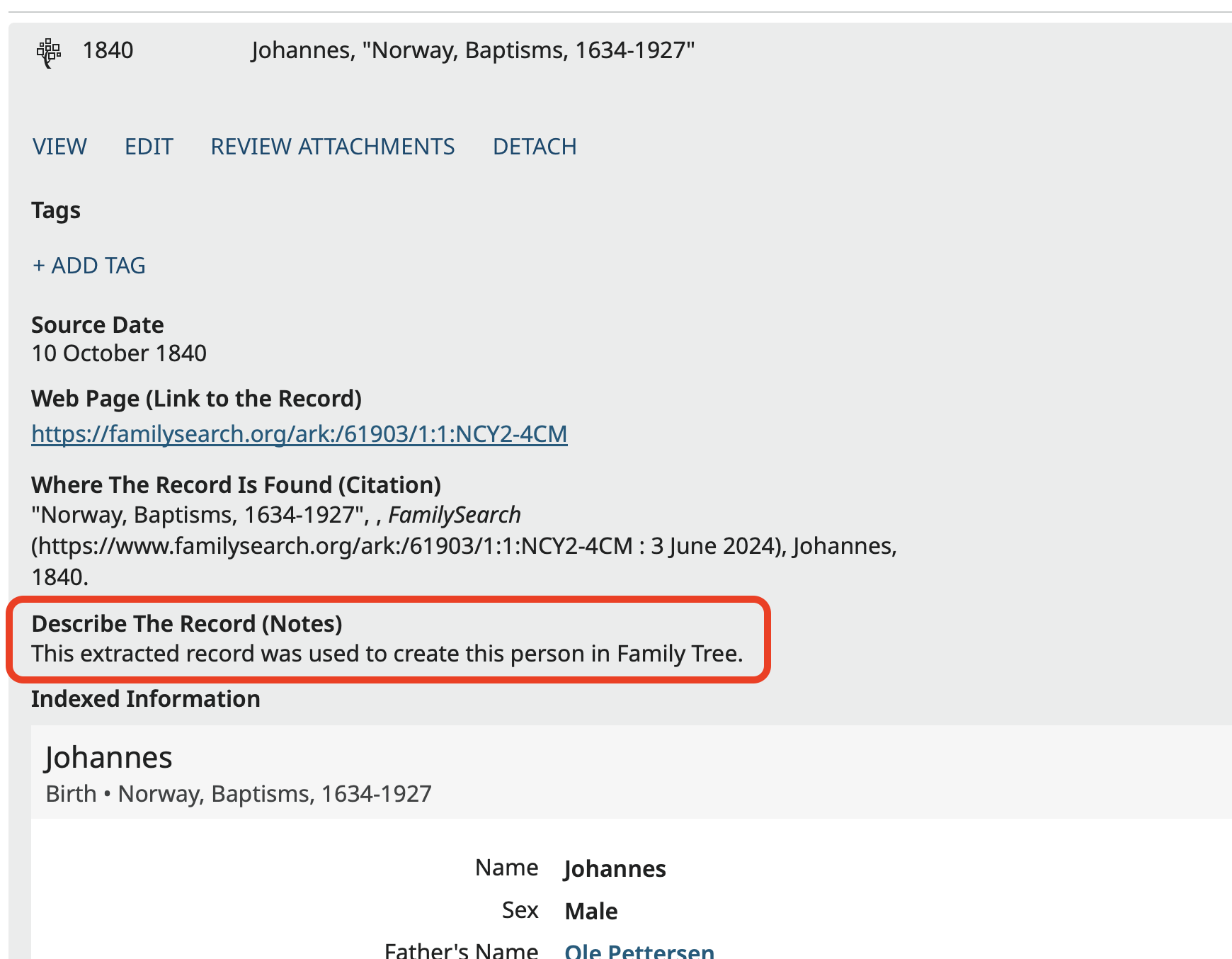
Viewing that source I see the current name in the profile it is attached to and, by opening the Document Information section, the Indexing Batch number:
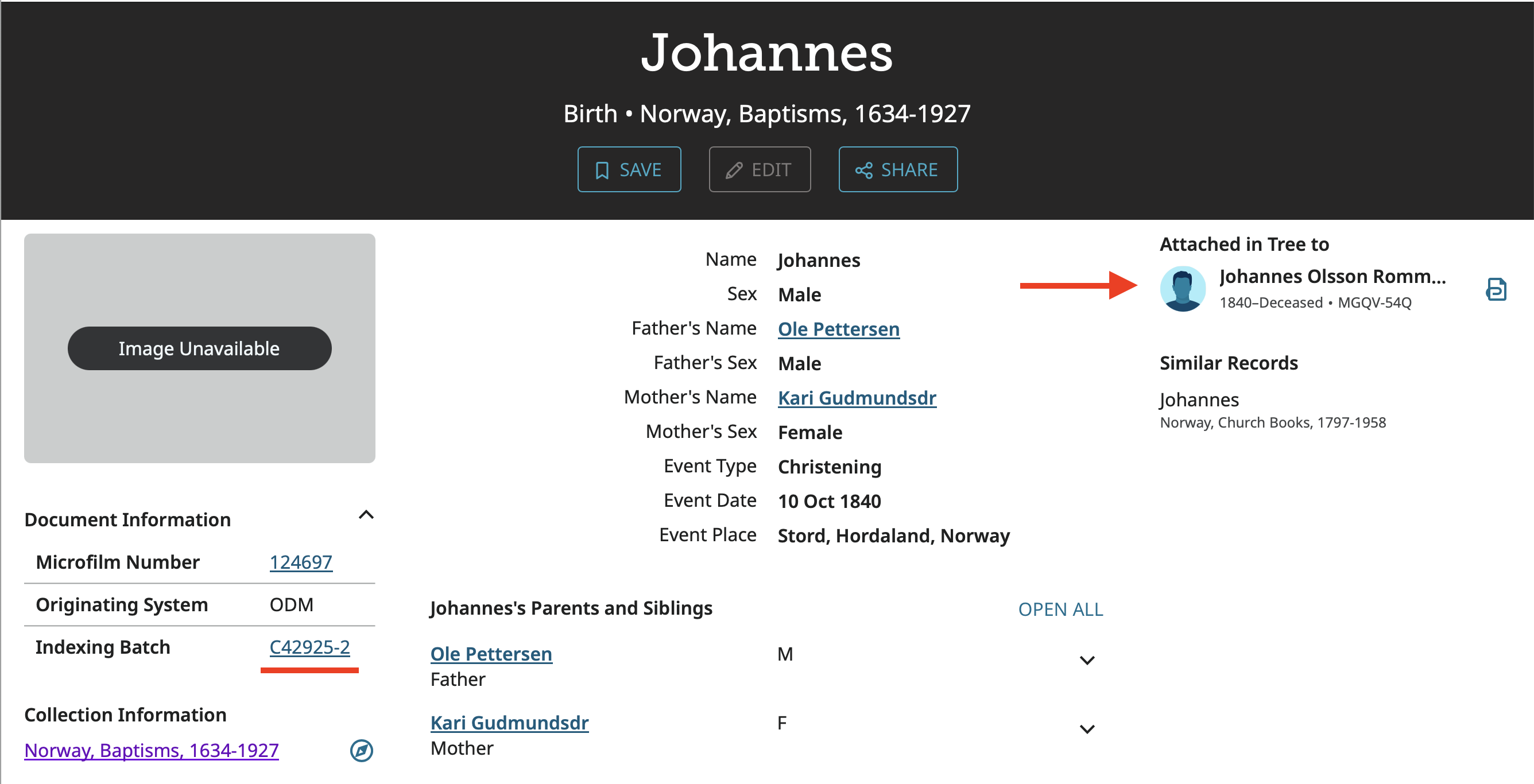
Click on the Batch number and you will jump to the records search section with the batch number already filled in:
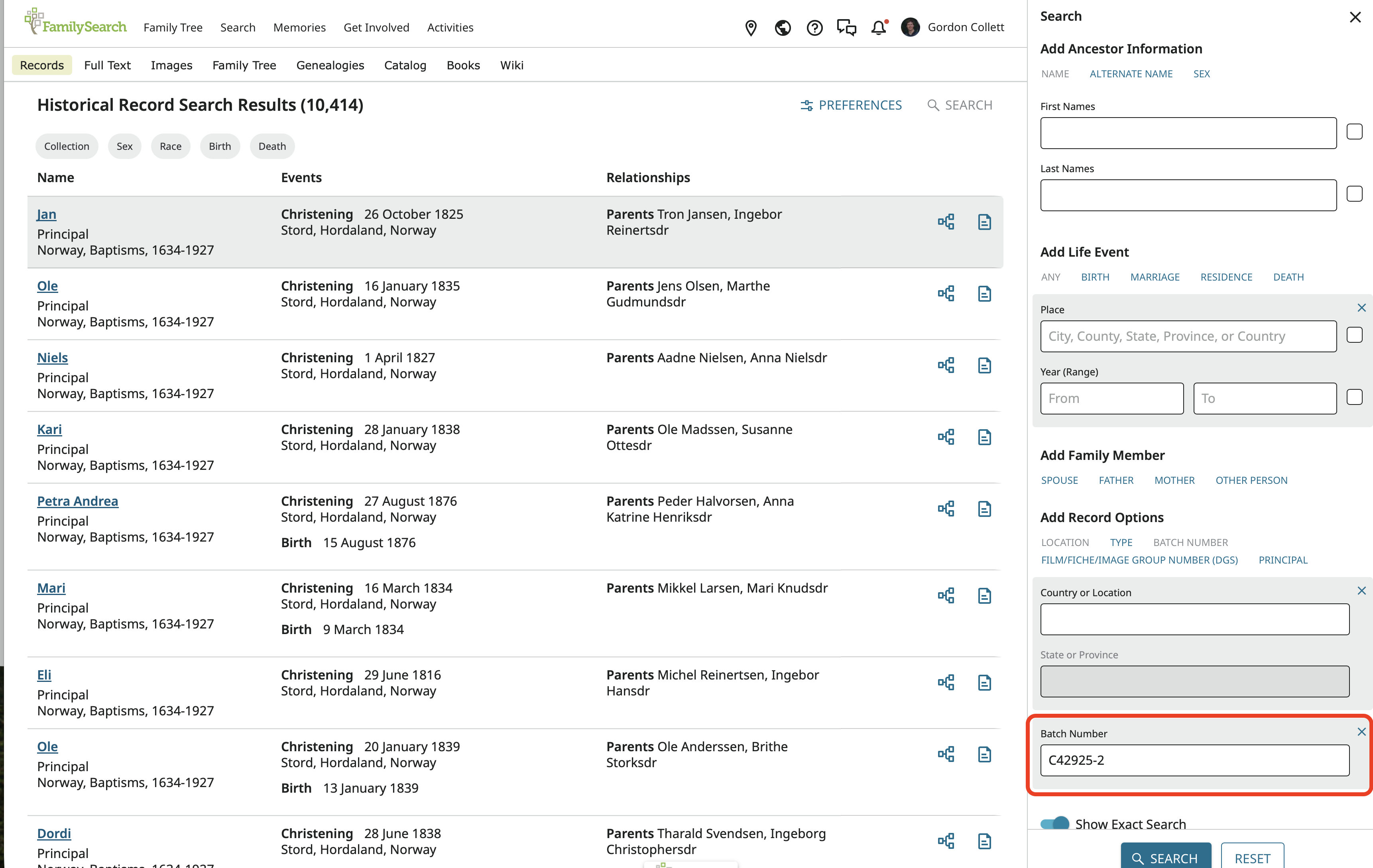
Notice that every single source is already attached to someone in Family Tree. These will be those twigs you have started running into.
Since this search localizes me to the specific parish Johannes was born in I can narrow this further to find all the twigs for his siblings by adding parent names Ol* P* and Ka* G*, using the wild card * to minimize problems with spelling variations and indexing errors:
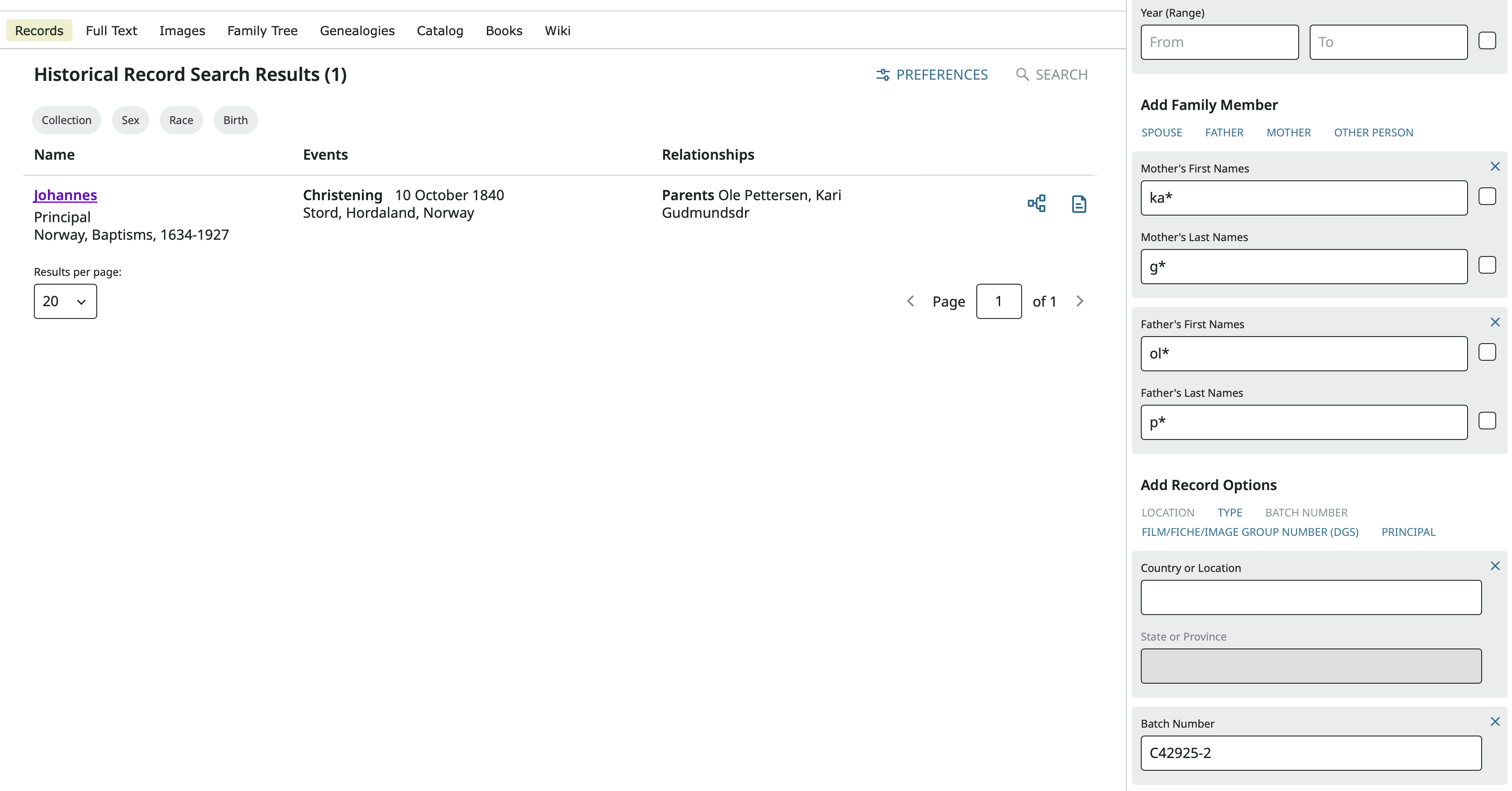
Turns out in this case that Johannes didn't have any siblings in this register. Typically the batch numbers are sequential. Here C is for christening, (M would be marriages), 42925 is the number for Stord Parish, -# is the specific register. So I'm going to increase that final number by one and search again:
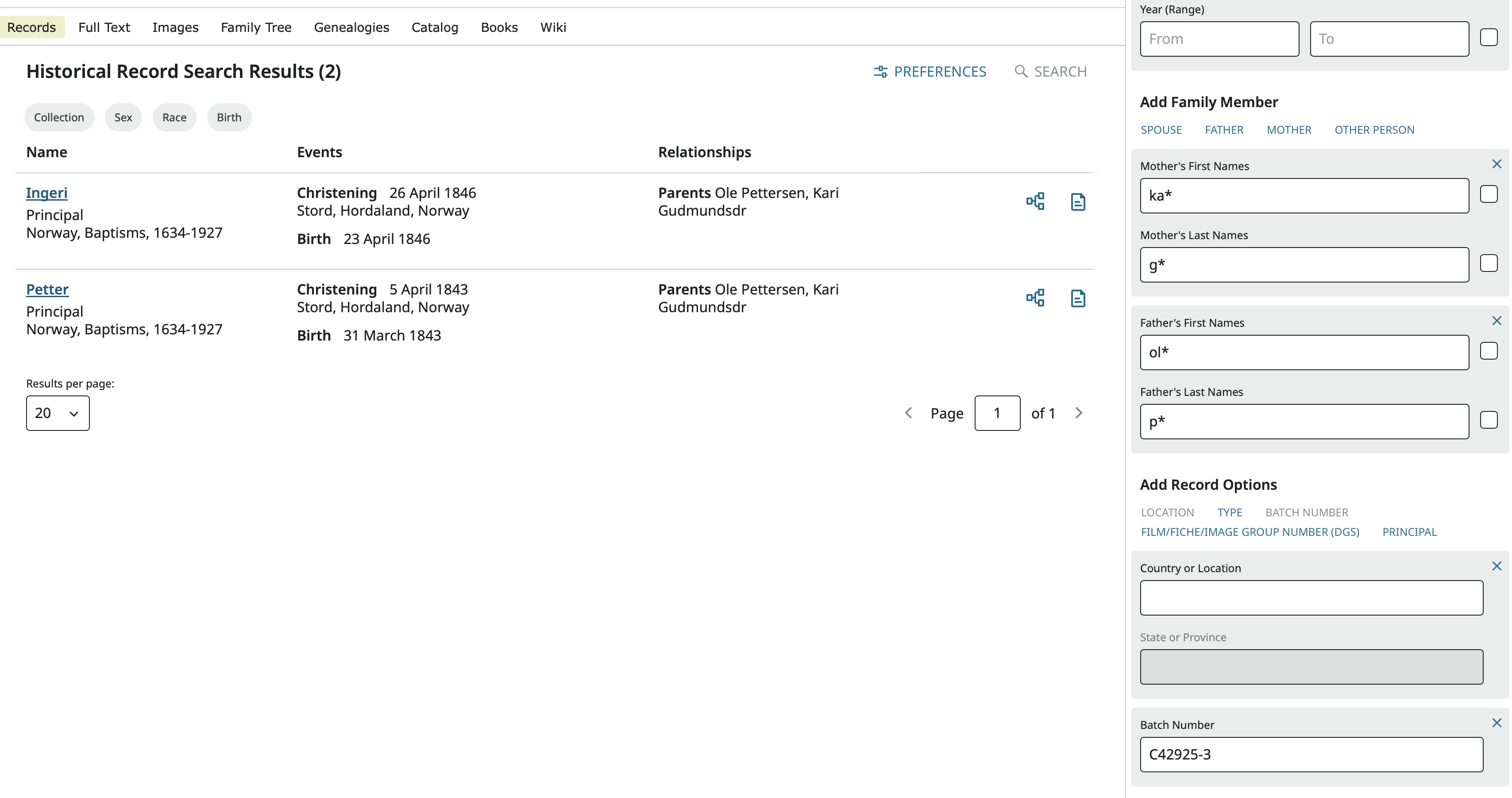
And there are the extraction batch/IGI records for his two siblings attached to the twigs in Family Tree that need to be merged into the family if that has not already happened.
Now, of course, you cannot just blindly assume that these three fathers and mothers are the same couples and merge away. You do need to confirm in some way either from census records or additional information in the original records that Johannes, Ingeri, and Petter really are siblings. In my example I would start by finding the actual microfilm image for these records because I know that the family's address is recorded there even though the extracted records show just the parish. But starting out with the knowledge that they all lived in the same parish gives some confidence that they are depending on how common the parent's names are.
I agree with Adrian that this can be tedious but it is very worthwhile work to eliminate duplicates in Family Tree. I don't remember the exact numbers, but I had one family in which the parish register was extracted twice for some reason, the duplicate parish register was extracted twice, and a couple of researchers had created very thorough family trees that were imported to Family Tree from the Pedigree Resource file. The family had about twelve children and I had to do around 120 merges to fully get to just one profile per person in Family Tree.
3 -
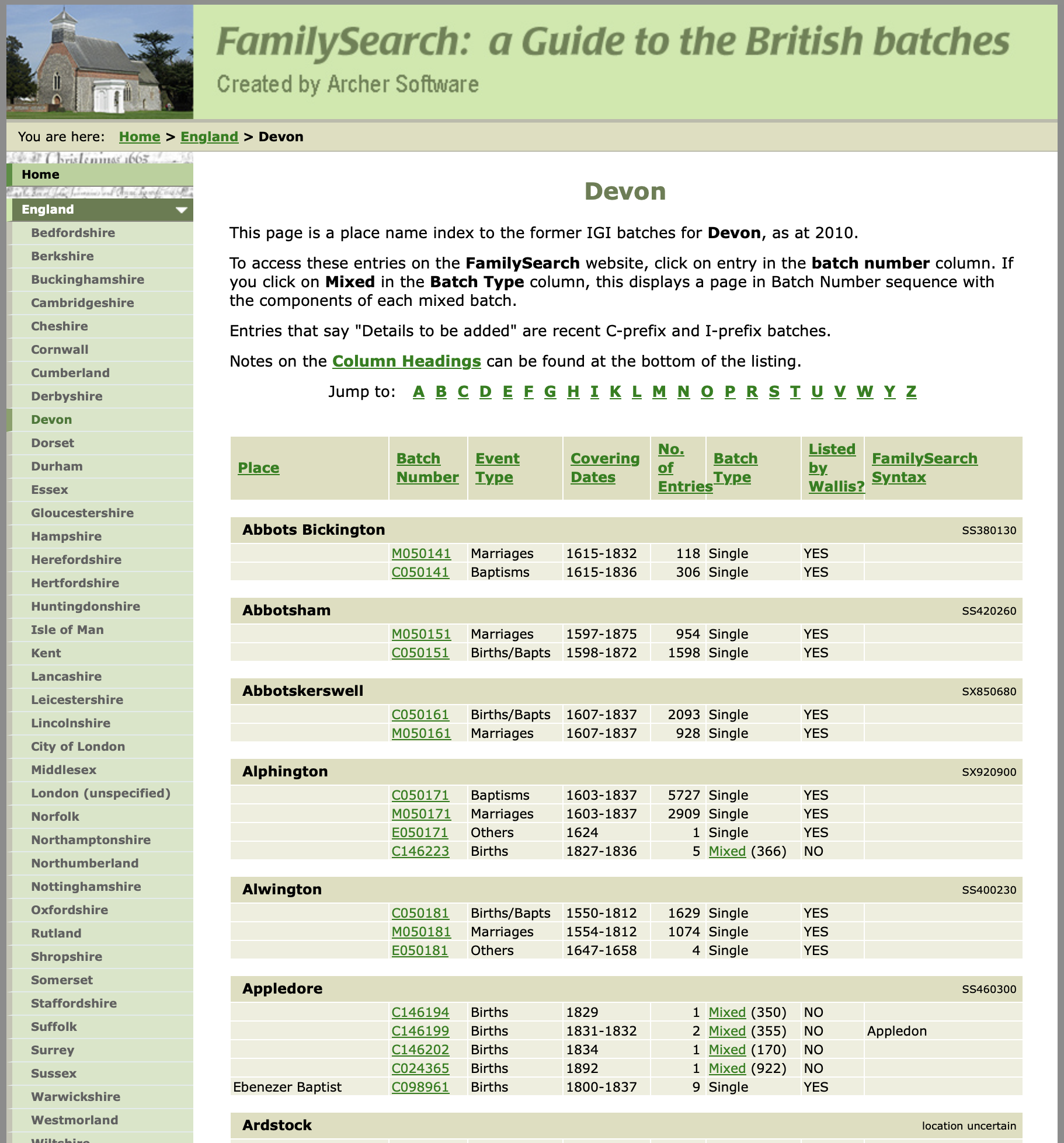
If you are lucky, someone has complied a reference for all the batch numbers for the area you are working in. For example, this website has them for the United Kingdom: http://www.archersoftware.co.uk/igi/ and has pages like this:
This looks like a good reference to sites with batch numbers: https://www.pricegen.com/global-batch-numbers-for-the-international/
2 -
All good comments, and great background by @Gordon Collett . It is awesome to look backwards in the various Genealogy programs and methods over the years used both in the Temple and in the research community; and to see them all utilized coming forward and building to the great FamilyTree we have now on FamilySearch.
The beauty of the FamilySearch program is that while all these various trees, programs and parts and pieces have all been dumped into the same stew, we now get to re-create the cow by putting these little twig pieces back together. The good news is that they were more often than not created by a currently indexed source, and by tying these people and sources together - using Merge, SourceLinker, etc. we can refine and true up the FamilyTree. (Like Gordon, I think my record was ~64 Merges into one individual.)
While doing this, always be sure to look at the source image if available and glean out any other relevant information - additional family, occupation, residence, etc - this will help prove out future sources/merges especially with common names, and the likes. By making note of these finer details, you can have even more confidence in the research and sourcing and linking of your area of the FamilyTree you are helping build.
1
