Discussion: Unsourced profiles from the 1700s and earlier

Can we talk about the profiles in the family tree, usually from the 1700s or earlier, with no sources? They generally lack any information other than names and relationships, and sometimes a birth country. Because of the lack of sources and information, I don't know where we arrived at this name being an ancestor of mine.
How can we work as a group to clean up and source these profiles?
Answers
-
Sure. First thing is to take a look at their creation date. If it is 2012, then these are imports from previous systems. Some of those older systems, such as the IGI, did not include sources so there was nothing to import. In the older systems that might have allowed for sources, those sources were either not imported or imported badly as Legacy sources. Keep in mind that Family Tree contains everything submitted to FamilySearch, formerly called the Genealogical Society of Utah, since it was organized in 1894 as well as even earlier records from the Church of Jesus Christ of Latter-day Saints.
If you have access to the database in FamilySearch called "Family Group Records Collection, Archives Section, 1942-1969," then you can see the family group sheets that were originally submitted during that time period. These will often have sources on them. Due to standard practices then, these can be rather cryptic looking.
If you have access to the Ordinance tab on Family Tree profiles then you can also get an indication of when the initial research was done on an individual. For example, I have a 4th great-grandfather who died in 1813 and the earliest date for him on that tab is 1888 so the information about him and his family relationships was first submitted to what would become FamilySearch in 1888. No, there are no sources connected with that submission.
Really the only thing we can do about the profiles you refer to is take individual responsibility to trace back step by step to reconstruct the original work, documenting it this time, and using the little bread crumbs currently present on the profiles as whatever guide they can be. We have much better resources than anyone back in, say, 1910, so if someone traced a connection then, we should be able to do so now.
This isn't a group project unless you can get in contact with cousins of various sorts who also trace back to these people and who have an interest in helping out with your project.
Do you have a specific example of one of these profiles you are referring to? People here might be able to give some concrete examples of what can be learned from it.
5 -
Thank you so much! I did not know this so it is very helpful.
Some random examples from my branch of the family tree:- Dayle Hargrave (LJ5B-KNF), 1600–1670, born in England, died in France
- Fortunata Eusebia Proto (LK3Q-618), 1660–1760, born in Italy, died in France
- Thomas Vincente (MLVB-3MQ), 1568–about 1609, born in Spain, died in England
Thanks again for all your help and God bless!
0 -
- Dayle Hargrave (LJ5B-KNF), 1600–1670, born in England, died in France:
Going to the Change Log you can see that this profile was created by a Family Tree user on October 14, 2014. Since that initial user, 20 other users have worked on it. I'm a bit surprised and disappointed that not one of them has put on any sources. There is a reference to Ancestry in a Reason Statement under her death that isn't much help. All you can do here is start trying to contact them through the Chat system and see if any of them have sources or are just copying this from other online trees.
- Fortunata Eusebia Proto (LK3Q-618), 1660–1760, born in Italy, died in France:
Same situation. Created June 7, 2015, worked on by a dozen or so different users, none of who seem to have grasped the concept of Family Tree sourcing.
- Thomas Vincente (MLVB-3MQ), 1568–about 1609, born in Spain, died in England
Here is a different situation. When you look at one of the two sources on Thomas' record you see this:
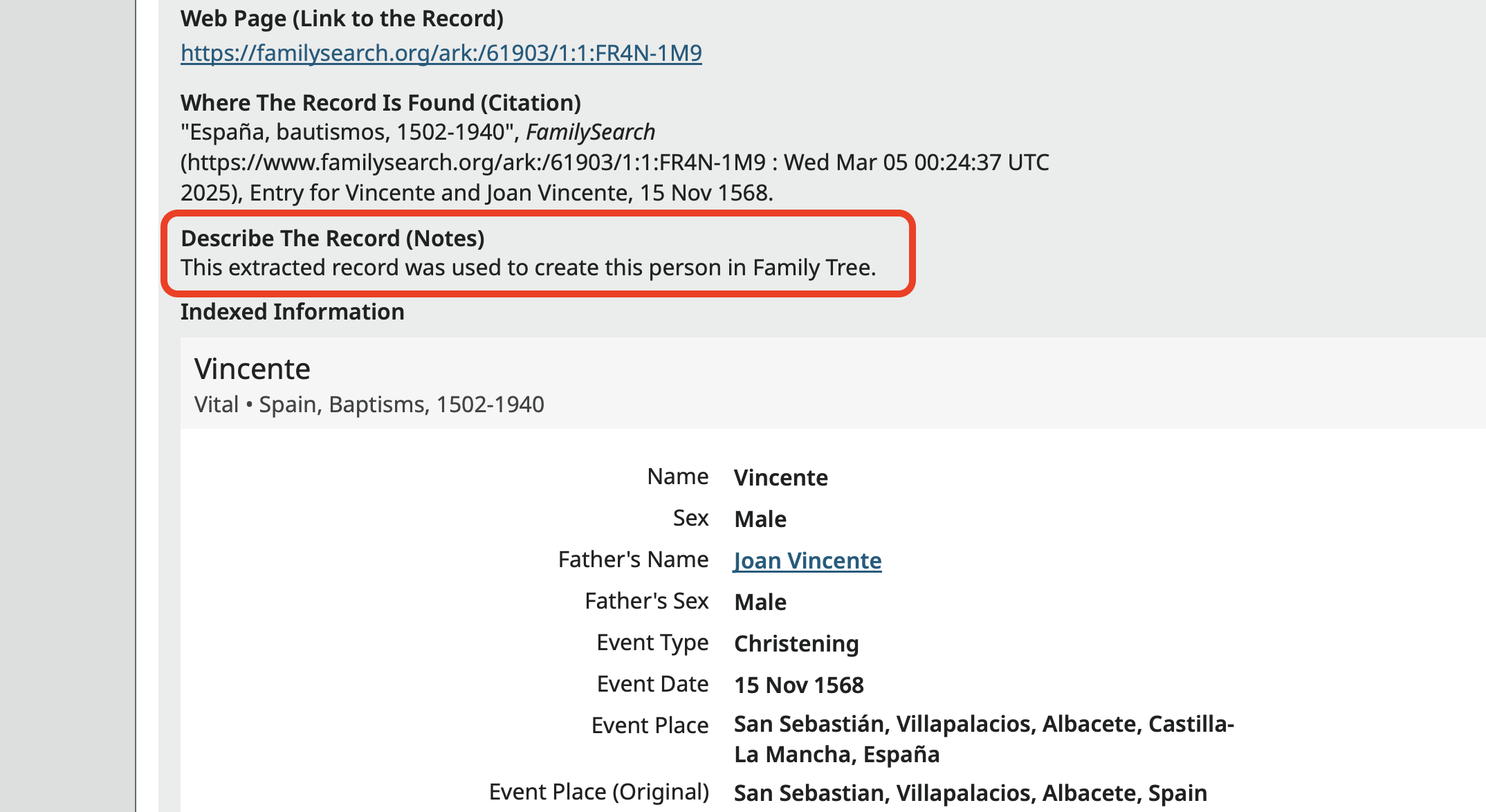
From the early 1970's to about the early 2000's or so, FamilySearch's extraction program, a predecessor to the indexing program had volunteers go through sets of microfilmed records and copy out the information in them for birth/christening and marriages. These would end up in the International Genealogical Index which was one of the sources for profiles in Family Tree when Family Tree was created in 2012. This is high quality information and you can track it back directly to the original data source by looking at the web page for the source:
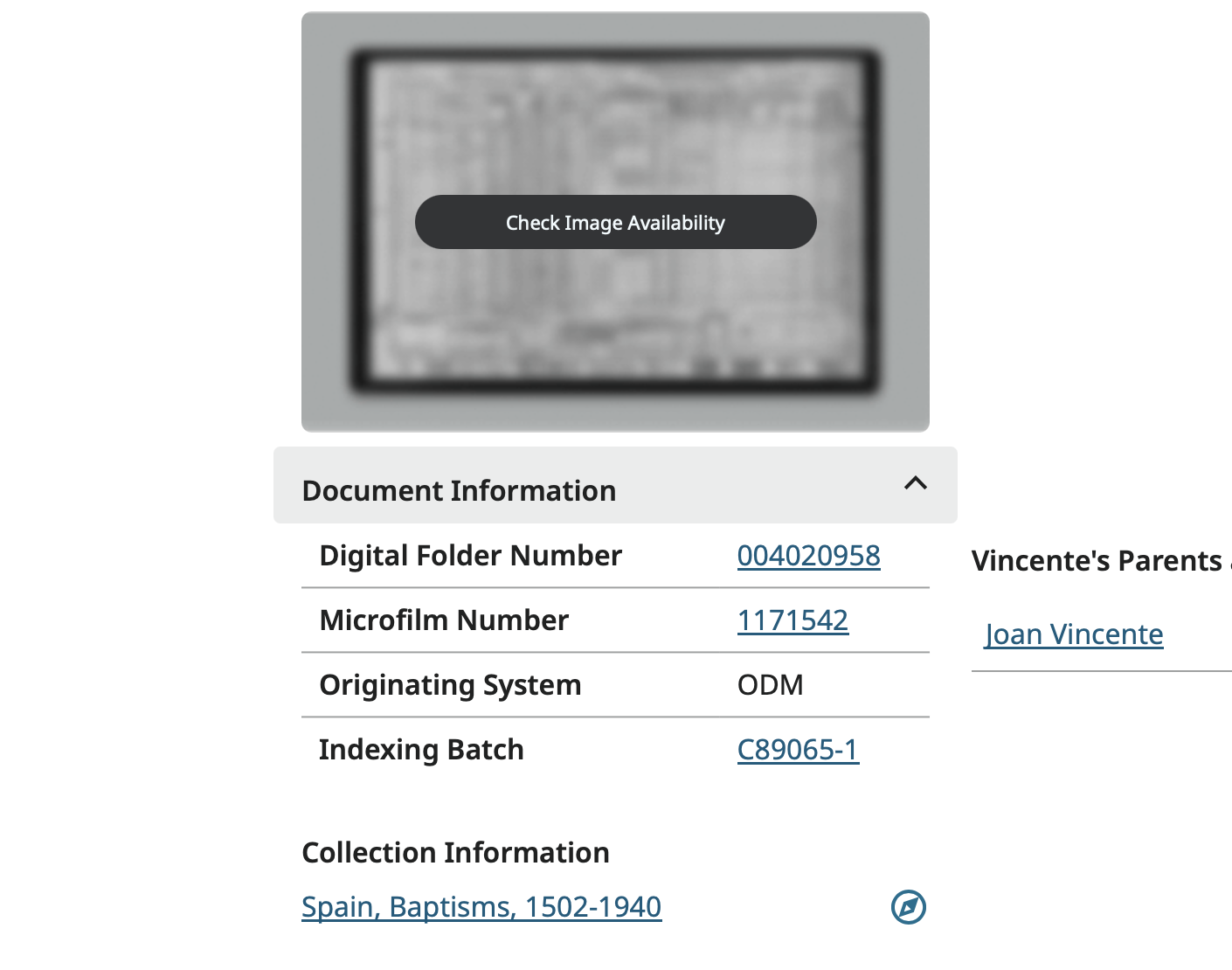
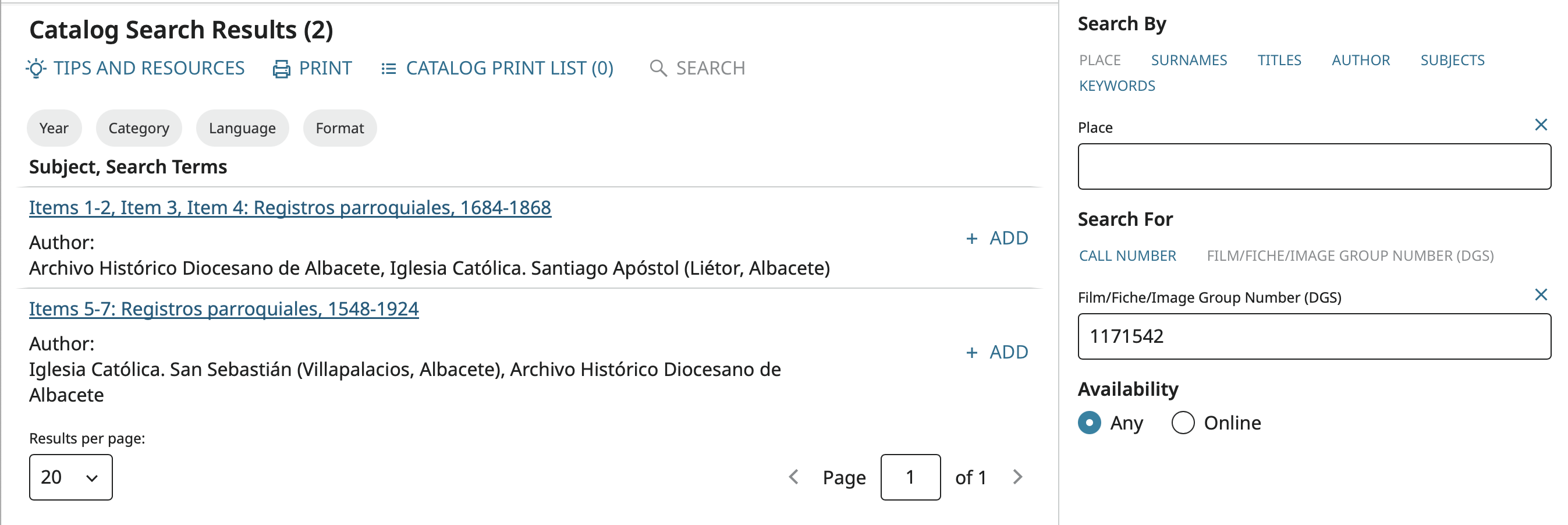
You can use the microfilm number to look this up in the FamilySearch catalog:
You can learn more about these extracted records in this presentation:
When this profile was originally imported into Family Tree, it contained only the information found in the extracted record, that is, the child's first name, the father's name, and the christening date and place and it would have matched the information in that source exactly.
The other source on his record looks to be a duplicate of the first source because it has the identical information but that one is linked to the image so you don't have to go searching for it.
Then, unfortunately, things fall apart. User's start changing parents, adding spouses and children, deleting family relationships, doing merges, all without giving any sources, reasons, or justifications. Once again all you can do is contact those other users and ask why they think any of this is correct and ask them for their sources. My fear would be they are just copying out of unsourced online trees. That doesn't mean the information is incorrect, but it does mean you are going to have to start with your own profile and go back step by step through the generations until you get to Thomas and document and source every connection.
One of the goals with Family Tree is for us to build such good, solid documentation on our profiles that users can trust what has been previously researched and not have to have the same information researched over and over and over again. That is not happening in your examples.
3 -
I would advise that in a case like these, you need to spread your net wider than just FamilySearch. For instance, acting on what @Gordon Collett said, I had a quick look in Ancestry and Dayle Hargrave (because it's such an unusual name) does bring up several responses in a full search of Ancestry.
This includes the gold dust of a genuine marriage record (index and image) for her. It's in Ancestry's West Yorkshire, England, Church of England Baptisms, Marriages and Burials, 1512-1812, and records her marriage in November 1670 (the day of the month has not been deciphered) at St. John the Baptist, Royston, Yorkshire, to Thomas Thicket. Now, issue 1 is that you need to get your eye in on the writing of that period, but the groom's name looks fine and he appears to come from the parish of Silkston (now Silkstone?). The bride's given name baffles me - I've never heard of the name "Dayle" in that era, but who knows? She does appear to come from the parish of Burton - in this context, that's where she was living at that point, not where she was born.
Having said that, everything else looks a mess - she's in (literally) hundreds of Ancestry trees, some of which show her as dying in 1643 before her marriage in 1670. Someone in Ancestry decided everything would make more sense for their tree if she married in 1620 - unfortunately the Ancestry images are clear that it's 1670, not least because the preceding year is 1669. (The 1620 nonsense gets into the Geneanet tree as well. I shall presume that people couldn't read the original register because it wasn't immediately available, rather than someone decided that the original register must be wrong because it didn't fit their view of the world. Oh yes, it happens….)
Frankly, everything is such a mess everywhere that one or two nuggets of gold aren't going to illuminate anything, I fear. Good luck - I fear your investigations need to start much later in date.
4 -
And keep in mind, one major question is going to be whether that marriage record on Ancestry has anything to do at all with the woman of that name whose profile you are looking at in Family Tree or if it is for a completely different woman of the same unusual name.
3 -
@Gordon Collett makes an excellent point about the tendency some people have to assume that two people with the same name are the same person. On some of those Ancestry trees, it's perhaps even worse as I fear that there might have been wishful thinking about whether a French and English name are the same.
@TheWaters13 - to be honest, I would question whether there is any benefit in thinking about cleaning up Dayle's profile before you ensure that you have a solid, fully sourced,basis in the later centuries of your ancestry. Jumping in at that point, even with a genuine marriage, could be a waste of time - especially if my gut feeling that the name in that image just isn't Dayle, is true. The image is so messy over her name - I had the distinct feeling that the name actually ends in a double -s. But I am not happy with my ability to read that style of writing...
2 -
On some of those Ancestry trees, it's perhaps even worse as I fear that there might have been wishful thinking about whether a French and English name are the same.
It's as bad as you can possibly fear and much worse. Ancestry is both the best and worst thing that's happened to Genealogy: it sparked a wider interest in it, but attracted hobbyists who are less concerned with accuracy than just making their tree big (and to find some way they can claim to be related to a celebrity, descended from nobility and/or are part Native American). If the info looks like it fits, they don't ask what the source is or whether it's correct. They don't look for mistakes or problems in their trees because they don't want to find them.
Ancestry is a business. They know that if users feel like they're making progress, they'll keep paying for memberships. Most of their site functionality is built for growing trees as easily as possible, not for identifying errors. Central to Ancestry's design is the ability other user's trees to yours. Ancestry encourages this — it's usually the first "hint" on an ancestor's page. Since the trees are personal and people are usually trying to grow them, they frequently include unverified information copied from unknown sources, pure speculation and many mistakes, Ancestry treats them as sources, on equal footing with legit primary sources like birth, christening, marriage and death records, census reports, wills, as well as putrid garbage piles like the U.S. & International Marriage Database, Geneanet, genealogie, Find a Grave, Family Data Collection, etc.
And it gets even worse. After encouraging users to fill the holes in their trees by copying whatever horrific trash they can find in other trees, Ancestry then basis what it considers 'the truth' on whatever appears most frequently in user trees, using it as the basis for their Historical Person Pages, as the structure for ThruLines DNA matching, and to suggest "potential ancestors", creating a feedback loop that ensure past mistakes are enshrined forever.
That's why I think the marriage record Gordon found is the actual original source for Dayle Hargrave (which somebody on FS interpreted as "Gayle Hargreave"), because I've seen this kind of broken telephone play out the same way several times already. Somebody finds a record that sort of fits — maybe in this case they legitimately thought it was this same couple and the marriage happened in England. So it gets added to their tree. Somebody else copies it to their tree, but changes a few details because they think the couple was in France at the time. Maybe they don't even see the original source, or maybe they see it and decide they can just copy what fits their tree and ignore what doesn't, something I've seen happen with depressing regularity.
Eventually other people with the same gap in their tree sees that someone who must be pretty smart found the missing info, so they copy it to their trees maybe tweaking the details further. Eventually the only information left from the original source is 'Thomas married Dayle Hargrave'. That how we end up with ridiculous messes like this: two generations of Thomas Tinquets that coincidentally both married a Dayle (or Dina) Hargrave, died in 1679, and had sons named William (despite being French) born in 1648 — and it's why this has been in FS for more than a decade and nobody's provided a single reputable source to prove this whole section of the tree isn't basically fiction at this point.
0
