
Translation

https://www.familysearch.org/ark:/61903/3:1:3QHV-532H-2KJ1?cat=olib%3A4114055&i=5&lang=en
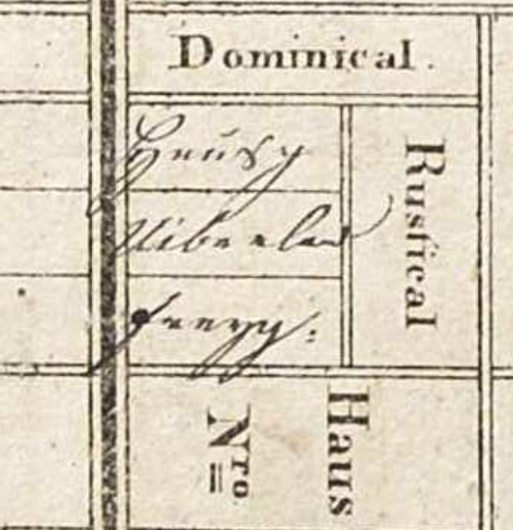
I'm looking at a land record from Triesch, Moravia, written in German, and I'm having trouble translating the handwritten entries under the "Rustical" section. My best guesses at the words are heňsy, Uibenler, and frezy, but I can't find any German terms that seem to match them.
I know that rustical land refers to property held or owned by non-nobles, and I've checked the helpful guide on the Czech FamilySearch site about the cadastre maps, but it doesn't cover the terminology used in the actual land books.
I would appreciate any help interpreting these handwritten terms. I know this type of record isn't very common in Germany, so I appreicate any help or guidance you could provide. Thank you.
Best Answer
-
Hello @ccr1107,
I haven't had much success in deciphering these terms. One thing to note is that Moravia in 1835 (which is the year on the title-page of this register (see image 4) was part of the Austrian Empire so these terms are likely Austrian-German terms.
I found a similar form in an Austrian book I have in my own collection where the three words under the word "Rustical" are printed, not handwritten.
Here are the terms as printed under "Rustical" in my book:
Haus Grund = house land; house plot; house parcel.
Haus Uiberland
Freier Uiberland
The word "Uiberland" in the next two terms is unusual. I could not find it in any dictionary and I wonder if it is an alternate spelling of the word "Überland"?
Reinhard Riepl, Wörterbuch zur Familien- und Heimatsforschung in Bayern und Österreich (3rd ed., 2009) defines "Haus Überland" (which he spells a one word) as: a piece of land that, while not part of the house's grounds (and having its own land register), was inextricably linked to the house and (in Austria) subject to its own land service and its own rights.
Unfortunately Riepl does not provide a definition for the third term, which when I put it into Deepl as "Freierüberland" it translates as: open countryside; and when entered as" Freier Überland" it translates as open country.
Hopefully this will give you some sense of these terms in your 1835 record for Triesch.
0
Answers
-
Yes, this is extremely helpful! I suspected the first category might refer to the house, but I wasn’t sure what the other two could represent. My ancestor owned numerous plots in and around Triesch—mostly rural—and I’ve only seen the 1st and 3rd categories chosen so far. As far as I know, he would have had only one house and possibly a workshop, as he was a master cloth maker. However, it seems he also held several farm fields, a few small gardens, some wooded parcels, and a number of meadows.
With your help, I’ll try to look for patterns to understand why they sometimes use an “x” or a “1” in the columns and how that relates to selecting the different categories. Once again, your additional help is greatly appreciated.
0