Norway Help Translation Birth Record

I'm working on Christian Christiansen (LC3N-VNG) family and parents. I think I found the birth record. Can someone translate page 11, line 203? I'm having a hard time reading the fathers last name, but you can also check everything else I'm translating. Thanks!
What I think it says:
Birth: 9 July 1842
Christening: 7 August 1842
Child Name: Christian
The parents were married
Father: Christian (I can't read the last name. This is what I need the help the most). Could Christian last name Tørrissen?
Mother: Kari Pedersdatter
Parish: Trongaarden
https://media.digitalarkivet.no/view/9163/14
Comments
-
Looks great. The only thing I would change is that Trongaarden is the farm, not a parish. I'm not sure, but I think the letters just after the child's name (X, A, V) might represent the sogn (Hof, Åsnes, Våler) which would also be the church the christening took place at. I'm just not sure why the priest used an X rather than an H. Maybe because that indicated Hof was the hovedsogn.
Depending on the translators preference, sogn will be translated as parish or local parish while the next level up, Hof prestegjed, will be translated as clerical district or parish.
And you are correct. The father's name is Christian Tørrissen Trongaarden. You can see the umlaut over the o which was the older way of writting ø, the dot for the i almost of the first s, and the double ss written as a short s followed by a long s.
1 -
Thank you for replying to confirm my record.
If you can answer another question to help me. I haven't done family history for six months and need a refresher. What is the difference between parish and farm? Usually it goes Country, County, Parish, then Farm? Is parish like the church and farm is the farm land they are on?
Thanks!
[name removed]
0 -
In the following I'll just be talking about rural areas. Large cities are a bit different.
There are actually three ways to fully describe a place a Norway and the complete description has more than the traditional genealogical description of four levels. Different users here have different ideas about how complete to be but it is good to be aware of the whole place name and to know that you can use just as much of it as you wish in Family Tree.
The three full, complete names are:
A. Ecclesiastical: Bruk, Gård, Sogn, Prestegjeld, Prosti, Bispedømme, Land (Sub-farm, Farm, Parish aka local parish aka sub-parish, Parish aka Clerical District, Deanery, Diocese, Country.
B. Civil: Bruk, Gård, Kommune, Fylke, Land (Sub-farm, Farm, Municipality, County, Country.
C. A mixture of the two: Bruk, Gård, Sogn, Prestegjeld, Kommune, Fylke, Land (Sub-farm, Farm, Parish aka local parish aka sub-parish) Parish aka Clerical District, Municipality, County, Country.
A Farm is just that. An area of agricultural land. Many farms were quite large and most were divided into several sections or sub-farms called Bruk. Each sub-farm would be owned by a different farmer or rented out to a tenant farmer by one of the farm owners.
For example, if you go to this website: https://www.dokpro.uio.no/cgi-bin/stad/matr50 and work down from Hedmark to Åsnes, to Trongaarden, you will see that in this properly list from 1950 it is farm 113 and is divided between the 21different owners of the 21 named bruk.
A Sogn or Parish aka local parish aka sub-parish (I like to stick with the Norwegian term Sogn so there is no confusion about whether I am talking about a parish or a parish) was a division of the Norwegian church. It would cover anywhere from a couple of dozen to many dozen farms. Each sogn would have a church which was usually called by the same name.
A Prestegjeld or Parish aka clerical district was a larger division of the church which was made up of one to about five sogn. Generally each prestegjeld had just one priest who would travel around to the various churches in the sogn on a rotating basis.
If you look closely at the parish register, you see that small letter after the children's names. As I said above, I'm pretty sure that means that on July 17 the priest was at Våler church in Våler sogn and christened all those kids, then on July 24 he was first at Åsnes church in Åsnes sogn and christened several but was also able to make it to Hof church and christen two more. July 31 was a busy day and he was at both Hof and Våler. August 7 he spent the whole day at Åsnes and christened Christian among others.
I have never seen anyone use the full ecclesiastical name, so I won't bother looking up the Prosti or Bispedømme Hof prestegjeld was in.
The parish register does not state which bruk in Trongaarden your family lived, so unless you find that in the proper records, version C of the place name for them is:
Trongaarden Gård, Åsnes Sogn, Hof Prestegjeld, Hof Kommune, Hedmark Fylke, Norway or to use the convention of dropping descriptors Trongaarden, Åsnes, Hof, Hof, Hedmark, Norway
Kommune or municipalities are civil divisions that were created in 1838. The process was pretty straightforward. In almost all cases, a municipality had the same boundaries as a parish and was given the same name as the parish. For example when created in 1838, Hof Kommune had the same boundaries as Hof prestegjeld. (In 1849 it was divided into Hof Kommune and Åsnes og Våler Kommune so after 1848 your family was living in Åsnes og Våler, not Hof. In 1854 Åsnes og Våler Kommune was divided into Åsnes Kommune and Våler Kommune.)
So the strictly civil name for where your family lived, which is the form I usually use, is:
Trongaarden Gård, Hof Kommune, Hedmark Fylke, Norway or Trongaarden, Hof, Hedmark, Norway.
Prior to 1838 where there were no Kommune, you have to use the parish instead, that is, Trongaarden Gård, Hof Prestegjeld, Hedmark Fylke, Norway or Trongaarden, Hof, Hedmark, Norway.
1 -
Here is an illustration of the relationship between the areas. The lines I have drawn are approximate as the placement of the churches.
Here are the the current Bruk that are part of farm 113 Trongarden:
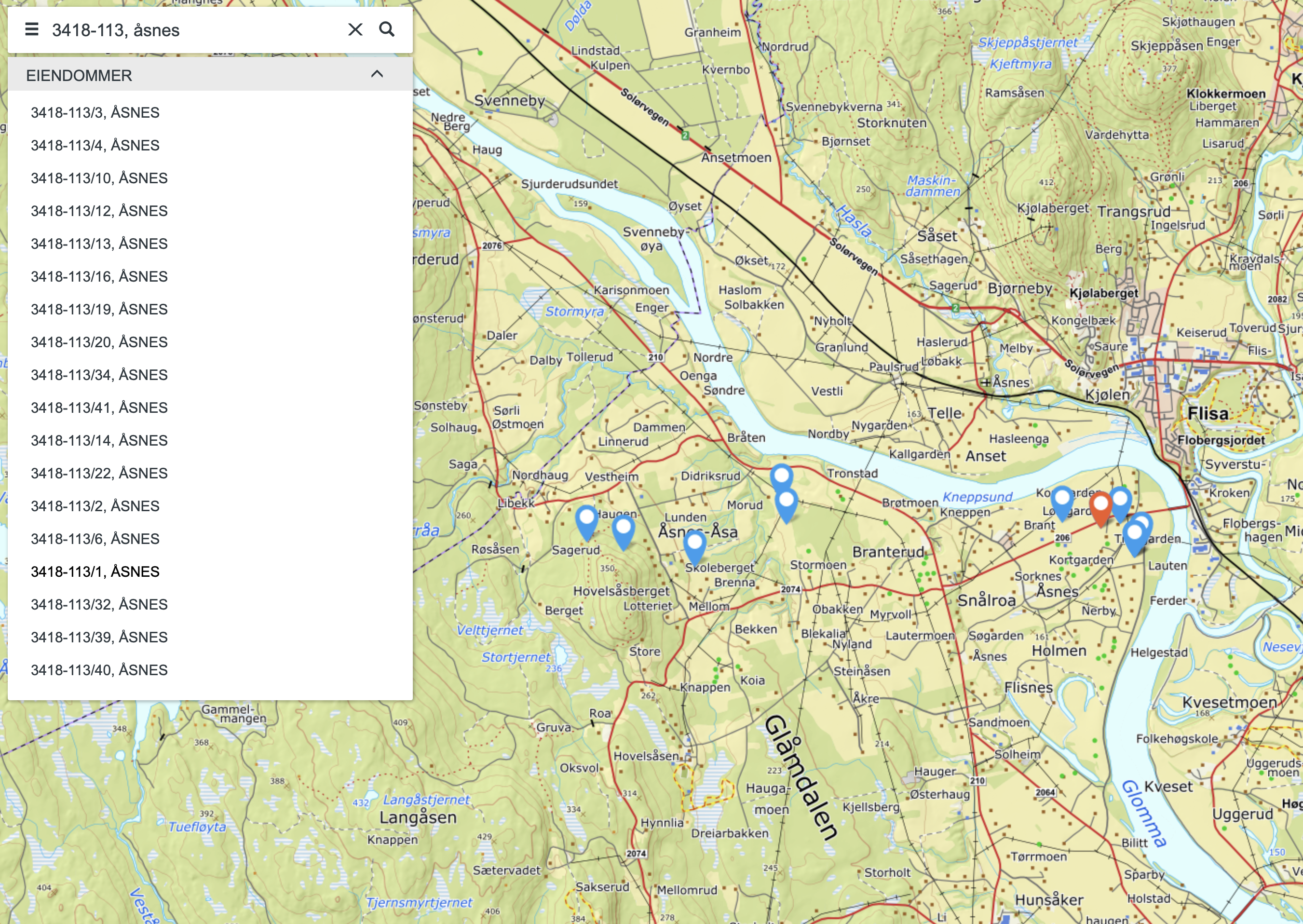
You can get a sense of the area the original farm covered. It was not necessary one contiguous piece of land. Bruk 1, which would have been the main part of the farm is at the red marker.
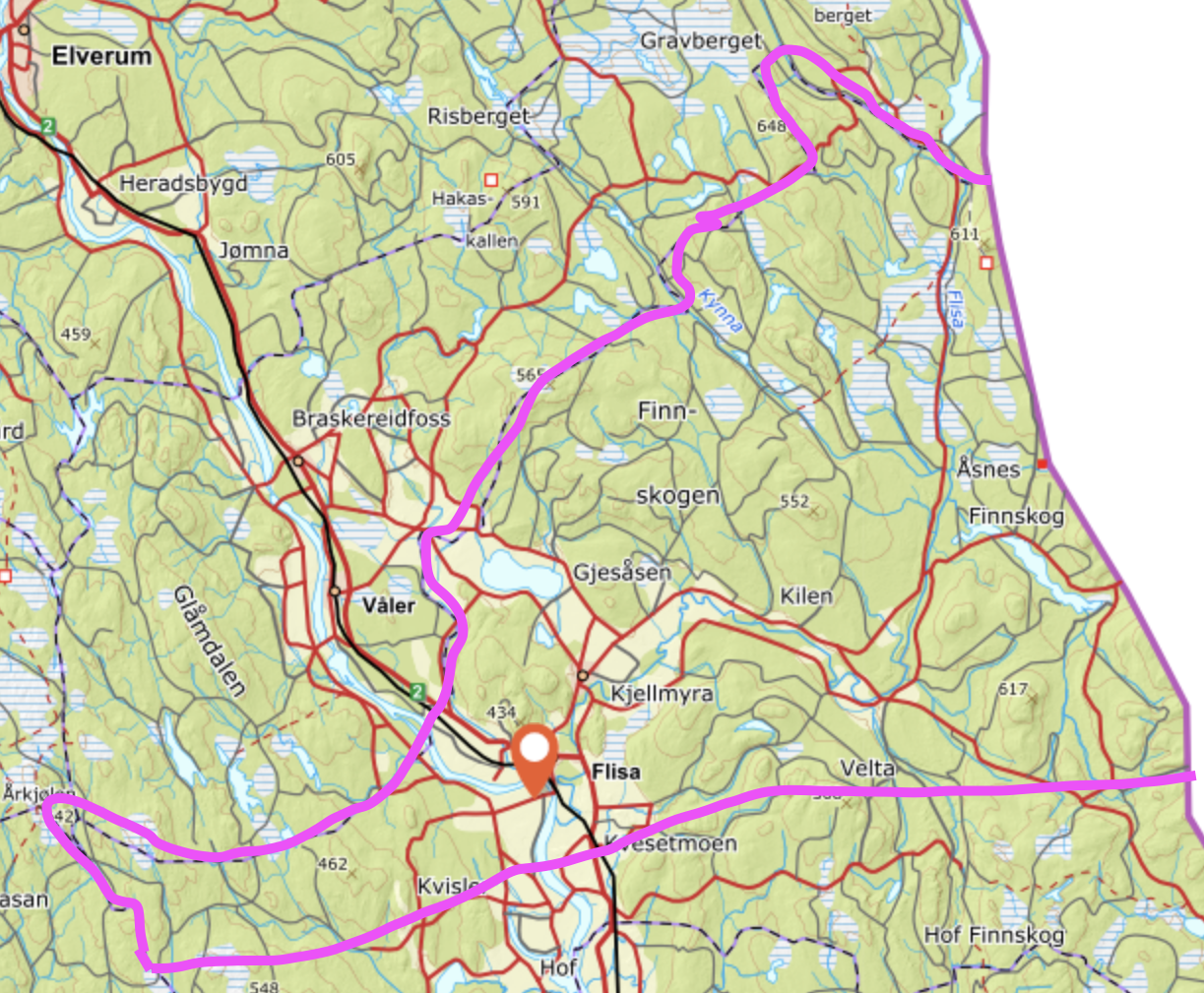
Here are the approximate boundaries of Åsnes Sogn (Parish) in the 1870s. It is larger today because Hof municipality was merged into it in 1965. You can see that Trongarden is just one of over 100 farms in the sogn:
And finally, here are the approximate boundaries of Hof Prestegjeld (Parish) that in 1838 became Hof Kommune. This is the size of the municipality before it was divided over the years as explained above and then finally discontinued when it was merged into Åsnes:
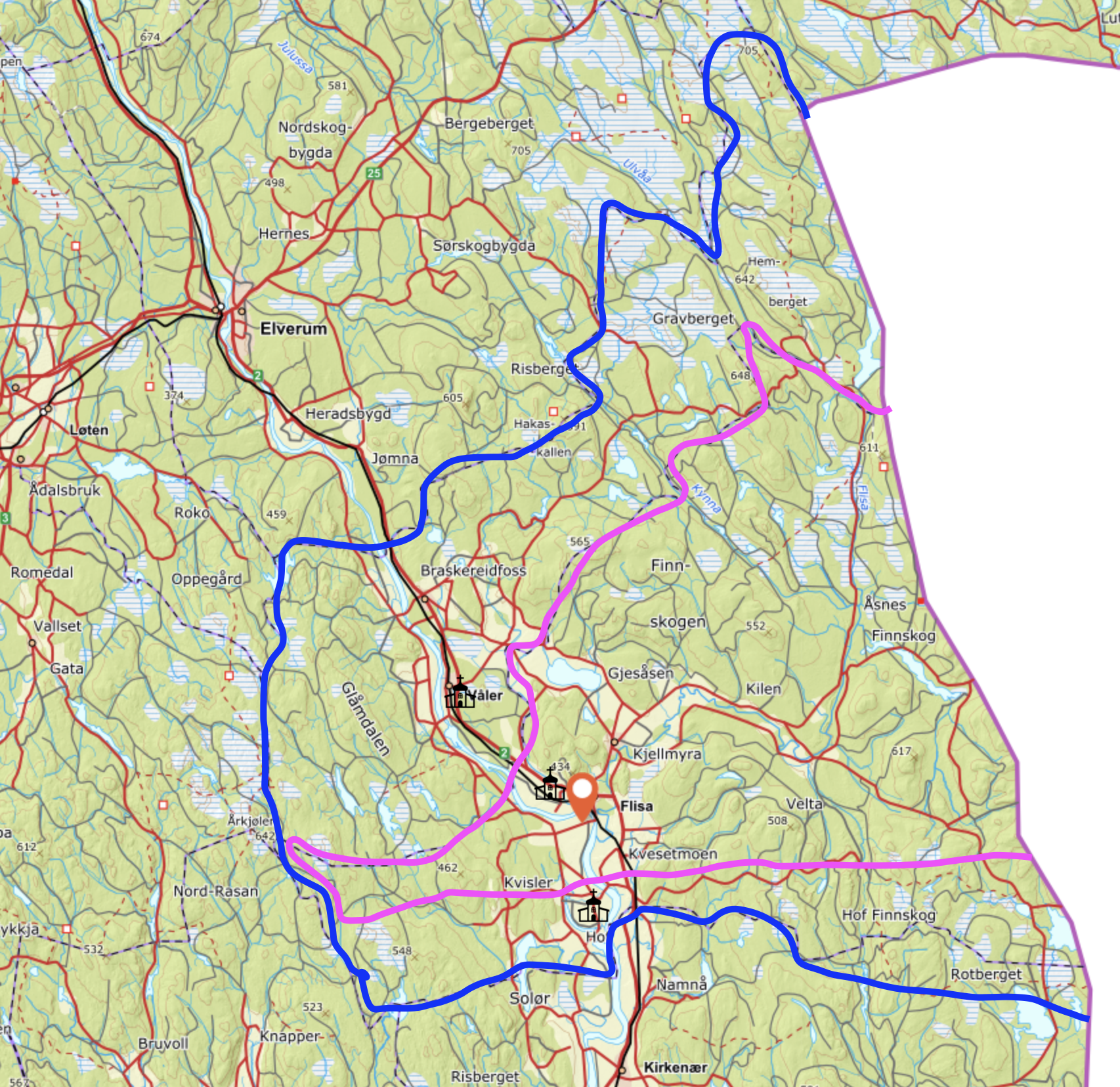
Here I have also place markers for, from top to bottom, Våler church, Åsnes church, and Hof church. The area above the upper pink line was Våler sogn and the area below the lower pink line was Hof sogn.
0 -
Mod note: This discussion was edited toremove personal information for privacy reasons. Please see the Community Code of Conduct for more details.
0 -
Thanks for replying on 10/27. It been a very busy week with work and finally reading your comments. Thank you so much so I can continue working on family history.
0