Stillbirths

Hier geht es um eine weibliclhe Totgeburt.
https://www.familysearch.org/de/tree/person/details/P7CT-MBH
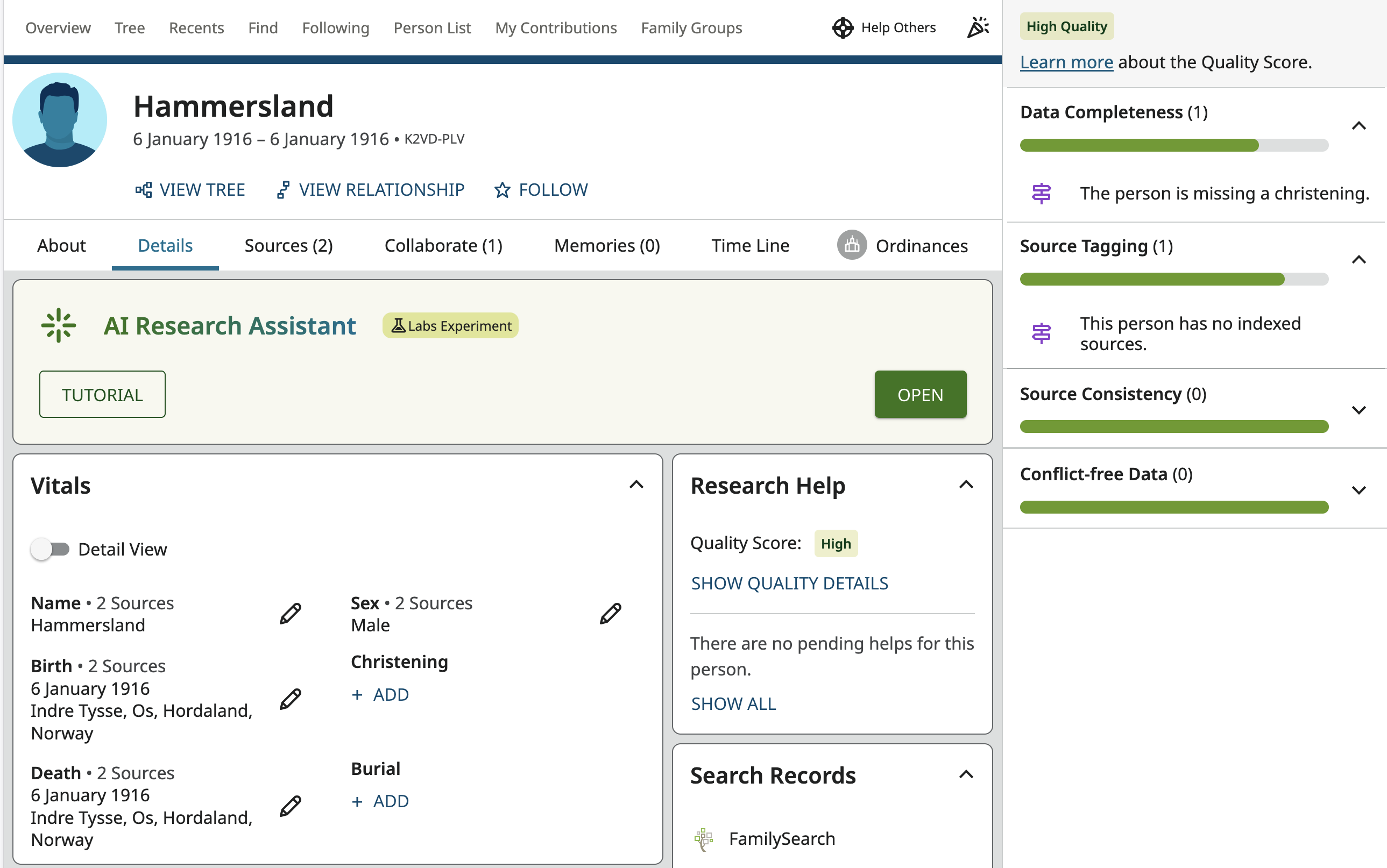
Die Quellenbewertung braucht also nicht meckern wegen unvollständiger Daten und nicht ausreichender Markierung. Totgeburten bekommen keine Namen und keine Geburtsurkunden, sondern werden nur als Todesfall vermerkt. Dementsprechend gibt es auch nicht viel zu markieren.
This concerns a female stillbirth.The source evaluation therefore does not need to omplain about incomplete data and insufficient marking. Stillborn babies are not given names or birth certificates, but are only recorded as deaths. Accordingly, there is not much to mark.
Comments
-
@Bettina58 Thank you for your feedback!
We are currently gathering information about stillbirths and how we can best evaluate them in each area. I would just dismiss the warnings for now as it could be a while before we implement new rules around stillbirths.
Thanks!0 -
@Mary Anna Ebert - you may already know this but we've had at least one extensive discussion in the Community about Stillbirths. Possibly multiple discussions.
IIRC the issues start with the definition of the term "stillbirth". England & Wales have a strict definition of stillbirth - if the child takes just one breath, it is to be regarded as born alive with a birth and (later) death certificate. Stillbirths are recorded separately as a single event and I think have no easily accessible indexes.
Conversely, it became apparent that "stillbirth" was officially used elsewhere to cover not just no-breath cases but also babies who died shortly after birth.
And I have only a hazy recollection of this but have the feeling that a term in Scandinavia was being translated as "stillbirth" - because it did include no-breath cases - but actually it included children who had died before baptism. It was a different perspective altogether.
Apologies if I got any of that wrong… You have my admiration if you can sort it all out!
1 -
Thank you everyone for your feedback. We have issued a ticket to look further into this issue :)
0 -
@Adrian Bruce1 , the term you are thinking of is "Dødfødt" which literally translates to "Dead-born." A help center article states: In some countries, children who died shortly after birth were listed in vital records as stillborn. Children listed as stillborn on records from the following countries [may have actually been liveborn]: Austria, Belgium, Czechoslovakia, Denmark, Finland, France, German states (Baden, Bavaria, Germany, Hesse-Darmstadt, Prussia, Saxony, Thuringia, Württemberg), Hungary, Iceland, Italy, Liechtenstein, Luxembourg, the Netherlands, Norway, Poland, Sweden, and Switzerland. ( https://www.familysearch.org/en/help/helpcenter/article/temple-work-for-stillborn-babies )
To take the example of Norway, a record for a stillborn child will usually contain the family's last name, whether male or female, date of birth/death, and residence at birth/death. For wide swaths of the period for which there are parish registers, there will be two copies of the record. One kept by the priest at the church and a copy kept by the deacon somewhere other than the church. (Offsite backup of important information is not a new concept.) Both of these sources can be tagged to the information in a Family Tree profile.
This keeps the data quality checker quite happy and leaves just two easily dismissable flags so the rules, @Mary Anna Ebert , at least for Scandinavia, are fine the way they are unless they want to put in the very specific rule that if a child has the same birth date and death date and no first name there will never be a christening record and so that flag can be suppressed. If the child had lived long enough to be christened, there would be a christening record, not just the notation in the death records, and the child would have a first name.
 2
2 -
Ob es sich um eine tatsächliche Totgeburt handelt oder ob die Hebamme es als Totgeburt eingeschätzt hat, steht hier überhaupt nicht zur Diskussion. Hier geht es darum, dass WENN die Hebamme von einer Totgeburt schreibt, es überhaupt keine Vornamen und Geburtsurkunden geben kann.
Whether it was actually a stillbirth or whether the midwife assessed it as a stillbirth is not the issue here.The point is that IF the midwife writes that it was a stillbirth, there can be no first names or birth certificates. The civil registry sometimes states that the child died during birth. The child may have taken a breath, but it still does not receive names or a birth certificate. There is not even a proper death certificate; instead, it is noted as a marginal note. Therefore, there can be no sources that require source evaluation. In the case of a stillbirth, there is only a single marginal note.
Es ist nicht notwendig. solch eine Regel einführen, dass es bei einem Kind mit demselben Geburts- und Sterbedatum und ohne Vornamen niemals eine Taufurkunde geben kann. Es reicht, wenn die Quellenbewertung hinterfragt, ob es sich um eine Totgeburt handelt oder nicht. Wer Daten einreicht, kann das unter sonstige Angaben vermerken. Wenn der Qualitätsprüfer darauf besteht, dass dieser Vermerk eingetragen wird oder nach der Geburtsurkunde gesucht werden muss. In der Zivilregistratur wird im Falle, dass das Kind für seine Namensgebung zu kurz gelebt hatte, dennoch immerhin eine Geburtsurkunde ausgestellt.
It is not necessary to introduce a rule stating that a child with the same date of birth and death and no first name can never have a baptismal certificate. It is sufficient for the source evaluation to question whether or not it was a stillbirth. Those submitting data can note this under “other information.” If the quality controller insists that this note be entered or that the birth certificate be searched for.
In the civil registry, if the child lived too short a life to be given a name, a birth certificate is still issued.0 -
@Bettina58 said:
… the point is that IF the midwife writes that it was a stillbirth, there can be no first names or birth certificates. …
Although, as is stated above, this does depend on the applicable rules in the relevant jurisdiction. In England & Wales, if the event is recorded as a stillbirth, there will indeed be no birth certificate. As for a name, the official stillbirth records have the ability to optionally record a name. However, I am fairly certain that this is not that relevant because the stillbirth records in England & Wales are totally locked away. However, parents may inform people of their chosen name for the child - I just don't think it'll be in any official source.
1 -
I learned many years ago from FamilySearch that you should add the birth and death date and place for the stillborn child. But you should also add it as 'Stillborn' under 'Other information'.
I would guess that a child marked as stillborn would be a good indicator for the system not to search for a christening record or other information.0