no marked indexed sourses

https://www.familysearch.org/de/tree/person/details/GZMM-NLT
https://www.familysearch.org/ark:/61903/3:1:3Q9M-CSG1-D8W8?cat=68076&i=439&cc=68076&lang=de
Hier habe ich wieder so einen Fall, dass die Quellenbewertung ihre sehr gute Bewertung zurückzieht, Denn, so lautet die Begründung: Diese Person hat eine Eheschließung, die von keinen markierten indexierten Quellen unterstützt wird.
Aber das ist nicht wahr. Die indexierte Quelle ist aus einem Kirchenbuch, und die Trauung in der Kirche erfolgte in der Regel eine Woche später, also nicht am gleichen Tag. Die nicht indexierte Quelle ist aus dem Zivilstandsregister und hat mehr Daten als die indexierte Quelle, genauere Daten, die gesetzlich geltenden Namen des Ehepaares, sogar die Sterbedaten der Eltern des Bräutigams, weil seine Eltern nicht in die Ehe einwilligen konnten, denn sie waren bei der Eheschließung schon verstorben. Deshalb sind sogar die Sterbedaten seiner Großeltern dokumentiert. Diese Eheschließung erfolgte nicht am gleichen Tag wie die kirchliche Trauung. Dennoch bestätigt diese zivilrechtliche Trauung die kirchliche.
Wenn die Quelle für die Eheschließung ein Ortsfamilienbuch wäre oder die Angaben wären aus einem anderen Genealogieforum, hätte ich ja noch Verständnis dafür, weil das keine Primärquellen sind. Ich verstehe sowieso nicht, warum die bei Familysearch durchaus vorhandene Zivilregistratur nicht indexiert wurde. Und wird ja auch nicht mehr, es wird ja ganz und gar nicht mehr indexiert. Die spannende Frage ist: Warum eigentlich nicht?
Ich habe jetzt den Einspruch verworfen. Muss ich mir meinen Einspruch jetzt abspeichern, um ihn wieder und wieder benutzen zu müssen?
Here I have another case where the source evaluation has withdrawn its very good rating. The reason given is that this person has a marriage that is not supported by any marked indexed sources.
But that is not true. The indexed source is from a church register, and the wedding ceremony in the church usually took place a week later, not on the same day. The non-indexed source is from the civil registry and has more data than the indexed source, more accurate data, the legally valid names of the married couple, even the dates of death of the groom's parents, because his parents could not consent to the marriage as they were already deceased at the time of the marriage. Therefore, even the dates of death of his grandparents are documented. This marriage did not take place on the same day as the church wedding. Nevertheless, this civil marriage confirms the church wedding.
If the source for the marriage was a local family history book or the information came from another genealogy forum, I would understand, because these are not primary sources.
In any case, I don't understand why the civil registry, which is available on Familysearch, was not indexed. And it won't be indexed anymore, because it is no longer being indexed at all. The interesting question is: Why not?
Do I have to save my objection so that I can use it again and again?
Comments
-
I would definitely agree that a link to an image on FamilySearch should not bring up that flag even though technically the flag is correct in that the FamilySearch system source in this case is not an indexed source.
I this point I would just save a short, general version of your dismissal reason such as: "Dieses Dokument wurde noch nicht indexiert" to use whenever needed. Does your system provide text substitution? I have a list of period-two or three-letter combinations that automatically expand so that such repetitive entry is very efficient. For example I can type ". b a p" without the spaces and have it expand to "Already recorded under Christening where it belongs" as I delete Custom Event christening that just duplicate Vitals christenings.
1 -
My system? I just use a txt-file to save repeatedly needed text moduls.
0 -
I use a Mac. A built in part of its system software is a text substitution feature:
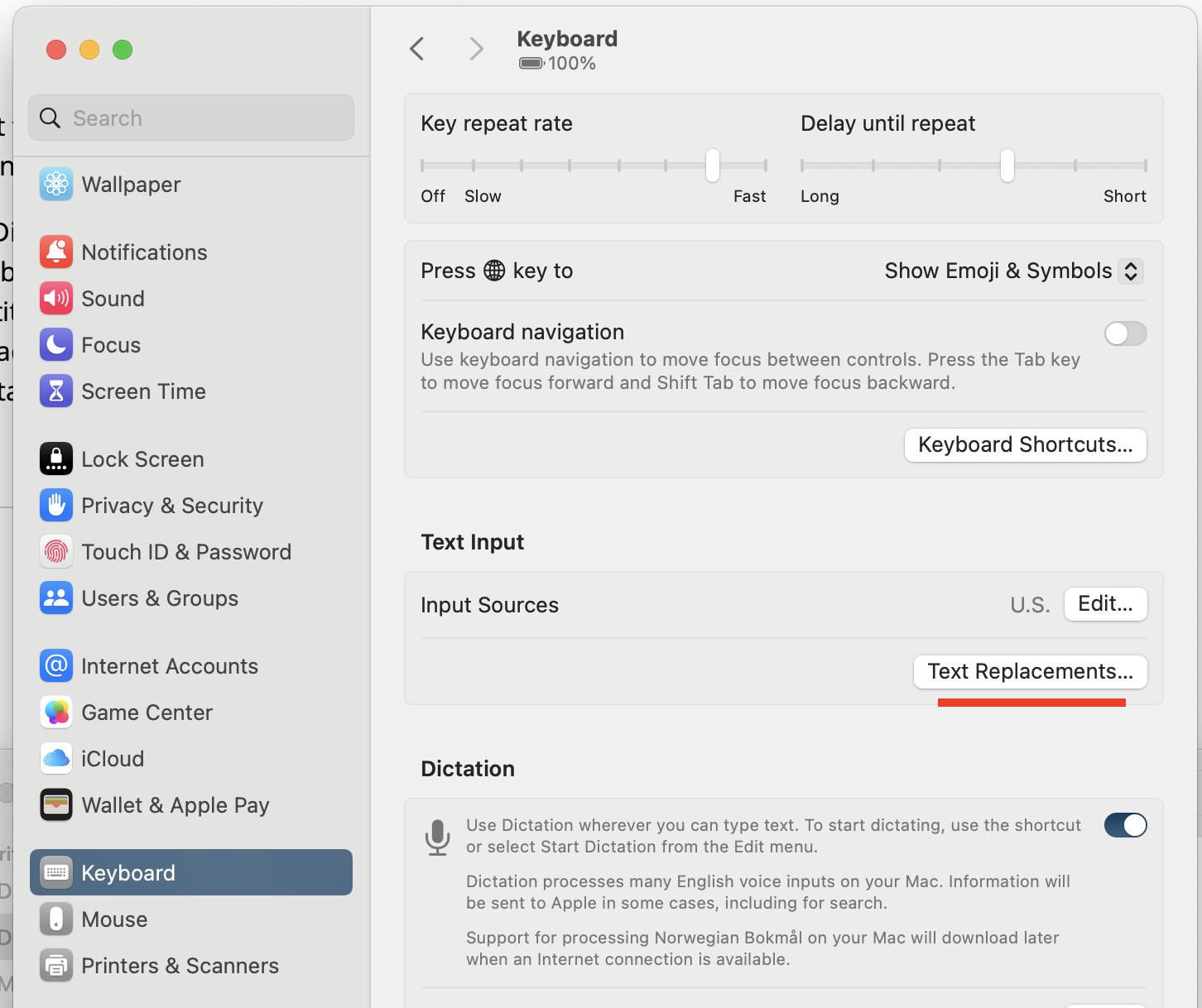
In it I have created a list of phrases I commonly use:
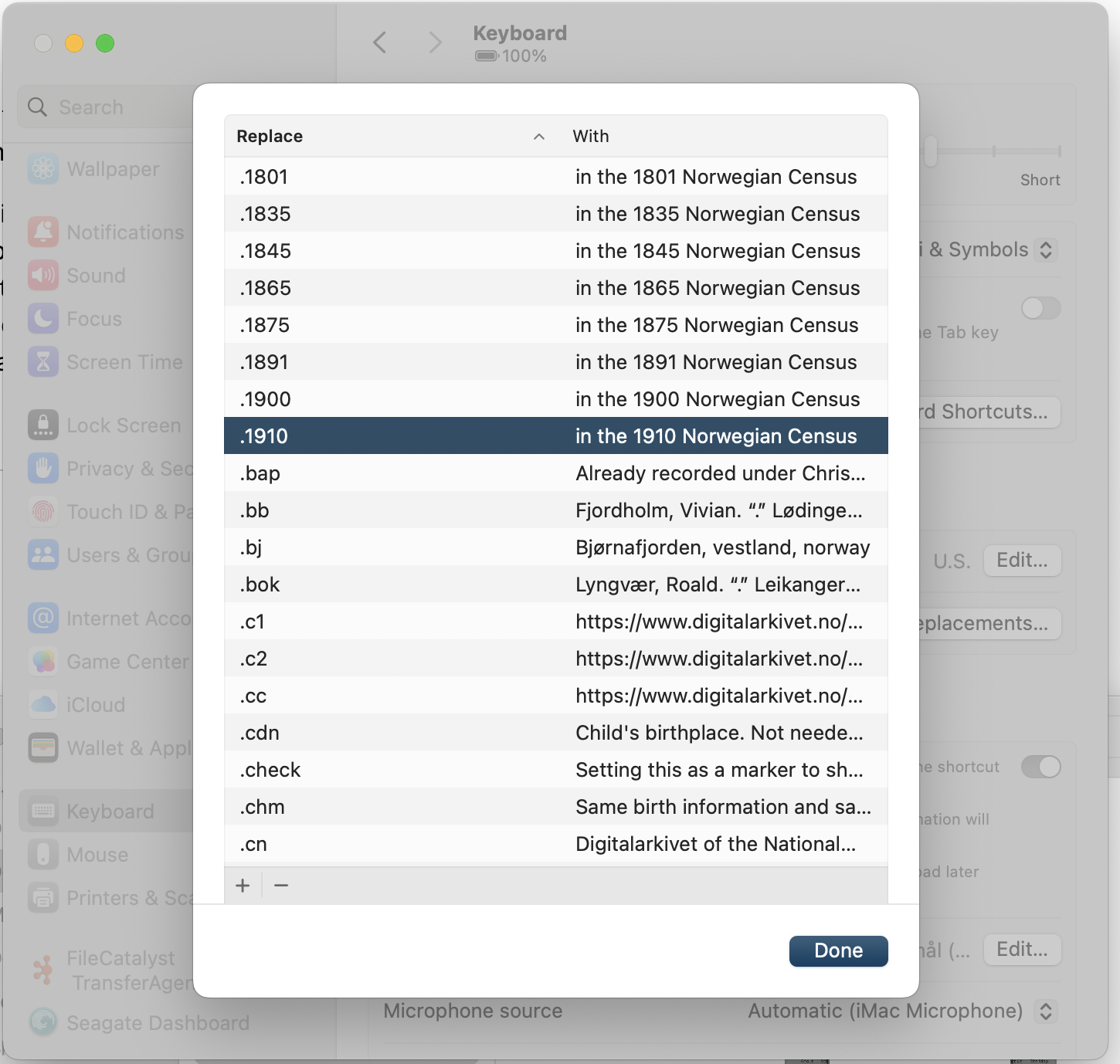
Then I can just type in the short code on the left and it expands to the longer, sometimes much longer, phrase on the right. I find it much more efficient than having a list of phrases in a text file that I then have to go to in order to copy and past the phrase. Not all applications allow their use. Firefox, for example, ignores the codes and just leaves them as they are. I don't know if the Windows operating system has such a feature.
0 -
@Bettina58 Thanks for your message!
We have plenty of records that we have not indexed yet because it's a volunteer effort and takes time for them to index everything.
You might be able to use the new full-text search feature, which can search non-indexed images.
While it is frustrating to have the warning about no indexed sources, it is still a helpful warning because algorithmically, we can't use sources to verify the information on the person page. We do give partial credit to the score for familysearch.org sources and other websites that we have reviewed.
Thanks!0 -
@ Gordon Collet , danke für die Mühe, doch ch habe mir abgewöhnt, mir irgendwelche Tools zu downloaden. In den seltendsten Fällen kann ich diese Programme dann auch tatsächlich nutzen, was nicht heißen soll, dass die Programme schlecht sind. Aber wenn ich sie nicht anwenden kann, weil ich zu dumm dazu bin, mülle ich nur meine Festplatte voll. Für mich wäre es erstmal sinnvoll, ged.com verwenden zu können. Viele haben schon erfolglos versucht, das zu erklären. Eine txt-Datei tut was sie soll. Reicht.
Thank you for your effort, but I've stopped downloading any tools. In very rare cases, I can actually use these programs, which doesn't mean that the programs are bad. But if I can't use them because I'm too stupid, I'm just cluttering up my hard drive. For me, it would make sense to be able to use ged.com. Many have tried unsuccessfully to explain this. A txt file does what it's supposed to do. That's enough.
0 -
@Gordon Collett And you think the source evaluation understands such abbreviations? If it doesn't understand the full text, it certainly doesn't understand abbreviations. Source evaluation is an important tool. It immediately recognizes inconsistencies and explains them in an understandable way. But pointing out errors that aren't errors only causes resentment.
Further more I do not use Mac. MAC is too extensive. I am glad, when I have enough to eat.
0