Inferring residence from christening records: good practice?

To enrich records, could this be a good practice?
As an example, see this record:
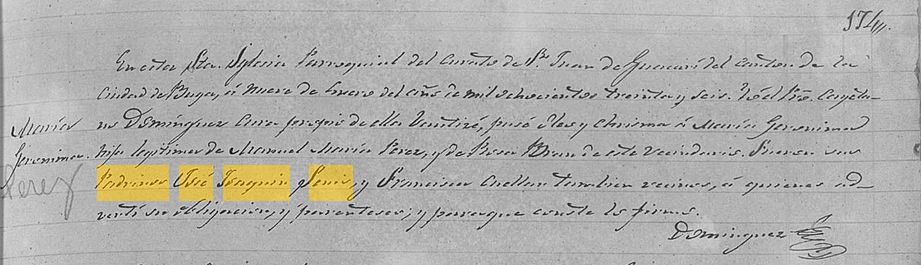
Guacarí (Valle del Cauca, Colombia) was a small and sleepy town — not many travelers. Parents (Manuel María Pérez & Rosa Bram) are noted to be "de este vecindario", as the godparents of the child ("también vecinos").
Would it be fair to assign to individuals MM Pérez, R Bram, JJ Lenis and F Cuéllar the event [Residence, 1836, Guacarí…], to enrich their records?
(Guacarí's parish has records where the parents or godparents are said to be "vecinos" of some other town and they should not be marked as residents of Guacarí).
Comments
-
In 1836 I would assume this would be a safe bet. The Godparents would have been at this special occasion in any case and if they didn't live there they would most likely have been in a very close community. I would mark this as a residence place. But the choice is yours.
0 -
I looked up translation and from what I see the parents are from this neighborhood, I am assuming Valle de Cauca. Tambien means also. so godparents were from the same neighborhood. Even if they are from a different small town, this location would be one they might come to often for big events and would be important to have as a reference point in your records
0 -
@jamiehadlock, by PersonX "de este vecindario" I bet it means residents from the same parish (Guacarí).
Buga (another parish often mentioned) is a larger town about 10 miles away. To send messages back and forth between Guacarí and Buga to potential compadres, have the people accept to be compadres (and spend 4 hours in a mule, bringing gifts), hosting & feeding them, likely means that the parents were relatively well off and had social contacts outside their small town. The children, when growing up, would be able to go to the larger town for school, being housed by their godparents, further growing their social capital.
On the other extreme, a single mother who would have the same vecina from the same parish as comadre for all her children, was likely to be very poor and socially isolated.
The Godparent and Residency labels add a lot to the picture.
0 -
Thank you for the lovely image you have given me of another time and place. The role of Godparents was truly a treasured gift.
1