The source evaluation proves a clear error, and now I nee help to fix it

https://www.familysearch.org/de/tree/person/details/LR8H-HC9
In diesem Falle können wir nur dankbar sein für dieses Tool der Quellenbewertung. Die Quellenbewertung hat nämlich einen gravierenden Fehler in der Zuweisung der Quellen gefunden: Der Ehemann habe nach seinem Tod geheiratet. Das bedeutet, dass diese Quelle einem anderen Michael Morsch zugeordnet werden muss. Es war in jenen Zeiten traurigerweise vollkommen normal, wenn zu viele Menschen vollkommen gleiche Namen hatten. Hier bin ich aber auch froh um die Zivilregistratur, die überreich an Daten ist. Hier habe ich eine Heiratsurkunde seines Sohnes. In jenen Zeiten war für die Eheschließung die Einwilligung der Eltern notwendig. Wenn der Vater oder die Mutter des Bräutigams oder der Braut verstorben war, wurde der Tod in der Heiratsurkunde dokumentiert. Wenn jemand als Vollwaise heiratete, wurden nicht nur die Sterbedaten der Eltern dokumentiert, sondern auch die der Großeltern, weil im Falle des Todes beider Eltern immerhin deren Einwilligung in die Ehe notwendig war.
Um Missverständnisse und/oder Fälschungen zu verhindern, hat Napoleon Bonaparte bestimmt, dass die Zahlen alle in Buchstaben ausgeschrieben werden müssen; Darum ist im Falle, dass ein Vollwaise heiratet, alles so dicht gedrängt geschrieben. Aber es sind viele viele Daten. So eine Heiratsurkunde der Zivilregistratur aus der Zeit VOR 1876 reicht also oft über drei Generationen.
Wie gesagt, ist dieser Fall interessant und besorgniserregend. Darum schreibe ich dies, denn ich brauche Rat. Das muss jetzt alles wieder getrennt werden, denn die indexierten Urkunden gehören nicht zu diesem Michel Morsch. Ein weiterer Vorteil der Zivilregistratur: Die tatsächlichen Namen der Menschen werden genannt, nicht die verlateinischten Versionen ihrer Namen. Diese Namen werden ab 1876 gesetzlich. Damit verlieren alle lateinischen Namen in Deutschland ihre Gültigkeit. Ich finde, dass Familysearch das nicht wirklich berücksichtigt und in der Quellenbewertung immer wieder noch anmahnt, dass der Name nicht lateinisch genug ist wie in den katholischen Urkunden niedergeschrieben.
Weil die Urkundenführer manchmal nicht viel Platz zum Schreiben hatten, ist es schade, dass die Lupenfunktion für die Quellen auf Familysearch beschränkt wurden. Deshalb habe ich die Datei runterladen müssen, um sie besser lesen zu können und den in diesem Falle relevanten Teil ausgeschnitten, vergrößert und hier als Bild hochgeladen. Ich hoffe, dass das Bild hilfreicher ist als die Lupenfunktion von Familysearch.
In this case, we can only be grateful for this source evaluation tool. The source evaluation found a serious error in the attribution of the sources: the husband remarried after his death. This means that the indexed sources must be attributed to another Michael Morsch. Sadly, it was completely normal in those days that too many people to have exactly the same names. But here I am also glad that the civil registry is so rich in data. I have found a marriage certificate for his son. In those days, the consent of the parents was required for marriage. If the father or mother of the groom or bride had died, the death was documented in the marriage certificate. If someone married as an orphan, not only were the dates of death of the parents documented, but also those of the grandparents, because in the case
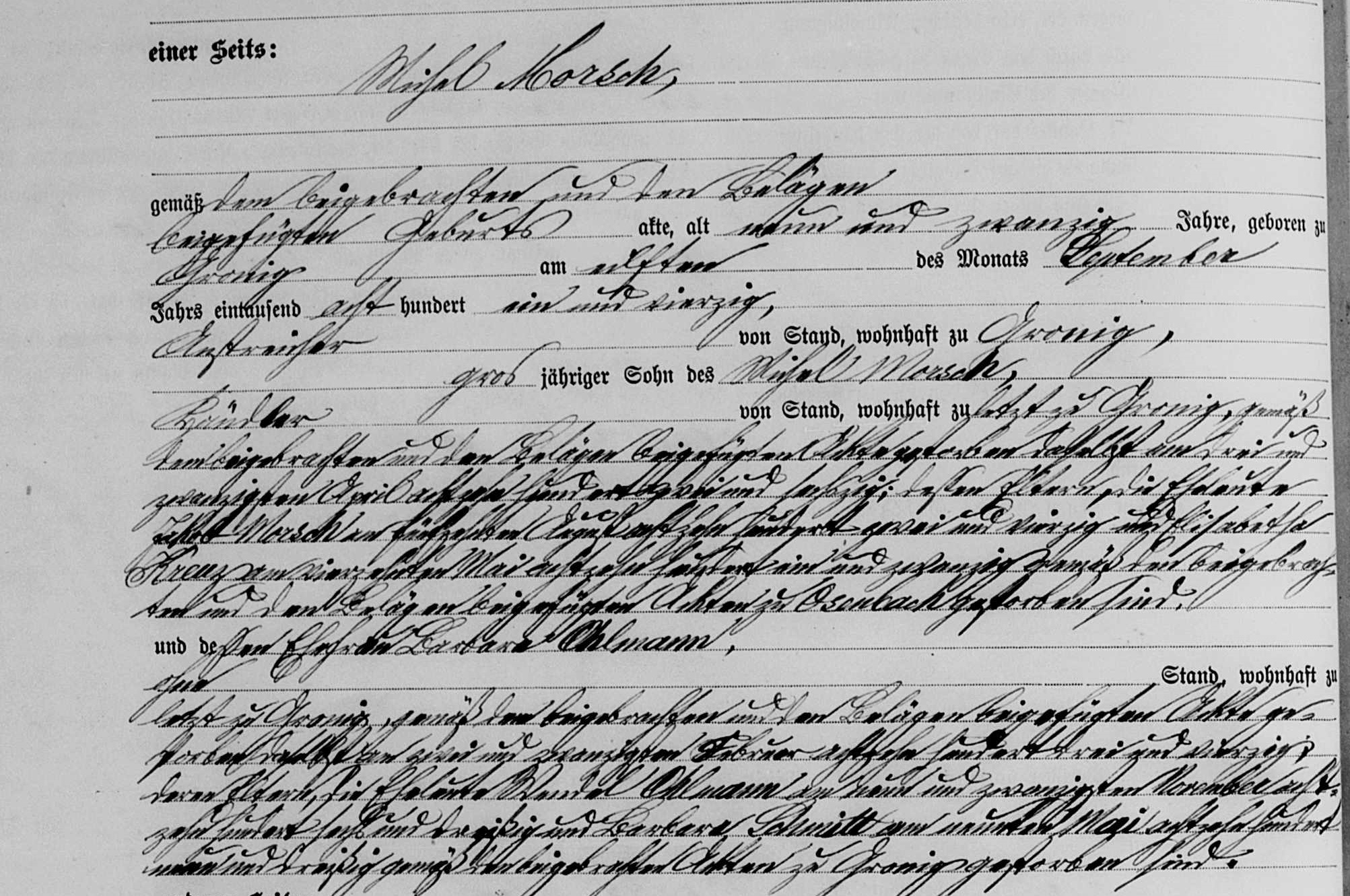
of the death of both parents, their consent to the marriage was still required.
To prevent misunderstandings and/or forgeries, Napoleon Bonaparte decreed that all numbers must be written out in letters; that is why everything is written so densely in the case of an orphan getting married. But there is a lot of data. A marriage certificate from the civil registry from before 1876 often covers three generations.
As I said, this case is interesting and concerning. That is why I am writing this, because I need advice. Everything now has to be separated again, because the indexed records do not belong to this Michel Morsch. Another advantage of the civil registry is that people's actual names are given, not the Latinized versions of their names. These names became law in 1876. This means that all Latin names in Germany lose their validity. I think that Familysearch does not really take this into account and repeatedly warns in its source evaluation that the name is not Latin enough as written in the Catholic records.
Because the record keepers sometimes did not have much space to write, it is unfortunate that the magnifying glass function for the sources was limited to Familysearch. Therefore, I had to download the file to be able to read it better and cut out the relevant part in this case, enlarged it, and uploaded it here as an image. I hope that the image is more helpful than the magnifying glass function of Familysearch.
Comments
-
Sorry that I can't reply in German or read the anything in the image you posted. But I think this has a rather simple solution. Since you know that the Michel Morsch who died 23 April 1862 cannot have married Theresia Staub on 11 November 1862, you just need to remove him from that couple relationship.
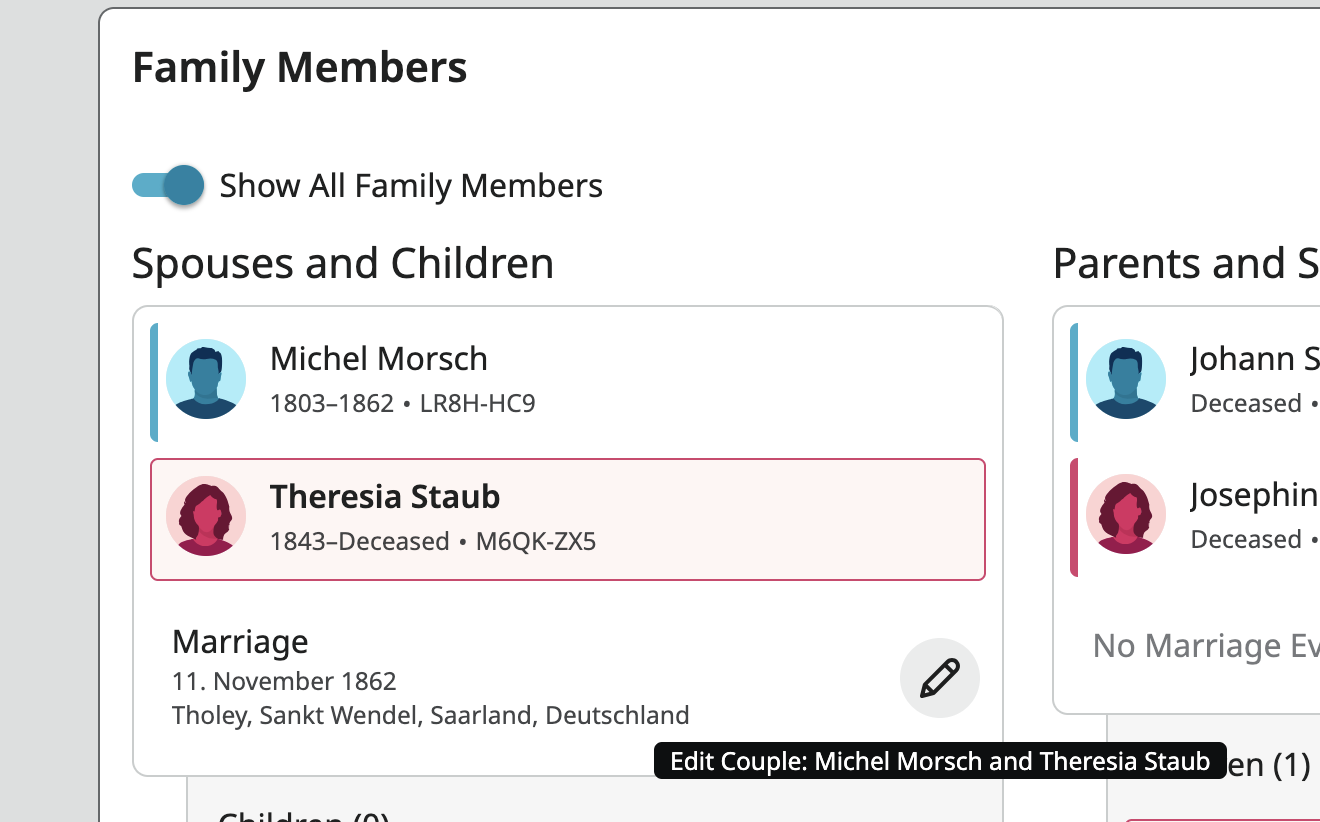
This works best if you first go to Theresia Staub's profile so that she is the one highlighted in the couple box. Then click on the pencil icon:
Then choose Remove Or Replace under Michel:
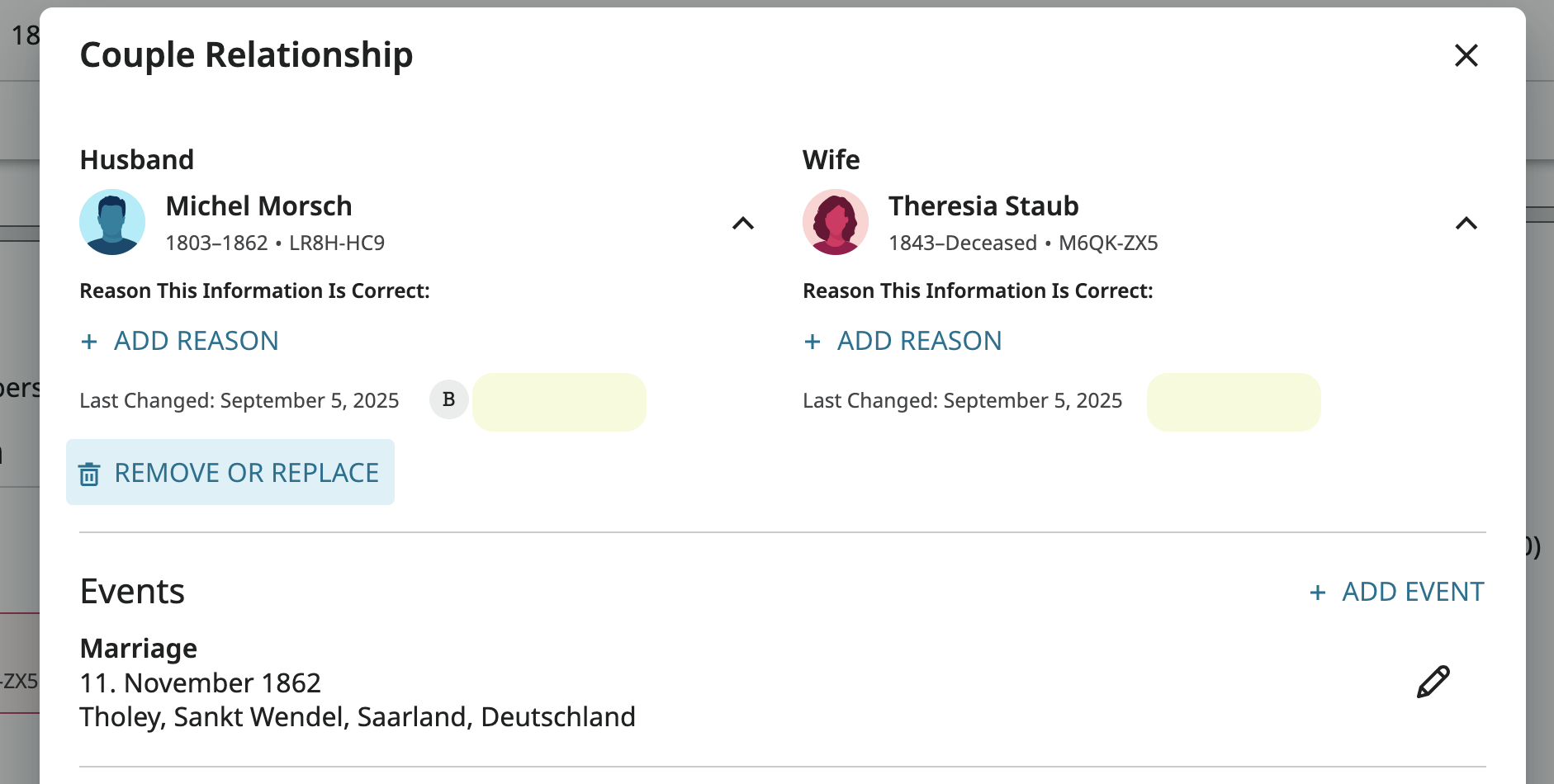
(If you entered here from Michel's profile the Remove Or Replace would be under Theresia but since the marriage is for her, you would want to keep her and remove Michel)
This will take you through a series of screen to give Theresia the correct husband. If you are not researching her and don't know who her Michel is, I would just create a new person named Michel Morsch with whatever information is found in the record.
After changing Theresia's husband, but sure to detach the marriage source from the incorrect Michel and attach it to the correct Michel.
1 -
@Bettina58 Thanks for the feedback!
We are happy to make improvements to the way we evaluate sources for Germany.
Is it just after 1876 that the Latin names lose their validity?
Thanks!0 -
Ich denke, zuerst sollte der Tod von ihm überprüft werden.
Da kann ja jeder kommen und aus Schabernack falsche Sterbedaten eintragen. Ich habe das Sterbedatum nicht eingetragen. Solche Fälle hat es tatsächlich gegeben. Ich habe das vor vielen Jahren erlebt, dass Doppelaccounts mit vertauschten Geschlechtern erstellt wurden. Das war gar nicht so einfach, das wieder in Ordnung zu bringen. Gronig ist ein Ort bei St. Wendel im Saarland. Davon finde ich bei Familysearch weder Kirchenbücher noch Zivilregistratur.I think his death should be verified first.
Anyone could come along and enter false dates of death as a prank. I did not enter the date of death. There have actually been cases like this. Many years ago, I experienced double accounts being created with swapped genders. It was not easy to fix that. Gronig is a place near St. Wendel in Saarland. I cannot find any church records or civil registries for it on Familysearch.0