
Standard place names for German places before 1871.

When an event is dated earlier than 1871 in the German states and no corresponding place for the time period, it is flagged by the program. If there is no standardized place name for the time period indicated then some mechanism is necessary to create the new place name in a timely manner. I have used the current place name app but I never see my suggestions implemented. I have researched my suggestions but nothing happen. Until the places for all German state time periods are updated, the program should not flag if a required time period is non existent.
Comments
-
@Joseph Jahrsdoerfer Thank you for the feedback. This area of Europe is a tough one. Many boundary and name changes through the centuries. Here are some possible helps:
Prussia's Territorial Changes: What They Mean (Plus Tools for Tracking Them) https://familytreemagazine.com/heritage/prussian/prussia-territorial-changes/?trk_msg=QUG8ATHQR6F49ACHEH1OO1IL4O&trk_contact=HAT0RNCAL23M14MGQ1JEUPNLO0&trk_module=new&trk_sid=OJQ7TAR2S4JT47CUJR154NGMA0&trk_link=SNH6H1FAF9UKRF36FP2RCRCB88&utm_source=Listrak&utm_medium=Email&utm_term=https%3a%2f%2ffamilytreemagazine.com%2fheritage%2fprussian%2fprussia-territorial-changes%2f&utm_campaign=FT+Newsletter
Research: Germany, Goal 1 https://thefhguide.com/project-9-germany.html
FamilySearch Wiki: Germany Genealogy: https://www.familysearch.org/en/wiki/Germany_Genealogy
Place Research Tool: https://www.familysearch.org/en/help/helpcenter/article/how-do-i-use-the-place-research-tool-in-my-family-history-research
0 -
@Rhonda Budvarson , I think you misunderstood Joseph's suggestion a little. It is not that he is having trouble find the place name for localities in Germany before 1871, it is that the places do not have any entry in the Places database to use for prior to 1871. For example:
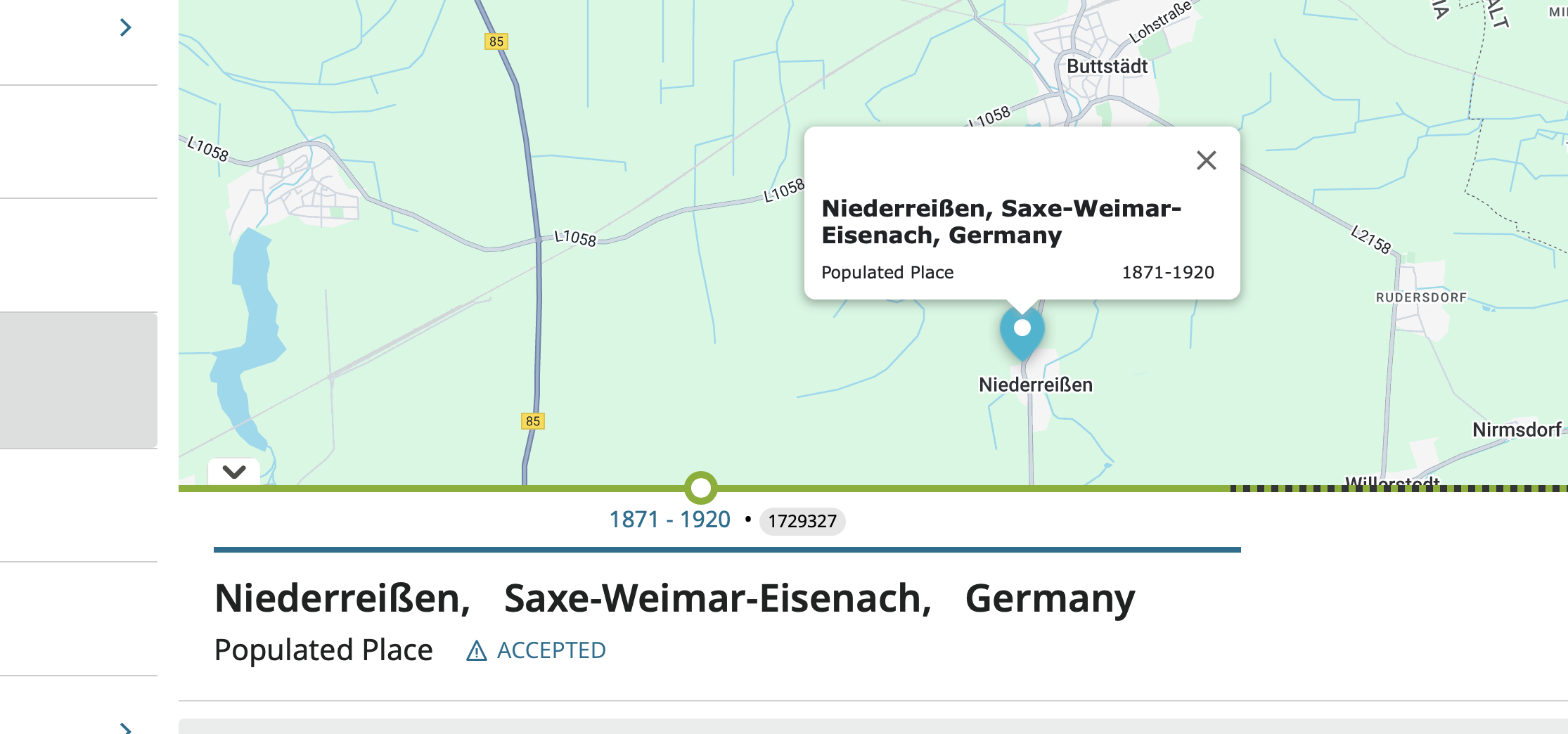
If he is working on a profile for someone born in Niederreißen in 1860 or 1930 he has only this one standard to link to his place name. Therefore, for every person born outside of that limited date range, he gets that Data Quality flag that complains about the place name being wrong because is it outside its timespan.
When he stated, (please correct me if I am wrong @Joseph Jahrsdoerfer ) "I have used the current place name app but I never see my suggestions implemented." I assume he means that he has submitted requests for additions to the Places database but none of them have been added yet. Also, it is probably not practical for him to submit the probably thousands of improvements needed for Germany in the Places database.
That is why he is suggesting that when a place does not have the correct time period available and one is forced to use the only time periods that are, that the Data Quality flag pointing out the date/place mismatch be suppressed.
1 -
Because there was no country of Germany until 1871 there cannot be any data quality for the individual German states. For example: Data Quality for "Continental Europe 1800 - 1920" is in error because the individual states like Baden or Württemberg are excluded from Data Quality for the time periods earlier than 1871. The individual independent German States should perhaps be considered as countries in their own right in order to include them in Data Quality estimates.
0 -
The individual states are considered countries prior to 1871. To take your example of Baden https://www.familysearch.org/en/research/places/?focusedId=25662 :
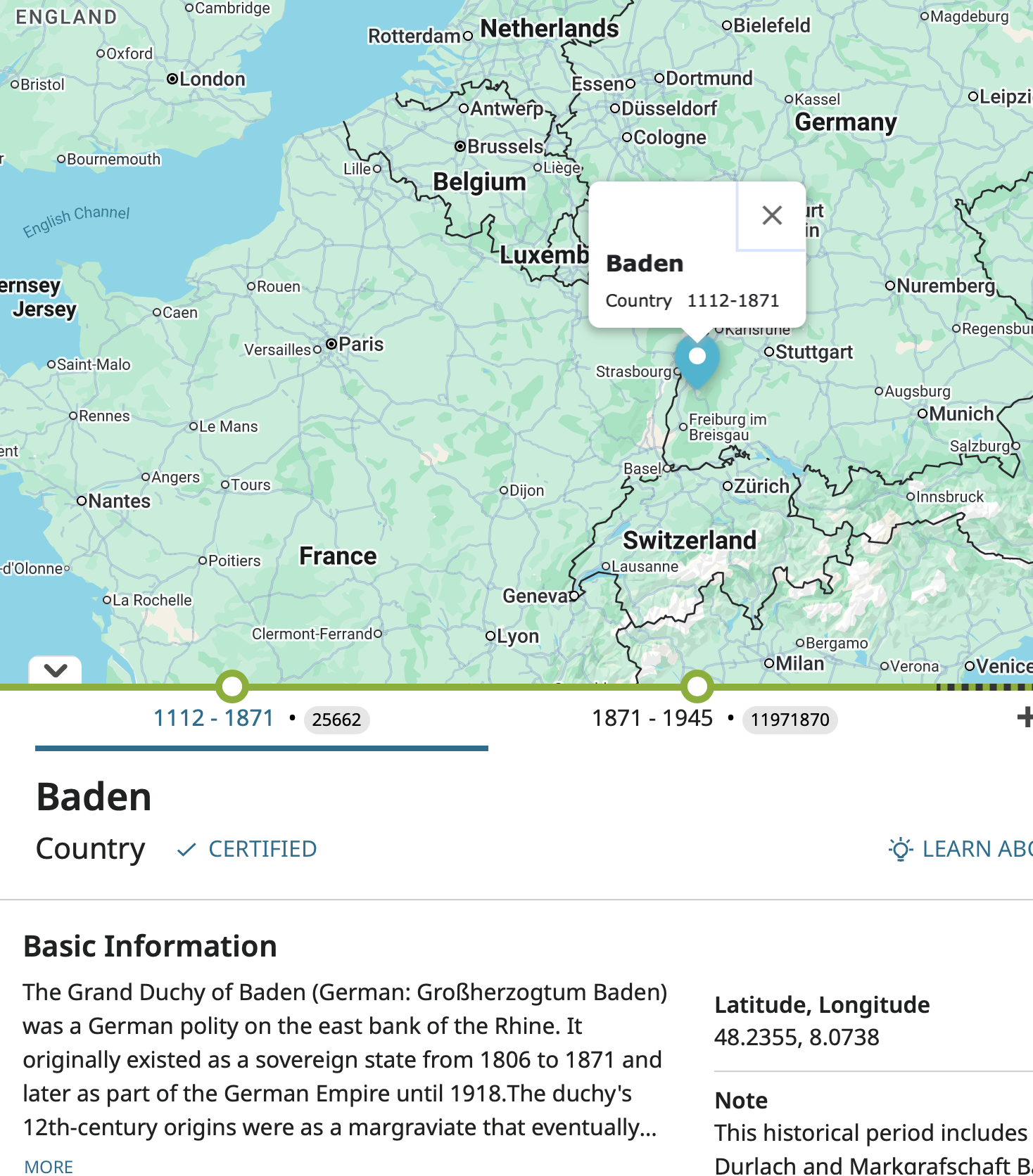
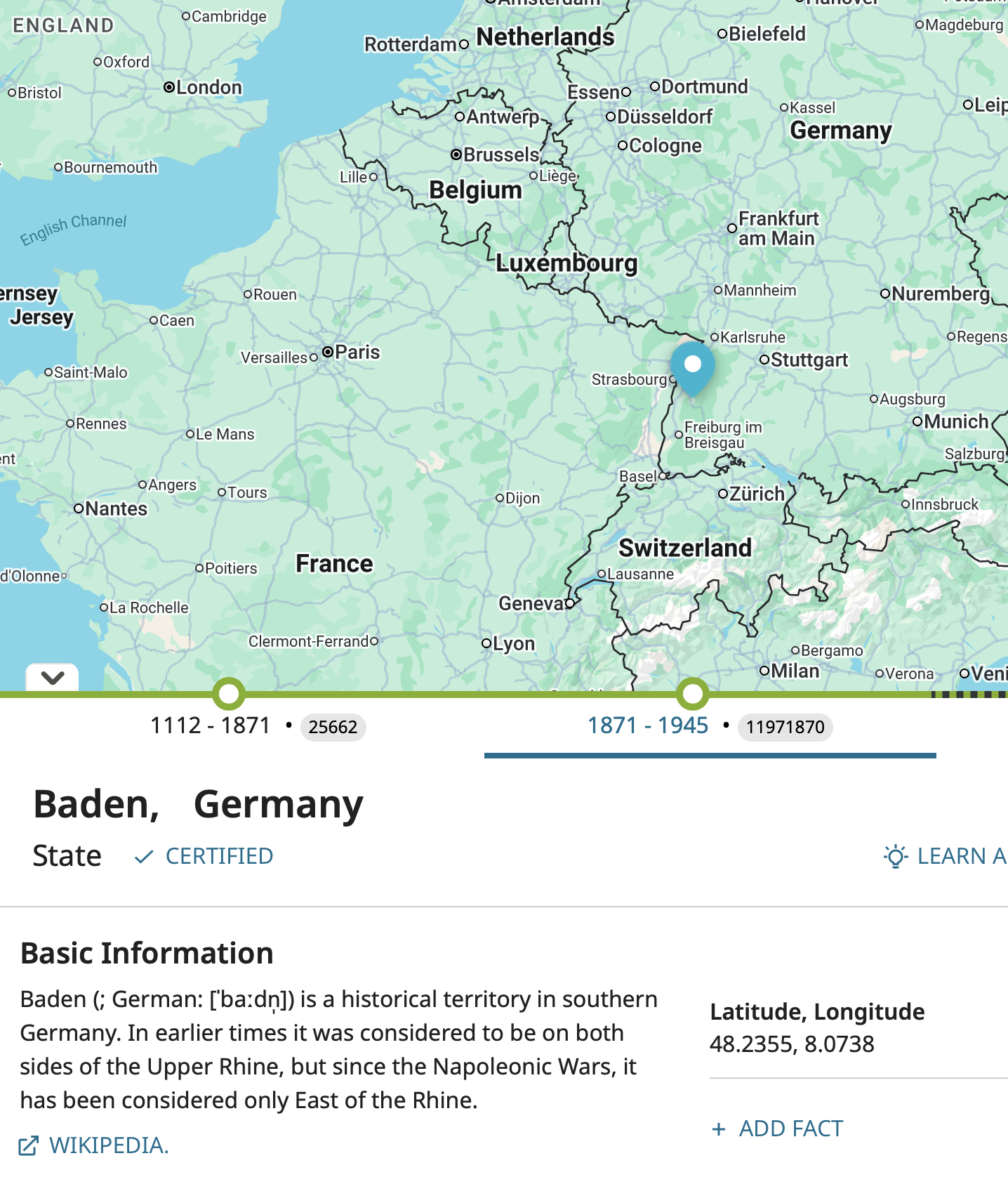
So this may be more complicated than just missing places and time periods for Germany. It may be an issue with the organization of the database or a problem with the place standardization on a person's profile.
Can you post one specific example of a profile page with the problematic Data Quality Score flag? I'd like to try and see what is really going on and what is needed to fix it. Please include what you regard as the correct historical place names for the place names on the profile.
0 -
@Gordon Collett Here's one example:
Franz Anton Moedl KWJF-2MP was born in Dollnstein, Bavaria in 1835. The only standardized place for Dollnstein is a post-1871 place. So the DQS for Conflict-free Data notes:
The standard "Dollnstein, Eichstätt, Bavaria, Germany" (ID: 9290725) is used for dates from 1871 onward. This conflicts with the birth date of 3 December 1835.
This conflict can be dismissed, of course, but there's no way to select a standardized place without getting a DQS conflict.
0 -
This looks like a good example:
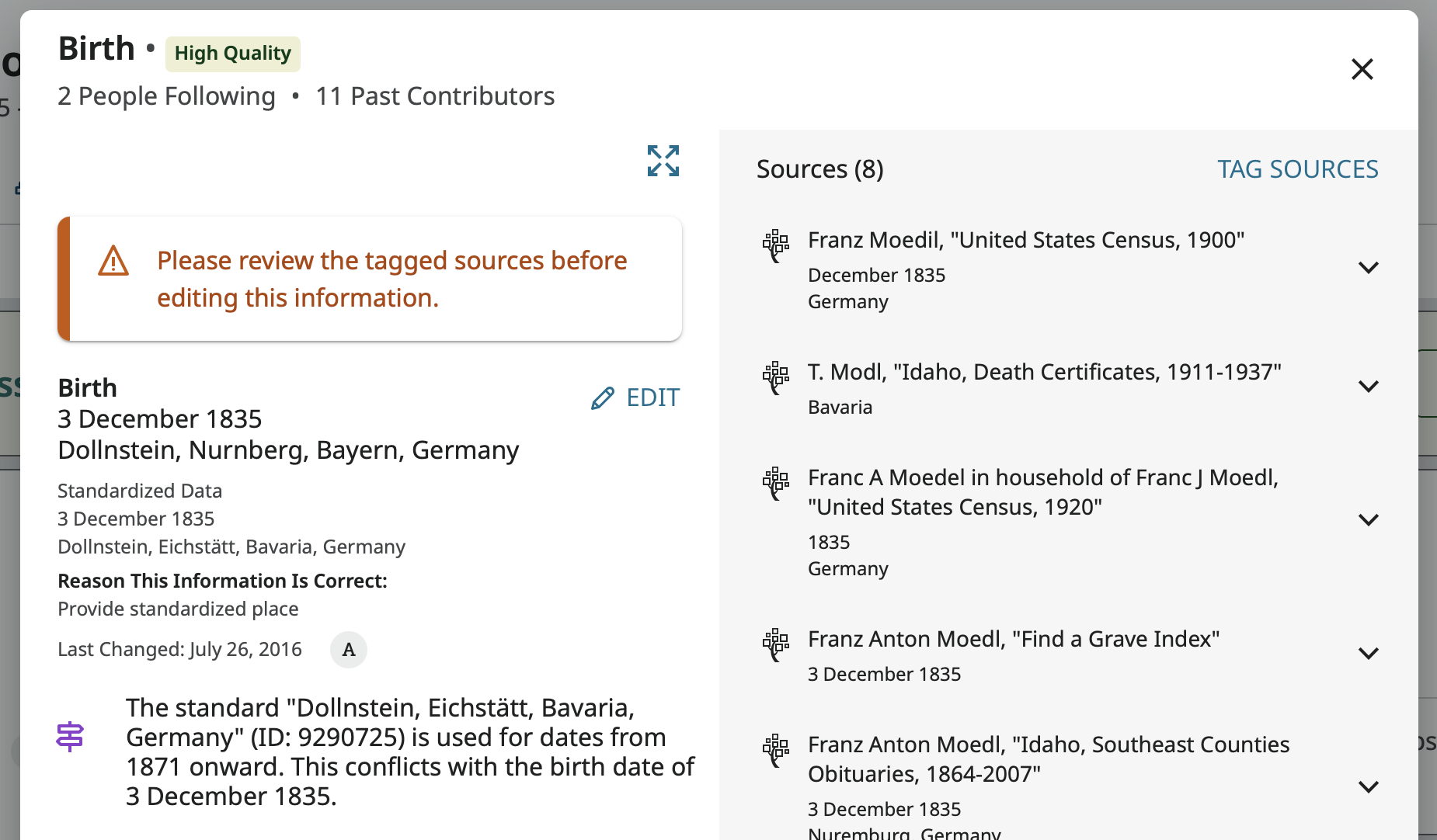
and see where things go.
First thing to look at is what guidelines the Places Authority Team have developed and see if they are following them for this place. These are found here:
and going under the Europe tab and scrolling to Germany we can read:
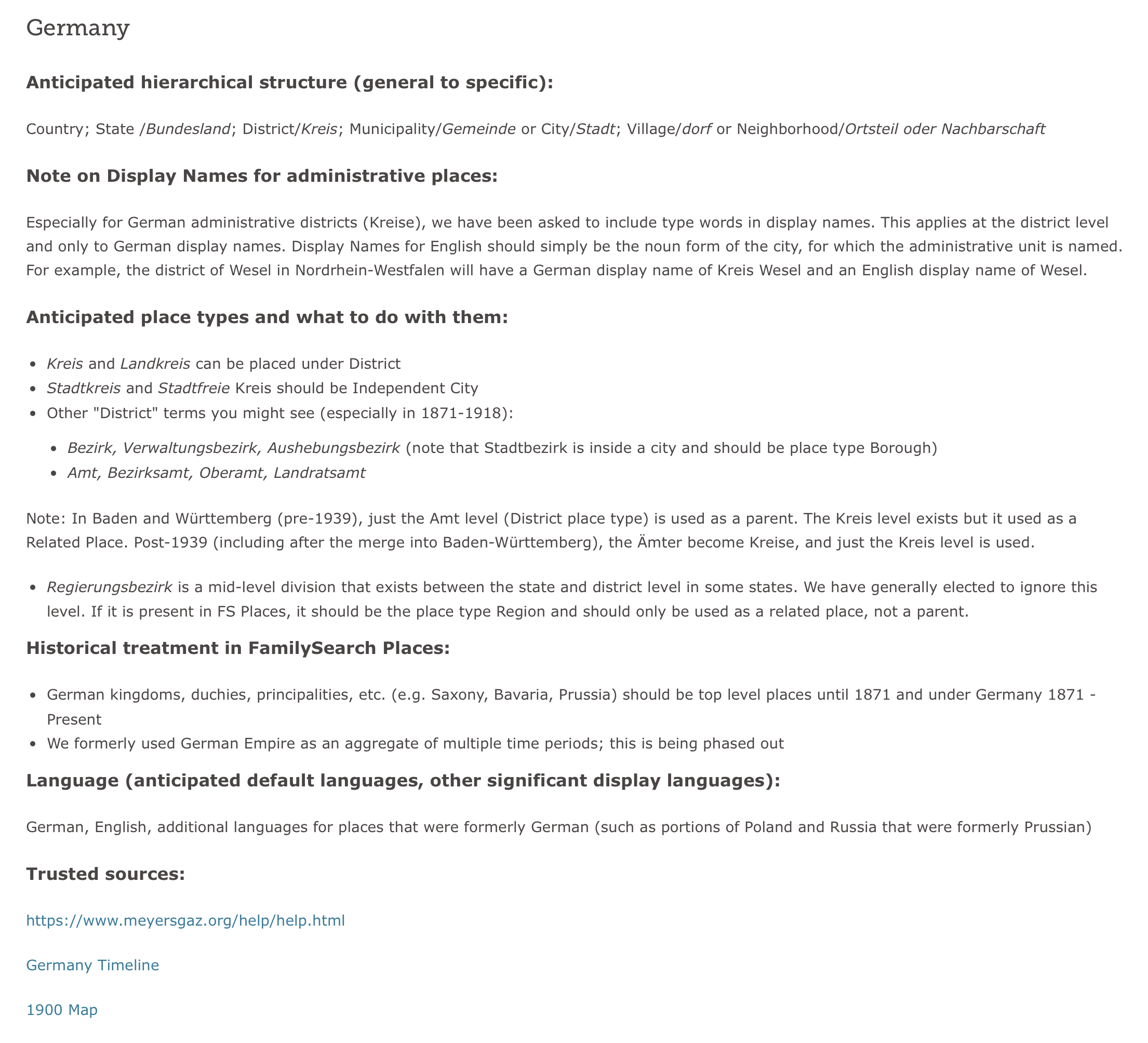
(As a side note it is interesting to read: "Especially for German administrative districts (Kreise), we have been asked to include type words in display names. This applies at the district level and only to German display names. Display Names for English should simply be the noun form of the city, for which the administrative unit is named. For example, the district of Wesel in Nordrhein-Westfalen will have a German display name of Kreis Wesel and an English display name of Wesel." Which suggests they are not making these up out of the blue. I wonder who asked them to include the type?")
In any event, their guidelines specifically state that Germany will never be used until 1871. So the question becomes, what it to be used instead? The quickest way to see all the place names in existence in a limited area in the Places database is to use the area search function. Since I have the ID of the place in question, I'll use that:
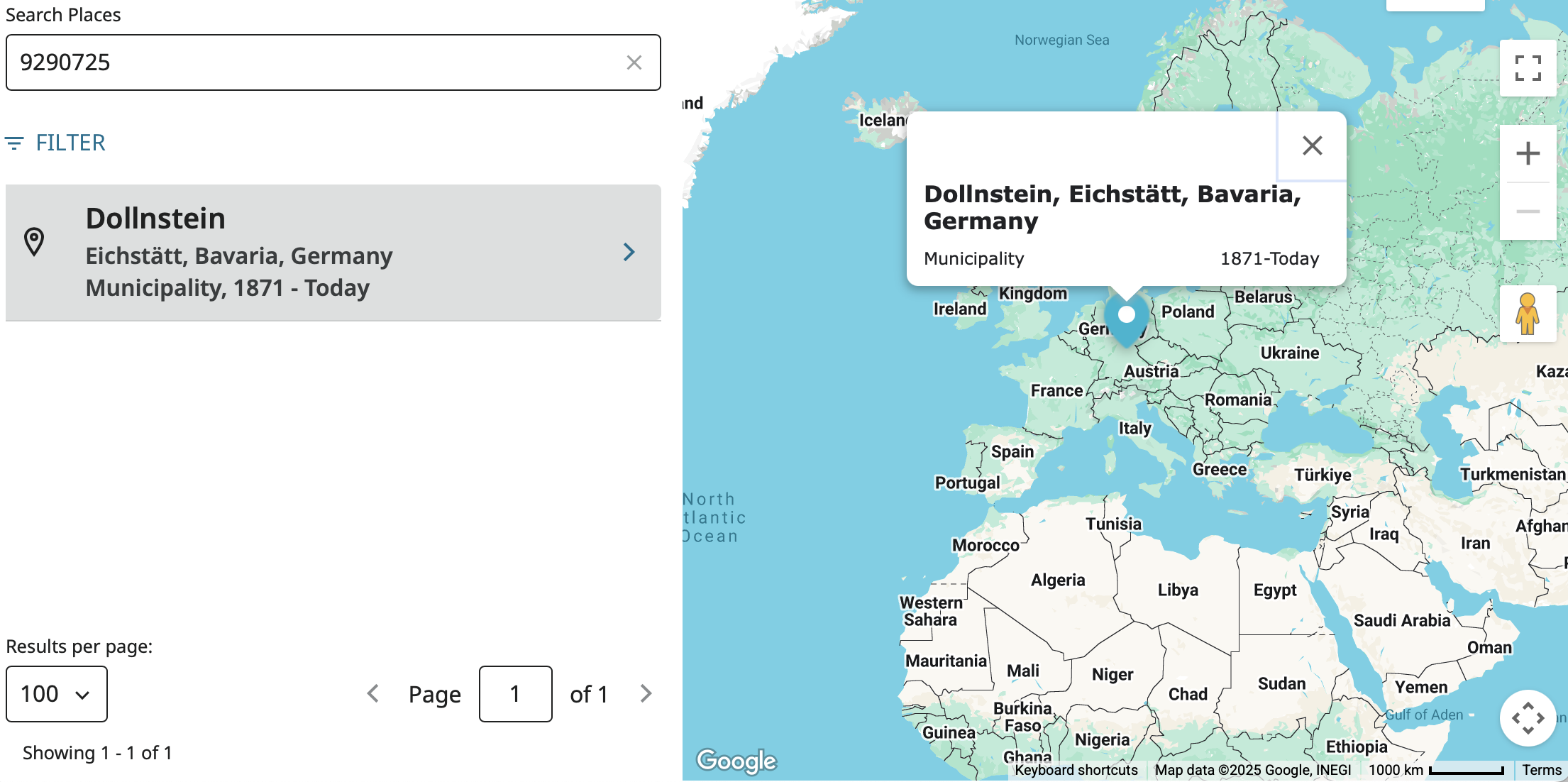
But before I get to the place itself, I'm wondering about the difference between Nurnberg and Eischstätt and why one is used in the Display name and the other in the Standardized name.
So I'm going to take a step back and look up each of those:
Nurnberg, the independent city, has four historical time periods covering 1050 through today.

Only the 1871 to today period has any children. I don't know much about Germany geographical politics so I can't say if this is incompleteness in the database or if prior to 1871 the city was just itself and did not contain any other places within it.
Eichstätt, Bavaria, also brings up four places, one of which does not appear to be involved here. There is the district in Germany from 1871 to today, the district in Bavaria from 1806 to 1871, and the municipality of the same name within the district.
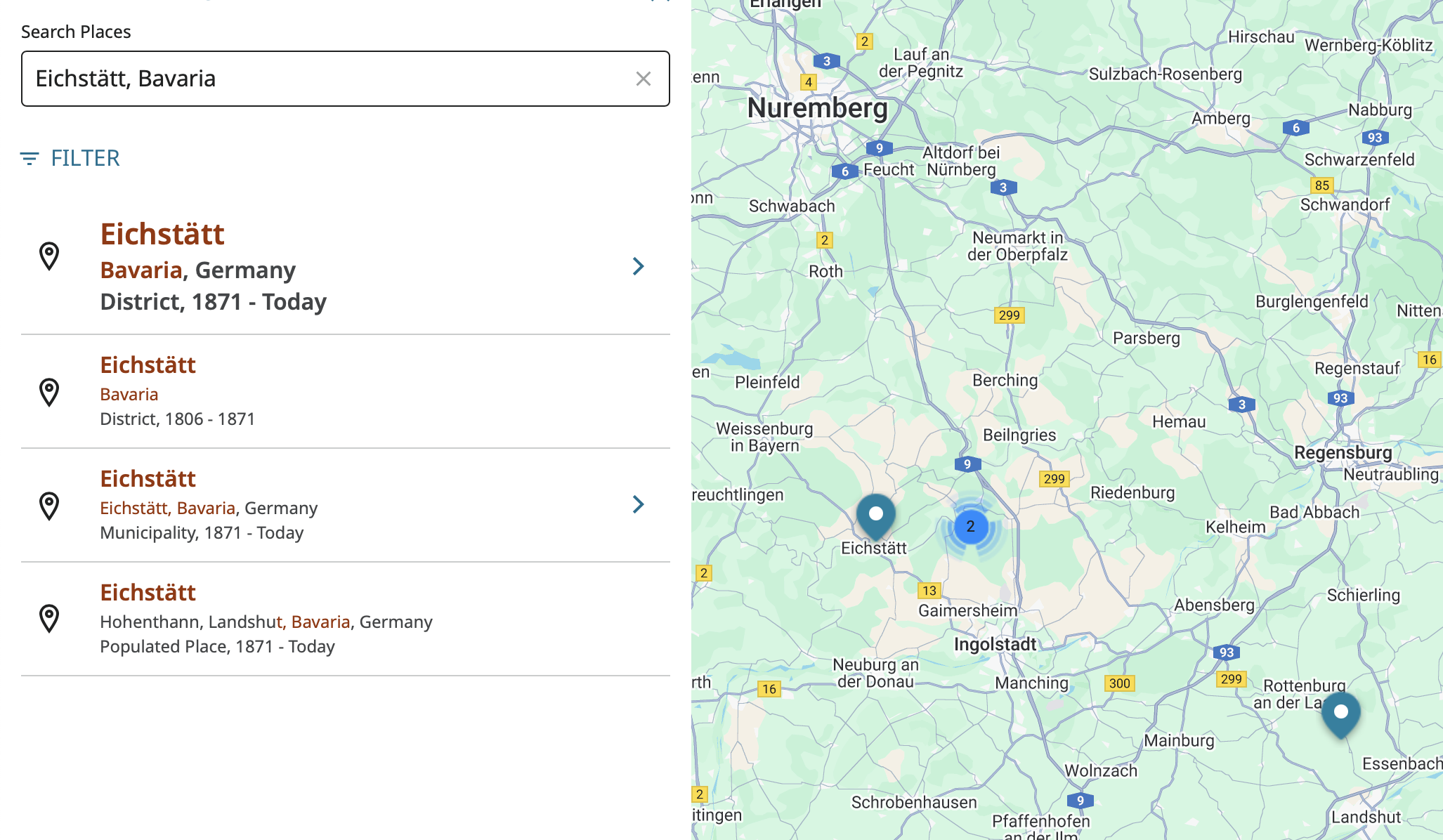
The district between 1806 to 1871 has no children so that would appear to be incompleteness in the database.
Going back to ID: 9290725:
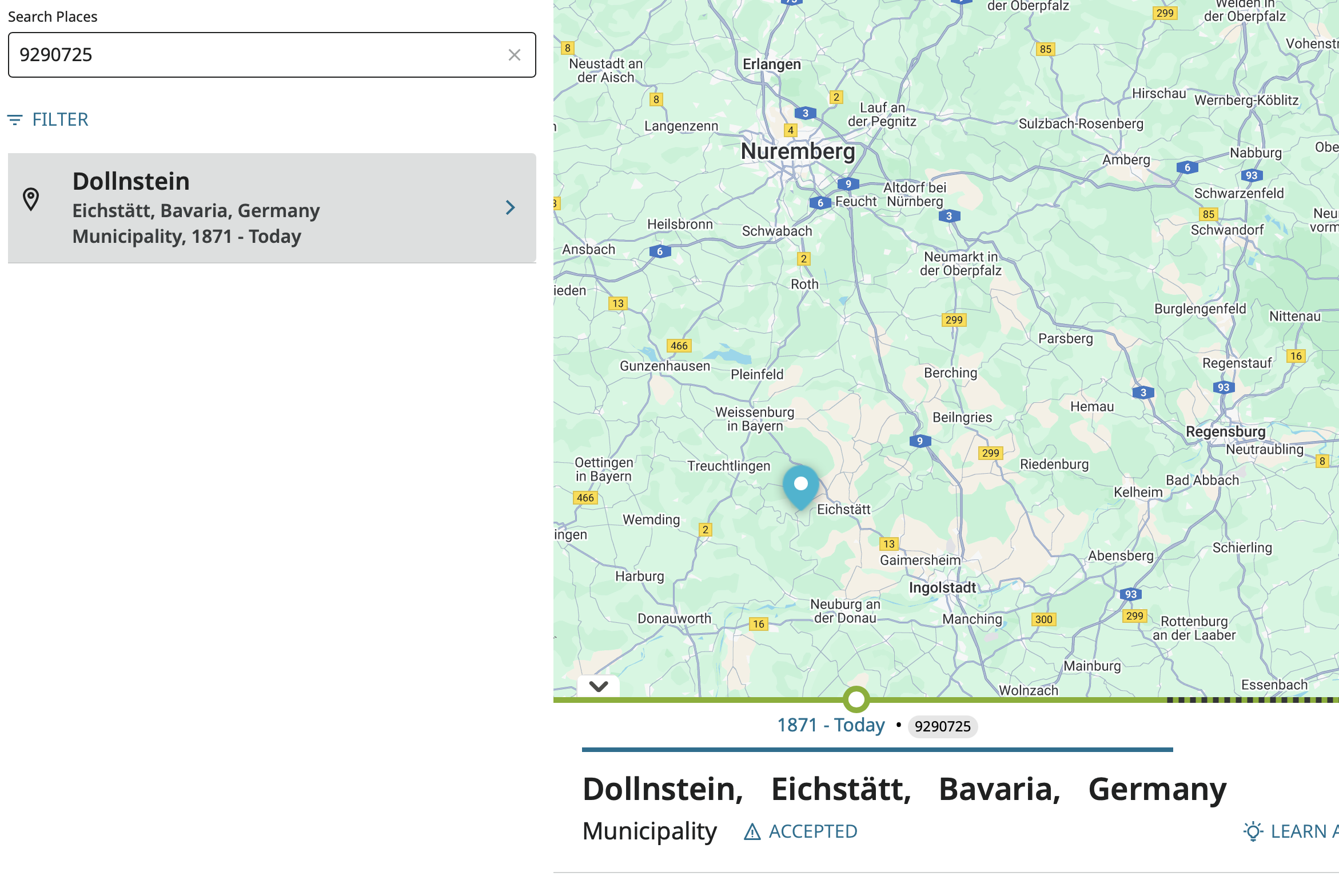
The first question is whether this is the correct place at all. The display name entered by the user is Dollnstein, Nurnberg, Bayern, Germany. This Dollnstein is quite a ways away from Nurnberg. Is that a mistake in the place name? Is there a different Dollnstein within the city of Nuremberg that is not in the Places database and needs to be added? Is there a different Nurnberg that is not the city which is not in the database? Please educate me!
For now, I'll assume this is the correct dot on the map. There is only the single historical time period. So now the question is whether this is a problem with the current structure of the database or a deficiency in the database
Zooming in, clicking right next to it to place a location dot, the searching in the circular area 2 km in diameter around it, brings up:
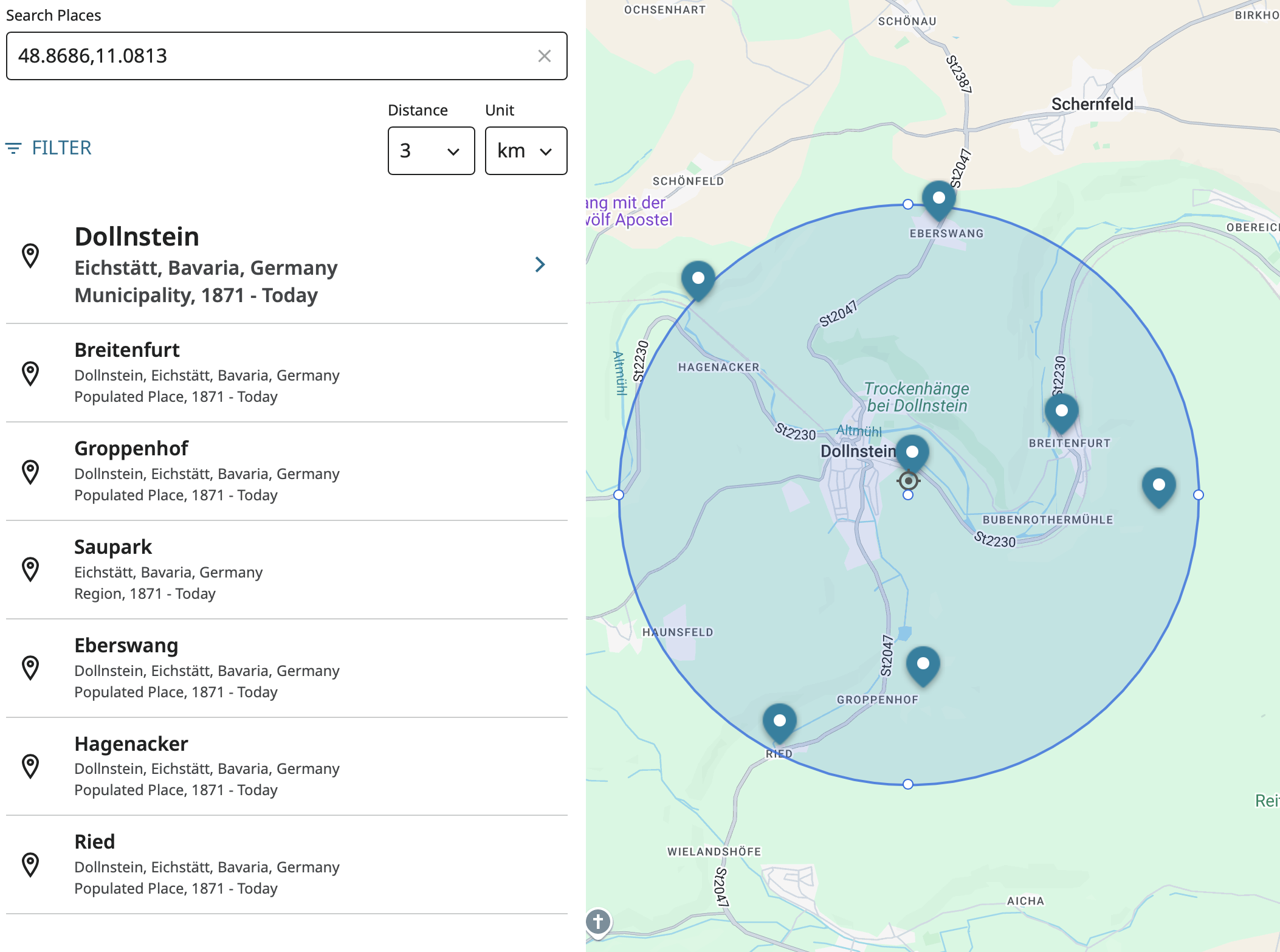
This brings up every place in the search area. None of them have time periods for before 1871. So this really is a deficiency in the database (You probably already knew this but everybody including the Data Quality people need to understand this.)
So now there are a few of options.
A. Use the incorrect standard, as has been done, so that the timeline map shows a mark right on Dollnstein, and dismiss the data quality flag.
B. Attempt to use the less complete but more correct standard of Eichstätt, Bavaria, and learn that one cannot because as soon as you add the Dollnstein, the current place name editing routine insists that you use the full, incorrect, standard:
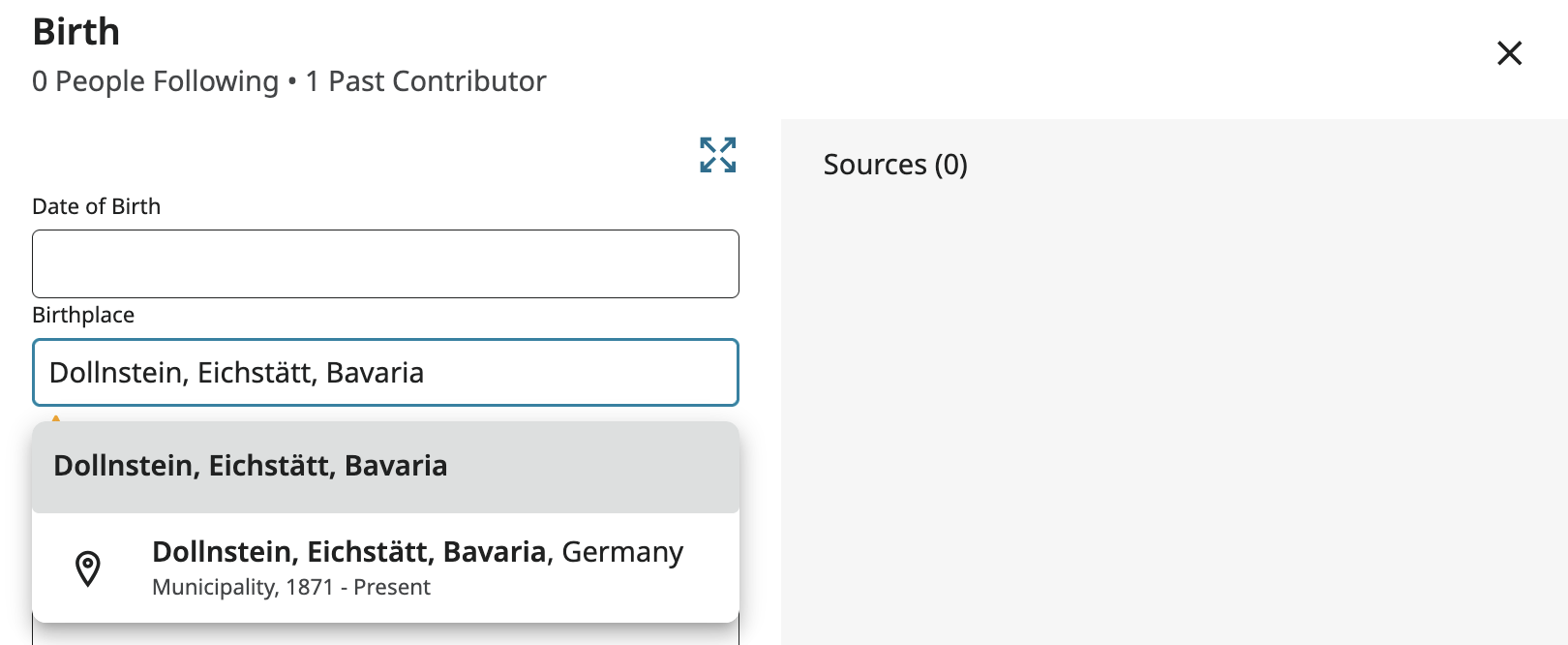
There is no option to use the pre-1871 standard for Eichstätt. So now we need the Data Quality engineers, the Places Authority team, and the engineers over the place name editing routine involved in this discussion. One should be able to link Dollnstein, Eichstätt, Bavaria, to the standard Eichstätt, Bavaria (District, 1806 - 1871), if you want to get rid of the data quality flag and don't care about the map marker not being in quite the right spot.
C. Leave the data quality flag in place as a reminder that there is no correct standard for Dollnstein prior to 1871 and send a request to the Places Authority Team to have a time period of 1806 to 1871 added for all the places within Eichstätt which uses just Eichstätt, Bavaria, and something for the time period prior to 1806. Currently there are just six. Then check back every few months and see if it is possible to correct the standard yet. As part of that process, the Dollnstein, Nurnberg / Dollnstein, Eichstätt, question has to be resolved.
I don't know how many people the Places Authority team has to work on German place name requests or how long their current list of such requests might be. I do know that they currently only have one person to take care of these requests for Norway. So it could take a fair amount of time for requested improvements to be taken care of.
Regarding the original post here, that data quality checking should just not be done for place names where the Places database is inadequate at the current time, it does seem that a statement that" this place name is wrong" when there is no correct place name to use is going to continue to frustrate users until these interlocked Data Quality Score / Places Database / Place Name Editing problems are resolved.
1 -
To take the example place of Bibersfeld, Hall, Württemberg, checking in the Places database:
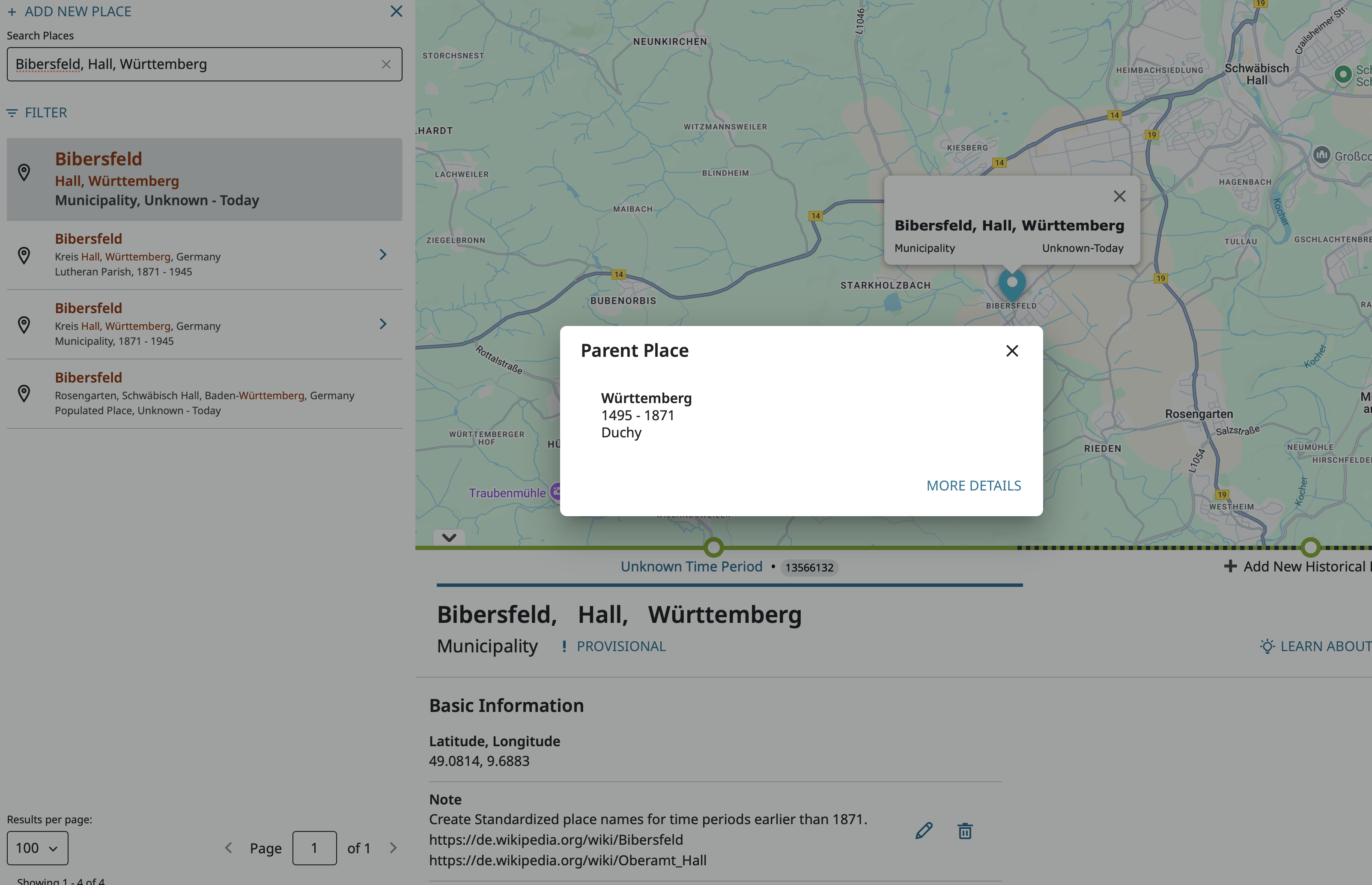
There are four options and one of them has just Württemberg as the top level place name and under "Note" it specifically states that this place should be used as the linked standard for the place earlier than 1871. So they are working on getting entries for pre-1871.
Going to Württemberg itself and clicking the arrow next to its name:
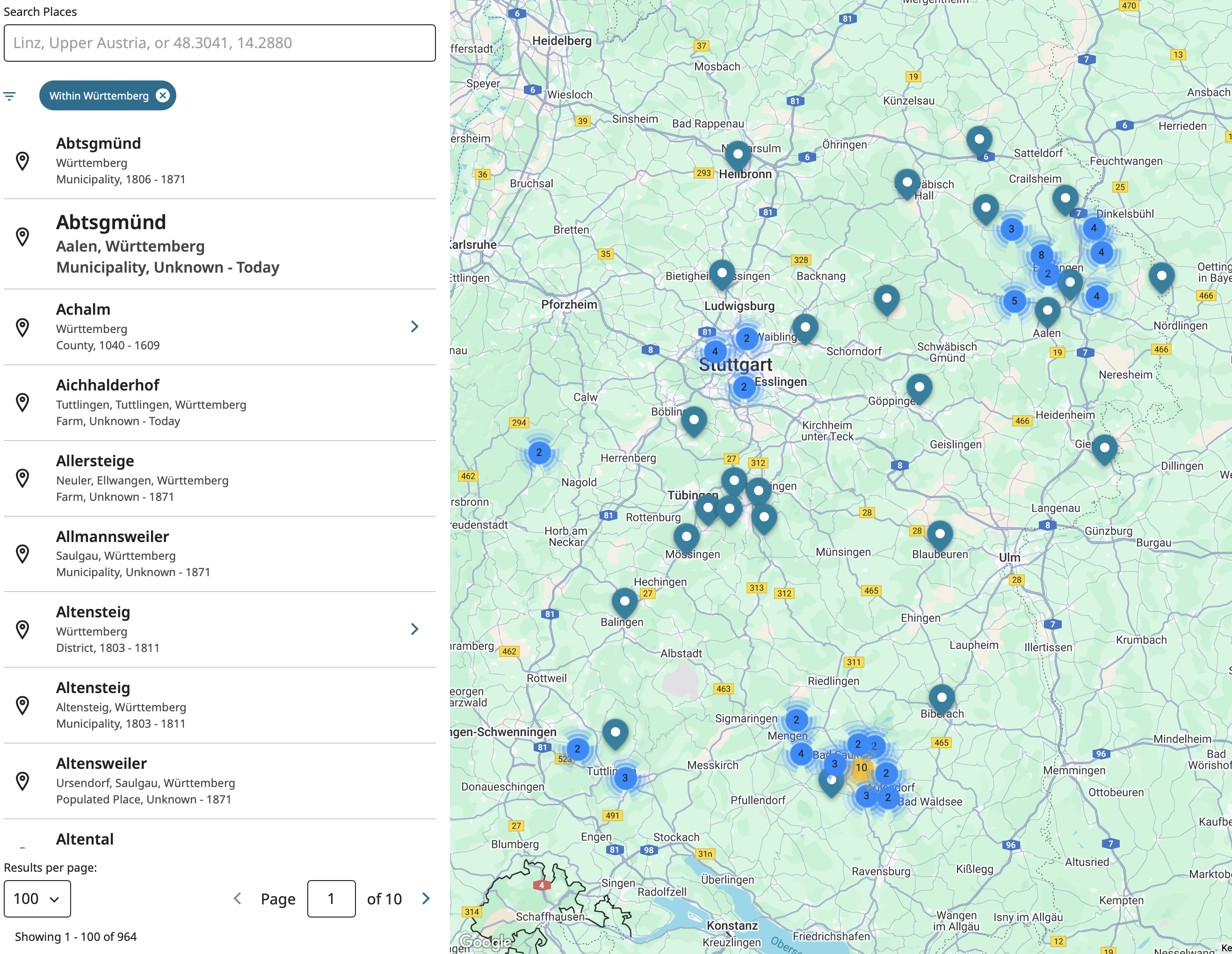
shows that there are 964 places which use just Württemberg the duchy as their top level parent. I would view that as pretty encouraging and that they are getting these versions of the place names in there.
Going back to Bavaria:
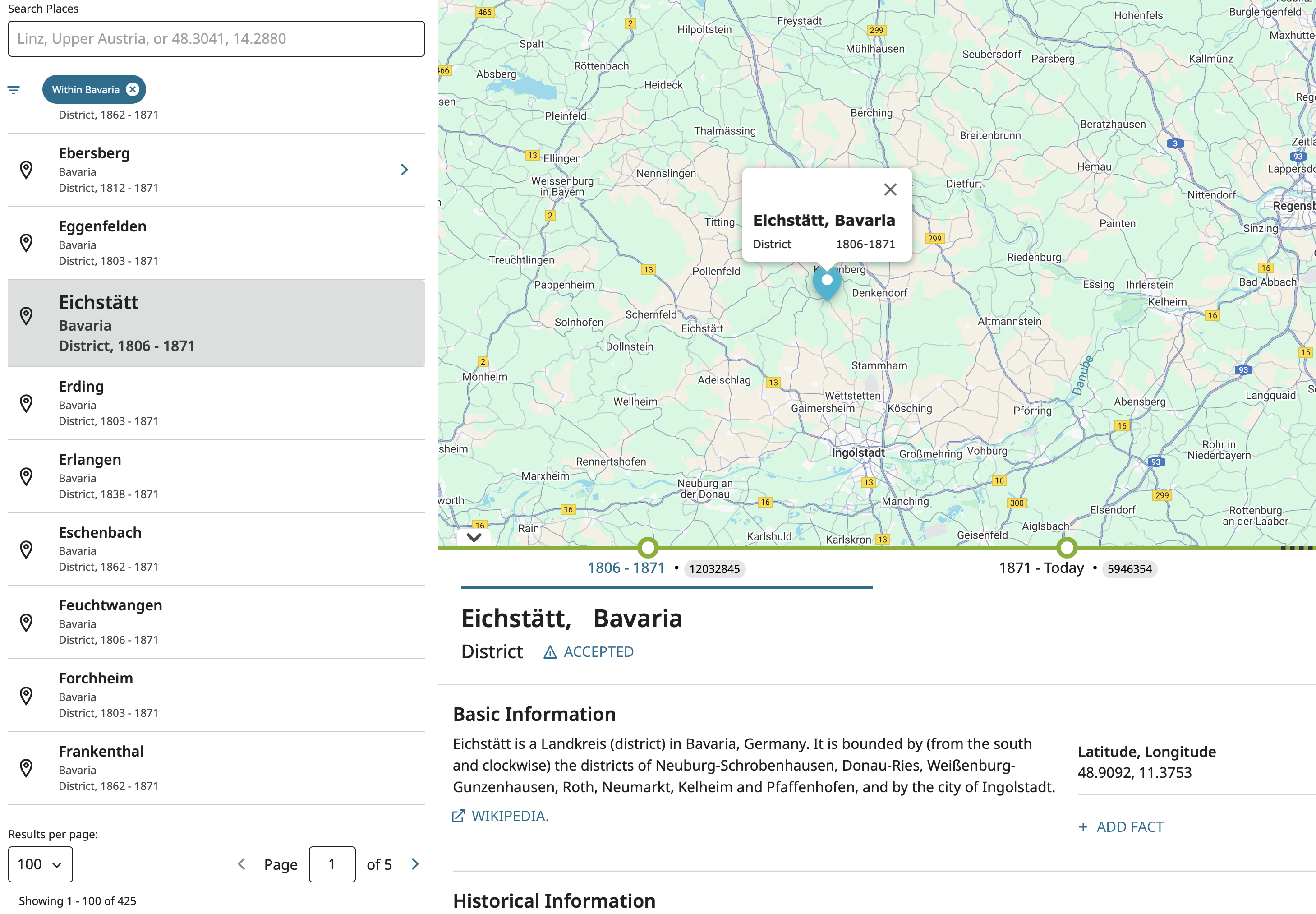
There are 425 places that use just that as the top-level option, including Eichstätt. But most of those do not have any children yet. The places under these areas that have a Germany time period need to have a time period as being just under Bavaria still added. I would assume it is a work in progress to get these taken care of since this post is not the first complaint about needing place names for pre-1871.
Can't say why Württemberg is a duchy and Bavaria is a "country" or if either of those terms are really accurate or whether there is a better term in the list of place types used.
Regarding the quality checking routine, if you look at this help center article: it does state that only certain places and times have this available. This is because the flags have to be tailored to the specific time and place.
For example, there is a flag that points out that places are missing a fourth level division for certain types of events. For places in Germany prior to 1871, it looks like most places will only have three levels ( Bibersfeld, Hall, Württemberg vs. Bibersfeld, Hall, Württemberg, Germany). So I am not surprised that data quality checking is not available for Württemberg but is for Württemberg, Germany. If it was, then every place name would likely be flagged as incomplete because of "missing" that fourth level.
That help center article does state that more times and areas will be added as the data quality check is refined and improved. I assume that part of that will be adding allowance for places that will never have four levels.
So overall, I would be optimistic that both the place names and the data quality checker will continue to improve and that we can best help by continuing to point out where that improvement is needed.
0 -
The Places Authorities team is aware of this issue. They are working to improve this. Please note, this may take some time. For now, when one needs an earlier period for a place, the best approach is to use the options as noted previously:
Suggest a new place, or improve this place.
1
